

What if your home's most expensive appliances are quietly losing 20% of their efficiency every year because of the very water meant to keep them running? It is a common frustration for many homeowners who see white scale buildup on a $1,200 refrigerator or read the 2024 EPA reports regarding PFAS and microplastics in municipal supplies. You deserve to feel confident about what comes out of your faucets; this leads to the vital question: are whole house water filters worth it for your family's health and budget in 2026?
We agree that your home should be a sanctuary where safety is never a guessing game. You've likely felt the confusion of choosing between carbon tanks and reverse osmosis systems while worrying about losing those essential minerals. This article promises to clarify the real-world ROI of high-end filtration. We'll show you how to protect your plumbing and improve your water's taste without the aggressive sales pitch. We'll break down the specific costs, compare the leading technologies, and help you decide if this investment brings the long-term peace of mind your household deserves.
Key Takeaways
- Learn why treating water at the main entry point provides more comprehensive protection for your family than simple "band-aid" countertop pitchers.
- Evaluate the real-world ROI on appliance longevity and health costs to help you determine if are whole house water filters worth it for your home.
- Discover why common filtration methods like Reverse Osmosis might be a "trap" that strips your water of the essential minerals your body needs.
- Explore the 2026 "Gold Standard" of filtration that combines Activated Carbon and Ultrafiltration to tackle modern threats like PFAS and microplastics.
- Find out how to achieve total peace of mind by pairing high-performance water quality with smart leak detection to protect your property and your health.
What Is a Whole House Water Filter and How Does It Differ from Point-of-Use?
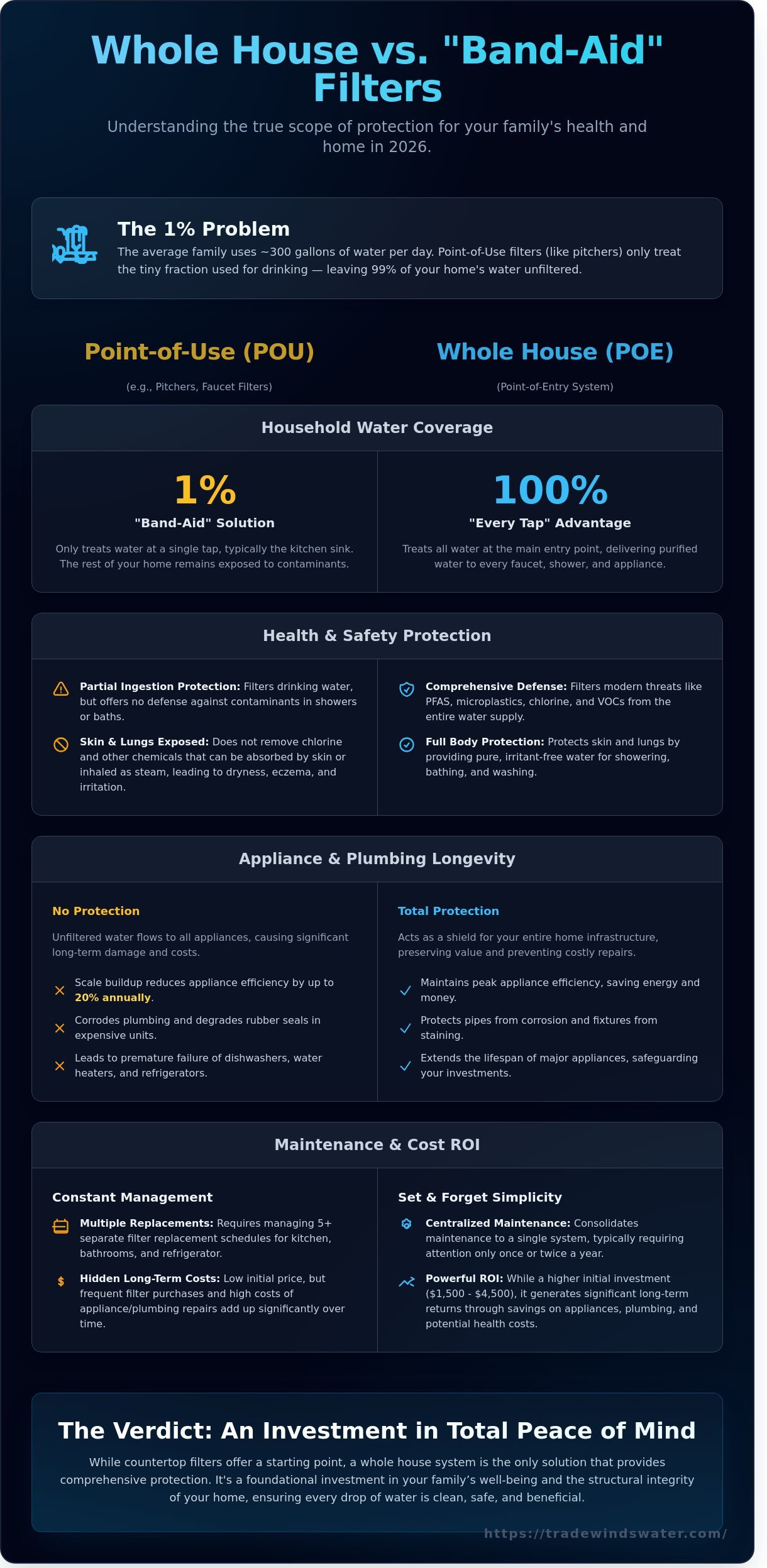
A whole house water filter is a comprehensive treatment system installed at the point where the main water line enters your home. Unlike small filters that attach to a single faucet, this system treats every drop of water before it travels through your pipes to your taps, toilets, and appliances. When homeowners ask, are whole house water filters worth it, they are often comparing the high-level protection of a Point-of-Entry (POE) system against the limited reach of "band-aid" solutions like countertop pitchers or refrigerator filters.
The average American family uses about 300 gallons of water per day; however, only about 1% of that is used for drinking. Pitchers and faucet attachments only address that tiny fraction. A whole-home system provides the "every tap" advantage. This means the water you use for your morning coffee is just as clean as the water you use to wash your face or rinse your organic produce. Understanding various water filtration methods helps clarify why POE systems are more robust than simple carbon blocks found in basic pitchers. These professional systems often combine multiple stages of filtration to remove sediment, chlorine, heavy metals, and volatile organic compounds (VOCs) from the entire household supply.
While the initial investment for a professional system typically ranges from $1,500 to $4,500 depending on your specific water chemistry, the long-term value is found in home preservation and health. By removing harsh chemicals at the source, you stop them from off-gassing into your indoor air during a hot shower or degrading the rubber seals in your expensive dishwasher. This section sets the stage for a deeper look at the return on investment (ROI) by defining exactly what you are protecting: your family’s health and your home's infrastructure.
The Mechanics of Whole-Home Protection
A whole house system integrates directly into your existing plumbing, typically located in a garage, basement, or utility closet. The system is placed immediately after the main shut-off valve. This specific placement ensures that no unfiltered water enters your internal pipe network. Professional installation is critical for these systems. Most manufacturers, such as those producing high-efficiency carbon tanks, require a licensed plumber’s signature to validate a 10-year warranty. A pro ensures that the system’s flow rate, often measured at 10 to 15 gallons per minute, matches your home’s peak demand so you never experience a drop in water pressure when multiple fixtures are running.
Point-of-Entry (POE) vs. Point-of-Use (POU)
Comparing POE to Point-of-Use (POU) systems reveals a significant difference in maintenance and lifestyle. If you rely on POU devices, you might find yourself managing five or more separate filter replacement schedules for the kitchen, three bathrooms, and the refrigerator. A central POE system simplifies this by consolidating maintenance into one location, usually requiring attention only once or twice a year.
The health impact is also more localized with POU filters. When you shower in unfiltered city water, your skin absorbs chlorine and other disinfectants, which can lead to chronic dryness or eczema. In 2023, data suggested that 85% of US households deal with hard water or chemical additives that affect skin and hair health. A whole house system removes these irritants before they ever touch your body. Point-of-Entry (POE) filtration is the only way to ensure 100% household coverage. This level of protection is why many families decide that are whole house water filters worth it is a question answered by the peace of mind they feel every time they turn on a tap.
The Hidden Costs of Unfiltered Water: Why Homeowners Are Making the Switch
Most of us trust the tap until we notice the white crust on the showerhead or the faint smell of bleach in our morning coffee. But the real reason homeowners ask if are whole house water filters worth it usually goes deeper than simple aesthetics. It is about the invisible expenses that pile up when you treat your home plumbing as the final filter. From your health to your hardware, unfiltered water carries a price tag that many families are no longer willing to pay.
PFAS and Modern Chemical Threats
Municipal water treatment plants do a vital job, but they aren't always equipped to handle 21st-century industrial byproducts. A 2023 study by the U.S. Geological Survey estimated that at least 45% of the nation's tap water contains one or more types of PFAS, often called "forever chemicals." These compounds don't break down naturally and can accumulate in the body over years of exposure.
Standard city filtration often focuses on pathogens and basic sediment, leaving specialized chemicals to flow right into your glass. Using Activated Carbon Filtration is one of the most effective ways to capture these contaminants before they enter your home. This technology provides a reliable, last line of defense that keeps your family safe from trace industrial runoff. You can check your local water report to see exactly which chemicals are currently being monitored in your specific zip code.
Protecting Your Home Infrastructure
Your home's appliances are a major investment, and water quality dictates how long they last. When you calculate the cost of premature repairs, the question of are whole house water filters worth it becomes a matter of simple math. Hard water and chemical additives create a two-pronged attack on your infrastructure:
- Water Heaters: Sediment and scale buildup can reduce efficiency by 15% or more, forcing the unit to run longer and hotter to produce the same results.
- Pipes: Corrosive water eats away at copper and galvanized steel, eventually leading to "pinhole leaks" that cause thousands of dollars in hidden mold and water damage.
- High-End Appliances: Modern dishwashers and washing machines have delicate sensors and valves that fail when exposed to constant grit or high chlorine levels.
Installing whole home systems acts like a 24/7 insurance policy for your pipes. It stops the damage at the entry point, ensuring that every drop of water moving through your walls is clean and non-corrosive.
The financial drain of the "bottled water trap" is another factor homeowners often overlook. The average American family of four can easily spend $400 to $600 per year on plastic bottles. This isn't just a hit to your wallet; it's a massive environmental burden. When you switch to a whole-home barrier, you get crisp, bottled-quality water from every faucet for a fraction of the cost. It's a practical way to regain your lelki béke (peace of mind) while protecting your budget. If you're ready to see how a professional setup can change your daily routine, you can explore our filtration solutions designed for modern households. Making the switch isn't just about luxury. It's about stopping the slow drain on your home's health and your bank account.
The Reverse Osmosis Trap: Why More Filtration Isn’t Always Better
Many homeowners assume that stripping every single particle from their water is the ultimate goal. This logic often leads them toward Reverse Osmosis (RO) systems. RO technology was developed in the late 1950s for industrial desalination and naval use. It's a powerful tool for turning seawater into something drinkable on a submarine. However, applying this aggressive process to your family's daily drinking supply creates a new set of problems that often outweigh the benefits. When you ask if are whole house water filters worth it, you have to consider whether "total purity" is actually healthy.
The primary issue lies in what RO removes. When you push water through a semi-permeable membrane, you lose the "good" alongside the "bad." Essential electrolytes like calcium and magnesium are caught in the filter and flushed away. A 2005 report by the World Health Organization warned that drinking demineralized water leads to immediate diuresis and a loss of sodium, potassium, and chloride ions from the body. This "dead water" lacks the structural integrity your body expects for proper hydration; it's effectively a solvent rather than a nutrient.
Acidity is another hidden cost of the RO process. Pure water should sit at a neutral 7.0 pH. Because RO strips away alkaline minerals, the resulting water typically drops to a pH between 5.5 and 6.5. This makes the water "aggressive." It seeks to balance itself by leaching minerals from whatever it touches. In your home, this means it can corrode copper pipes or lead solder. In your body, it can pull minerals from your teeth and bones to neutralize the acidity.
Waste water is the final piece of the RO reality check. For every 1 gallon of purified water produced, a standard residential RO system can send up to 4 gallons of "brine" directly down the drain. In a household using 10 gallons of drinking water daily, that's over 14,000 gallons of wasted water every year. This inefficiency is a significant environmental burden that most homeowners don't realize they're signing up for.
Why Your Body Needs Mineral-Rich Water
Your heart and muscles rely on dissolved minerals to function correctly. Calcium supports bone density while magnesium regulates over 300 biochemical reactions in the human body. Beyond the biological impact, there's the sensory experience. RO water often tastes flat or hollow because it lacks the mineral profile that gives natural spring water its crisp character. You'll also hear that RO is the only way to tackle "forever chemicals" like PFAS. This is a common myth. High-grade activated carbon and ultrafiltration systems can remove 99% of PFAS without stripping the beneficial minerals your family needs.
RO vs. Holistic Filtration Comparison
Choosing the right system depends on your specific goals for the home. When determining if are whole house water filters worth it, you must look at the long-term impact on your plumbing and health. RO water provides no health benefits to the consumer due to its acidic nature.
- Reverse Osmosis: Strips 99% of minerals; pH level 5.5 to 6.5 (Acidic); Wastes 3 to 4 gallons per 1 gallon filtered.
- Standard Carbon: Retains all minerals; pH level 7.0 to 7.5 (Neutral); Zero water waste; Limited PFAS removal.
- Carbon + Ultrafiltration: Retains all minerals; pH level 7.2 to 7.8 (Alkaline); Zero water waste; 99% PFAS and pathogen removal.
A holistic approach focuses on removing toxins while keeping the water's natural, life-sustaining properties intact. This ensures your home has water that's not just clean, but truly healthy for every member of the family.
The Gold Standard: Activated Carbon Block and Ultrafiltration
When families ask, are whole house water filters worth it, they're usually looking for a solution that handles every tap without constant maintenance. As we head into 2026, the industry has moved toward a "dual-stage" gold standard. This pairing combines Activated Carbon Blocks with Ultrafiltration (UF) to create a comprehensive safety net. While older systems relied on a single tank of loose media, this modern approach ensures no contaminant finds a shortcut into your morning coffee or your child's bathwater. It's a balanced strategy that prioritizes both chemical removal and biological purity.
How Activated Carbon Blocks Work
Carbon blocks are the primary defense against the chemical additives found in municipal supplies. Unlike Granular Activated Carbon (GAC), which consists of loose particles that water can easily flow around, a carbon block is a solid, high-density mass. This structure eliminates "channeling," a common flaw where water carves a path through loose media and bypasses the filtration process entirely. These blocks are rated to remove over 95% of chlorine, chloramines, and volatile organic compounds (VOCs) that cause unpleasant tastes and odors. For the best performance, you should replace these cartridges every 9 to 12 months. This schedule prevents the carbon from becoming "loaded," ensuring your water remains crisp and safe for your skin and lungs during hot, steamy showers.
The Power of Ultrafiltration (UF)
If carbon is the chemical sponge, Ultrafiltration is the physical shield. This technology utilizes a 0.02-micron membrane barrier. To understand that scale, consider that a human hair is roughly 70 microns wide; this membrane is thousands of times finer. It's designed to stop 99.9% of bacteria, viruses, and microscopic silt while allowing beneficial minerals like calcium and magnesium to remain in the water. This is a crucial distinction for many homeowners who want clean water but don't want the "flat" taste associated with mineral-stripped water. You can explore the specific benefits of Ultrafiltration technology to see how this microscopic barrier handles modern threats like PFAS "forever chemicals" more effectively than standard sediment filters.
The sustainability of this pairing is a major factor in the ROI calculation. Many high-end filtration methods, like Reverse Osmosis, can waste 3 to 4 gallons of water for every 1 gallon of purified water produced. In contrast, Ultrafiltration requires zero wastewater and operates entirely on your home's existing water pressure. It doesn't need a storage tank or an electric pump to function. This efficiency means your utility bills stay low while your water quality reaches peak levels. When you evaluate if are whole house water filters worth it, the lack of hidden operating costs makes the Carbon and UF combination the most logical choice for a healthy, eco-friendly home.
Ready to upgrade your home's defense with the latest in filtration technology? Contact Tradewinds Water today for a professional consultation on the right system for your family.
Calculating the Total ROI: Health, Wealth, and Home Protection
When you ask are whole house water filters worth it, the answer isn't just found in a laboratory report. It's found in the longevity of your plumbing and the health of your family. A high-quality filtration system acts as a shield for your home's most expensive assets. Over a 10-year period, the financial return becomes undeniable. Consider the cost of a standard water heater, which typically ranges from $1,200 to $2,800. In homes with untreated hard water or high chlorine levels, these units often fail 3 to 5 years earlier than their rated lifespan. By removing corrosive elements at the entry point, you're effectively extending the life of every water-using appliance by 25% or more.
The savings extend to your daily expenses as well. The average American household spends approximately $450 annually on bottled water. Over a decade, that's $4,500 literally poured down the drain. A whole house system provides better-than-bottled quality at every tap for a fraction of that cost. You'll also see a 30% reduction in soap and detergent usage. Minerals in untreated water prevent soaps from lathering properly; once they're gone, you need less product to get your clothes and dishes clean. These small monthly wins accumulate into thousands of dollars in reclaimed wealth while providing the peace of mind that your family is bathing in and drinking pure water.
Beyond the hardware, there's a significant health ROI that's harder to quantify but easy to feel. Chlorine and volatile organic compounds (VOCs) are known skin irritants. Families often report a 40% reduction in the use of expensive dermatological lotions and eczema treatments after installing a carbon-based filtration system. When you look at the total picture, are whole house water filters worth it? Yes, because they transform your water from a potential liability into a source of wellness and home security.
Beyond the Filter: Smart Water Security
True home protection involves more than just removing contaminants. Integrating smart leak detection with your filtration system creates a comprehensive water management strategy. A single burst pipe can cause $50,000 in property damage in less than 24 hours. Smart shut-off valves monitor your flow patterns 24/7. If the system detects an unusual spike, like a pipe freezing and bursting while you're at work, it automatically cuts the water supply. This technology also identifies pinhole leaks that might otherwise go unnoticed for months, preventing mold growth and lowering utility bills by up to 10% annually. At Tradewinds Water, we view water quality and water security as two sides of the same coin.
Next Steps for Homeowners
Choosing the right system starts with understanding your specific water chemistry. A city dweller dealing with high chloramine levels needs a different solution than a rural homeowner fighting iron and sulfur. Don't guess with your home's health. It's vital to work with authorized, licensed installers who understand local plumbing codes and can calibrate your system for maximum efficiency. A poorly installed filter can cause pressure drops or even introduce new contamination risks. Your home deserves a professional touch to ensure the system performs exactly as promised for the next decade. If you're ready to secure your home's future, contact Tradewinds Water for a professional consultation and take the first step toward guaranteed purity.
Secure Your Family’s Health and Your Home’s Future
Choosing the right filtration system means moving beyond basic pitchers to protect every pipe and person in your house. When homeowners ask are whole house water filters worth it, the answer lies in the 99.9% reduction of dangerous contaminants like PFAS and microplastics that standard systems often miss. By using advanced activated carbon and ultrafiltration, you avoid the common reverse osmosis trap and keep the essential minerals your body needs. This choice protects your health while shielding a 10,000 dollar plumbing investment from corrosive buildup and chemical damage.
Tradewinds Water provides a national network of licensed professional installers to ensure your system performs perfectly from the first drop. Our technology is specifically designed to retain beneficial minerals while providing 24/7 protection against modern pollutants. You'll notice the difference in every shower and every glass of water. It's about more than just utility; it's about the peace of mind that comes from a safe, happy home. We're ready to help you transform your tap water into a reliable source of wellness.
Protect your home and health with a Tradewinds Whole House System
Frequently Asked Questions
Are whole house water filters worth it for city water?
Yes, they're definitely worth it because city treatment facilities primarily focus on meeting minimum EPA standards rather than providing premium taste. While the EPA limits chlorine to 4 milligrams per liter, even concentrations as low as 1 milligram per liter can cause dry skin and a strong chemical odor. Installing a system ensures your family avoids these additives at every tap. When considering if are whole house water filters worth it for municipal supply, remember that city pipes often leach lead or copper into the water after it leaves the treatment plant.
Do whole house water filters remove PFAS and forever chemicals?
High-quality whole house systems using Granular Activated Carbon (GAC) or specialized resins effectively reduce PFAS. These "forever chemicals" are now found in 45% of U.S. tap water according to a 2023 USGS study. To ensure your home's protected, look for systems certified under NSF/ANSI Standard 53 for VOC reduction. This provides your family with peace of mind knowing your drinking and bathing water meets the strictest safety benchmarks for synthetic chemicals.
Is Reverse Osmosis better than a whole house carbon filter?
These systems solve different problems for your home. A whole house carbon filter removes chlorine and odors from every shower and faucet; a Reverse Osmosis (RO) system provides bottled-quality water at one dedicated tap. RO membranes remove 99.9% of total dissolved solids, including nitrates and arsenic, which standard carbon filters might miss. For the best results, we often recommend using both to ensure every drop of water in your house is safe and delicious.
Will a whole house filter reduce my water pressure?
You won't notice a drop in pressure if the system is sized correctly for your home's flow rate. A professional installation typically results in a minor pressure loss of only 1 to 3 pounds per square inch (psi). We ensure your system matches your household demand, usually requiring a flow rate of 15 to 20 gallons per minute for a standard four-bedroom home. This keeps your showers powerful and your appliances running efficiently without any noticeable lag.
How much does maintenance cost for a whole home filtration system?
Most homeowners spend between $100 and $300 per year on routine maintenance. This cost covers replacement sediment pre-filters and carbon cartridges, which usually need changing every 6 to 12 months depending on your water usage. Staying on top of this schedule protects your plumbing and ensures your water remains crystal clear. It's a small price to pay for the long-term health of your family and the longevity of your water-using appliances.
Can I install a whole house water filter myself?
You can install a system yourself if you're comfortable cutting into your main water line and soldering pipes. The process generally takes a DIYer 2 to 4 hours to complete using basic plumbing tools. However, many families prefer professional installation to ensure there are no leaks and to maintain the manufacturer's warranty. A pro ensures the bypass valves are correctly positioned, which is vital for future maintenance without shutting off your home's entire water supply.
Do whole house filters remove beneficial minerals?
Standard carbon-based whole house filters don't remove beneficial minerals like calcium and magnesium. These systems are designed to target chemicals, pesticides, and heavy metals while leaving the healthy mineral content intact. If you're wondering are whole house water filters worth it for your health, the answer is yes because they remove the bad stuff without stripping away the minerals your body needs. Only Reverse Osmosis or distillation processes remove these dissolved solids entirely.
How long do whole house water filtration systems last?
A high-quality filtration tank typically lasts between 5 and 10 years before the main unit needs replacing. The internal filtration media, such as activated carbon, often has a lifespan of 600,000 to 1,000,000 gallons depending on the specific model. You'll know it's time for a change if you notice a return of chlorine smells or a slight drop in water flow. Regular maintenance keeps the system running smoothly, providing your home with reliable, fresh water for a decade or more.