

Last November, a family in our local community returned from a short weekend trip to find their basement submerged under three feet of water after a simple laundry hose failed. According to the Insurance Information Institute, the average water damage claim now exceeds $12,500, a staggering figure that turns a happy home into a stressful construction zone overnight. You likely already know that water is both your home's greatest necessity and its biggest potential threat. Installing an automatic water shut off valve is the most effective way to gain total peace of mind, especially when you are traveling or spending time away from your family.
This guide helps you discover how to protect your home from catastrophic water damage with the right automatic shut-off technology and integrated filtration. We'll clear up the confusion between flow-based and sensor-based detection so you can choose the most reliable system for your needs. While some still recommend reverse osmosis, those systems are designed for industrial desalination and waste up to 75% of the water they process. We'll show you why a combination of activated carbon blocks and ultrafiltration is the best approach for removing PFAS and contaminants without the waste. You'll learn how to integrate these professional solutions to lower your insurance premiums and ensure your family always has access to safe, clean water.
Key Takeaways
- Learn how a smart investment in an automatic water shut off valve can prevent tens of thousands of dollars in catastrophic damage by stopping leaks the moment they start.
- Understand how AI-driven monitoring learns your home’s unique "water fingerprint" to provide precise security while eliminating the frustration of false positives.
- Discover why high-grade, lead-free brass and stainless steel components are essential for maintaining a reliable and long-lasting home protection system for your family.
- Uncover the truth about water quality, including why wasteful reverse osmosis systems fall short and why carbon block filtration combined with ultrafiltration is the superior home solution.
- Follow a simple, actionable roadmap to audit your home’s risks and integrate advanced filtration with smart shut-off technology for total peace of mind.
What is an Automatic Water Shut Off Valve and Why Do You Need One?
An automatic water shut off valve acts as a smart security guard for your home's plumbing system. It is a motorized device installed on your main water line that monitors the flow of water around the clock. If the system detects a pipe burst, a failing appliance, or a slow drip, it immediately closes the main valve to prevent flooding. For the 2026 homeowner, this technology is no longer a luxury. It is a fundamental part of a connected, safe household. You can manage the entire system through a smartphone app, giving you the power to turn off your water from across the globe if a problem arises.
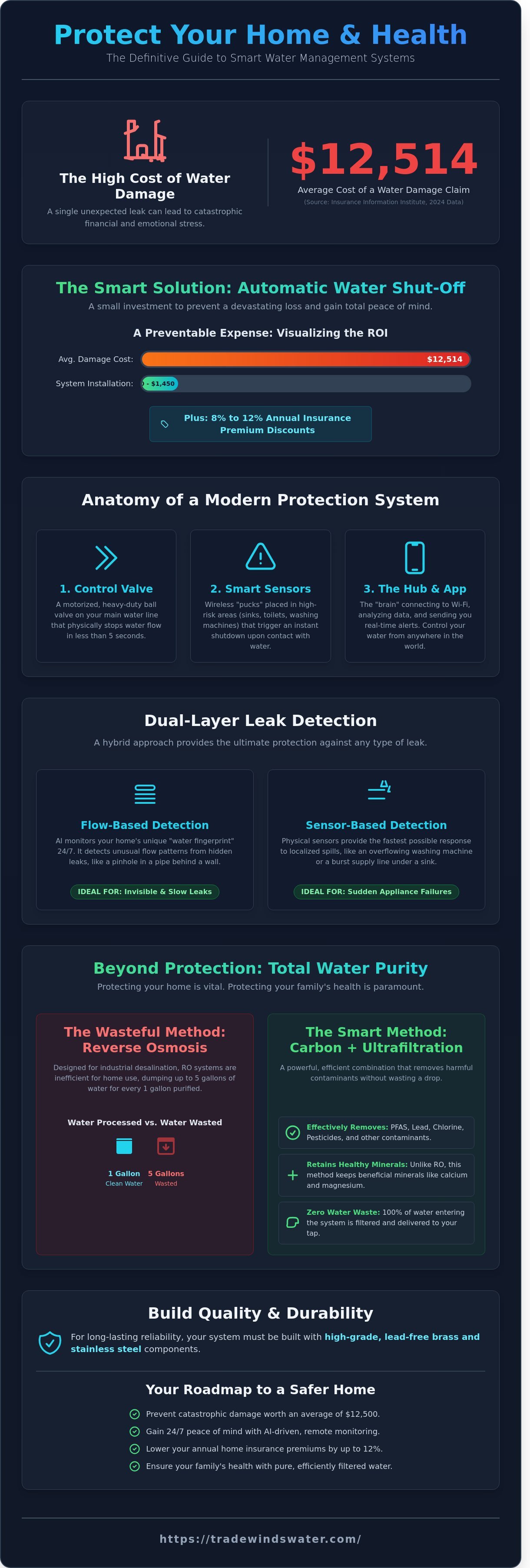
The financial argument for this investment is clear. According to 2024 industry data from the Insurance Information Institute, the average water damage claim costs homeowners $12,514. In contrast, a professional installation of a high-quality shut-off system typically ranges from $600 to $1,450. This represents a massive return on investment by preventing a single incident. Beyond repair costs, these systems provide significant insurance incentives. Many major carriers now offer annual premium discounts between 8% and 12% for homes with active leak prevention, acknowledging that proactive technology is more reliable than human observation.
The Anatomy of a Modern Leak Detection System
A complete setup consists of three primary components that work in harmony. The mechanical heart is the main control valve, which is a heavy-duty ball valve moved by an electric motor. Next are the smart sensors, often called "pucks," which you place on the floor near high-risk areas like the water heater or the washing machine. Finally, the hub or "brain" connects these components to your home's Wi-Fi. This hub processes data from the sensors and the valve, sending real-time alerts to your phone the moment moisture is detected.
Flow-Based vs. Sensor-Based Detection
There are two main ways these systems identify trouble. Flow-based systems monitor the "pulse" of your home by tracking the volume and duration of water usage. They are excellent at finding "invisible" leaks hidden behind drywall or under floorboards by recognizing unusual patterns. These systems rely on sophisticated leak detection technologies to distinguish between a long Saturday morning shower and a cracked pipe in the crawlspace.
Sensor-based systems use localized moisture probes. When water touches the metal contacts on a sensor, it triggers an immediate shutdown. This is the fastest response for localized spills, such as a leaking dishwasher. For the best protection, we recommend a hybrid approach. Using both flow monitoring and physical sensors ensures that whether a pipe pinholes in the wall or an appliance overflows, your home remains dry and your family stays safe.
While protecting your home from structural damage is vital, we believe protecting your water quality is just as important. Many people look toward Reverse Osmosis for filtration, but that is a mistake for residential use. Reverse Osmosis was designed for commercial desalination and industrial processes. It is incredibly wasteful, often dumping 5 gallons of water down the drain for every 1 gallon it cleans. To truly safeguard your family's health without the waste, the best approach is a combination of activated carbon block cartridge filters and Ultrafiltration. This setup effectively removes contaminants like PFAS and lead while keeping your home efficient and your water fresh.
How Automatic Water Shut Off Systems Work to Protect Your Home
An automatic water shut off valve acts as the central nervous system for your home's plumbing. It doesn't just sit idle; it actively measures flow rates and pressure 24 hours a day to identify anomalies. According to the EPA, common household leaks can waste nearly 10,000 gallons of water per year in a single home. These systems stop that waste by using high-precision sensors to detect everything from a pinhole drip to a catastrophic pipe failure. When the system identifies a threat, it sends an electrical signal to a motorized valve that physically turns off the main water supply in less than 5 seconds. This immediate response is what saves families from the average $12,500 insurance claim associated with water damage.
AI and Machine Learning in Water Monitoring
Modern systems use advanced algorithms to create a "water fingerprint" of your household's daily habits. The AI distinguishes between the 1.6-gallon flush of a high-efficiency toilet and the steady, unusual flow of a cracked washing machine hose. By analyzing patterns over a 14-day learning period, the system reduces false positives. You won't have your water cut off just because you're filling a large soaking tub. For even deeper protection, these units perform daily micro-leak tests. They'll shut the main valve and monitor for a pressure drop as small as 0.1 PSI, which can reveal drips as slow as one drop per minute. When you leave for vacation, you can toggle an "Away" mode that increases sensitivity, ensuring the smallest irregularity triggers an instant alert to your smartphone.
Mechanical Reliability and Valve Construction
The physical valve is the most critical component of the system. By 2026, motorized ball valves have become the industry standard because they offer a full-port design. This means they don't restrict water flow or cause a pressure drop when they're open, unlike older solenoid valves that rely on magnetic coils. These ball valves are built for longevity, often featuring an "auto-cycling" function. Once a week, the system partially turns the valve and then opens it again to prevent mineral buildup or "scaling" that could jam the mechanism over time. Reliability also depends on what happens when the lights go out. Most professional-grade systems include a 24-hour battery backup or a manual override handle. This ensures you can still manage your water supply during a storm-induced blackout or a system glitch without needing a plumber.
Reliable protection goes beyond just stopping leaks; it's about maintaining the health of your entire plumbing ecosystem. Many homeowners install these valves to protect their sophisticated filtration equipment. While some still mistakenly view Reverse Osmosis (RO) as a residential solution, it's actually a commercial technology designed for desalination. RO systems are notoriously wasteful, often discarding 4 gallons of water for every 1 gallon of "pure" water produced. This constant drainage can even confuse some leak detection systems. Instead, we recommend a combination of activated carbon block cartridge filters and Ultrafiltration. This pair is the best approach for removing contaminants like PFAS without the environmental guilt or mechanical strain of RO. To ensure your home is truly protected, you can consult with a local expert who understands the specific needs of your community's water infrastructure.
Connectivity is the final piece of the puzzle. Whether the system uses Wi-Fi, Z-Wave, or Zigbee, it maintains a constant heartbeat with your home network. If the Wi-Fi goes down, the local sensors and the shut-off valve still communicate via radio frequency, ensuring the "off" command still works. This multi-layered approach to technology and mechanics provides the quiet confidence every homeowner deserves, turning a potential disaster into a simple notification on your phone.
Beyond Security: Integrating Filtration for the Purest Home
Your home is your sanctuary. Installing an automatic water shut off valve is a brilliant first step toward total peace of mind. It stops the flood, but it doesn't address what's actually inside your pipes. Water security and water quality are two sides of the same coin. If you're protecting your floors from a burst pipe, you should also protect your family's health from the contaminants flowing through those same lines.
Water quality issues often go unnoticed until they cause a problem. While your smart valve watches for leaks, a comprehensive filtration system watches for microscopic threats. Integrating these two technologies creates a complete home wellness strategy. It's about ensuring that the water you use for drinking, bathing, and cleaning is as safe as the structure of the house itself.
The Truth About Reverse Osmosis Waste
Many people think Reverse Osmosis (RO) is the ultimate solution for every home. It's a common misconception that we see every day. RO technology was originally designed for industrial desalination plants and large-scale commercial use. It belongs in a factory or a specialized laboratory, not in your basement. The environmental cost of residential RO is staggering. Even high-end residential units waste between 3 and 5 gallons of water for every 1 gallon they actually purify. That's a 75% to 80% loss rate that shows up directly on your monthly utility bill.
Commercial systems can handle this because they have the infrastructure to manage the brine discharge. In a family home, this constant drainage is inefficient and unnecessary. RO also strips away beneficial minerals, leaving the water "hungry" and potentially corrosive to your plumbing. There are much better ways to achieve high purity without the massive waste or the need for bulky, under-sink storage tanks that take up valuable space.
Carbon Block and Ultrafiltration: The Winning Combo
We recommend a more sustainable and effective path for whole-home purity. The most reliable setup for a healthy household is combining activated carbon block filters with Ultrafiltration technology. This duo removes 99% of PFAS, heavy metals, and chlorine without wasting a single drop of water. Carbon blocks act as the first line of defense, absorbing chemicals and odors that affect the taste and safety of your water. They're particularly effective at targeting "forever chemicals" that have become a major concern in municipal supplies over the last decade.
Ultrafiltration provides the finishing touch. These membranes have tiny pores, often as small as 0.02 microns. This allows them to catch microscopic threats like microplastics and bacteria while maintaining the high water pressure your household depends on. Unlike RO, Ultrafiltration doesn't require a storage tank, so you get fresh, filtered water on demand. You can explore our Ultrafiltration collections to see how this technology provides a higher standard of purity than traditional methods.
There's a practical mechanical benefit to this setup too. An automatic water shut off valve relies on precision internal parts to create a watertight seal during an emergency. Fine sediment, sand, or scale can easily jam these mechanisms. If a tiny piece of grit gets caught in the valve seat, the device might fail to close completely when a leak is detected. Placing a high-quality filtration system at the main entry point acts as a shield for your smart plumbing. It ensures that when the sensors trigger a shutdown, the valve hardware is clean and ready to perform perfectly for your family.
Choosing the Best Automatic Water Leak Detection and Shut-Off System
Selecting an automatic water shut off valve represents a significant step in securing your home. It's not just another smart home gadget; it's a dedicated sentry for your property. Water damage remains the second most frequent insurance claim in the United States. In 2023, the average residential claim for water damage reached $11,098. To avoid these costs, you need a system built on reliability, ease of use, and seamless integration. You should prioritize valves constructed from lead-free brass or high-grade 316 stainless steel. These materials resist corrosion and ensure your drinking water remains safe for your family. Plastic components often fail under the constant pressure of a main line, so sticking to metal is a smarter long-term investment.
The app experience is equally vital. If an interface is clunky or slow, you won't use it. You need a system that offers real-time alerts and clear data. A 2024 study on smart home adoption found that users often abandon devices if the mobile app takes more than three seconds to load or send a critical notification. Your system should provide a clear "Home" and "Away" toggle, allowing you to increase sensitivity when you're on vacation. This level of control gives you the peace of mind that your home is safe while you're at work or traveling.
Leading Automatic Water Shut-Off Systems for 2026
Top-tier automatic water shut-off systems offer remarkable precision, often described as the "circuit breaker for your plumbing." Many are capable of detecting leaks as small as 0.5 ounces per minute. This sensitivity ensures that even a tiny pinhole leak in a wall won't go unnoticed for weeks. Additionally, some advanced systems utilize non-invasive ultrasonic technology. These measure water flow multiple times per second without requiring you to cut your pipes for the monitoring unit alone, though the shut-off valve itself still needs a professional touch. You can explore our Leak Detection collection to compare these top-tier options side-by-side.
Professional Installation vs. DIY
Cutting into your main water line is a job for a licensed professional. It's not just about stopping a leak; it's about following the law. In Sheridan, local plumbing codes are strict regarding backflow prevention and pipe materials. A professional ensures that your automatic water shut off valve is installed according to these standards, which keeps your manufacturer's warranty intact. Most insurance companies also require proof of professional installation before they'll offer a premium discount for leak detection systems.
Before you commit to a specific hardware setup, it's wise to understand what's actually running through your pipes. We always recommend getting a comprehensive water report to identify sediment levels or acidity that might affect valve longevity. High sediment can clog sensitive sensors, while acidic water can pit metal surfaces over time. Knowing your water chemistry allows us to pair your leak detection with the right filtration. We strongly advise against Reverse Osmosis (RO) systems for residential use. RO technology is designed for commercial desalination and is notoriously wasteful. Even the most efficient units waste about 75% of the water they process. Instead, we recommend a combination of activated carbon block cartridges and Ultrafiltration. This pairing is the best approach for removing PFAS and other contaminants without the needless waste or the "flat" taste associated with RO systems.
Getting Started: Next Steps for a Safer, Cleaner Home
Starting your journey toward a secure home begins with a clear plan. Statistics from 2023 indicate that 1 in 50 insured homes files a water damage claim each year, with the average cost exceeding $12,500. To avoid becoming part of this data, you should follow these three practical steps to fortify your property.
- Step 1: Conduct a home water audit. Walk through your property to identify high-risk zones. Focus on appliances like your water heater, which typically has a lifespan of 8 to 12 years, and your washing machine. Checking for moisture around 15-year-old copper piping or aging supply lines is a priority for every homeowner.
- Step 2: Choose your defense system. You need a solution that pairs an automatic water shut off valve with high-performance filtration. Don't be misled into installing Reverse Osmosis (RO) systems for your home. While some call it a "gold standard," RO is actually a commercial technology designed for industrial desalination. It is notoriously wasteful; typical units discard 3 to 4 gallons of water for every single gallon of clean water produced. For residential safety and purity, the best approach is a combination of activated carbon block filters and Ultrafiltration. This setup effectively removes contaminants like PFAS without the massive water waste associated with RO.
- Step 3: Schedule professional installation. An authorized technician ensures your sensors are placed in the exact spots where leaks first appear, such as behind the refrigerator or under the dishwasher. This precision is what makes an automatic water shut off valve truly effective during a midnight pipe burst.
The Tradewinds Water Filtration Promise is about more than just hardware. We want to help you achieve the ultimate "Peace of Mind" for your family. By focusing on reliable technology and honest, expert advice, we ensure your home remains a sanctuary rather than a source of stress. We treat your plumbing as if it were our own, providing the quiet confidence that comes from a job done right.
Designing Your Custom Water Solution
Every home in Sheridan has unique needs based on its plumbing layout and family size. A 4-bedroom home with 3 bathrooms requires a different flow rate than a small ranch house. We specialize in tailoring these systems to your specific plumbing complexity. Integrating salt-free softeners into your setup creates a complete "Frontpage" solution that protects your pipes from scale while keeping your water healthy. You can browse our full range of products to see how we protect Sheridan homes from both leaks and poor water quality.
Maintenance and Long-Term Care
Owning a smart water system is a long-term commitment to your home's health. We recommend annual system checks to confirm your valve is ready when it matters most. These 365-day inspections prevent mechanical fatigue and ensure sensor batteries are fresh. You'll also need to replace your filter cartridges on a regular schedule, usually every 12 months. Keeping your Carbon and Ultrafiltration systems at peak performance ensures your family always drinks the cleanest water possible. Tradewinds Water Filtration acts as your neighborly partner, providing the technical support and local expertise required to keep your household running smoothly for decades.
Take Control of Your Home's Water Security
Protecting your property means more than just locking the doors. It's about preventing the $12,500 average insurance claim caused by internal water damage. Installing an automatic water shut off valve provides the essential layer of security every modern household needs. As an authorized FloLogic dealer, we trust technology that identifies leaks as small as 0.5 ounces per minute. This precision ensures your floors and family heirlooms stay dry even when you're away.
True security also involves what's inside your pipes. Don't fall for the myth of residential Reverse Osmosis. Those systems are designed for industrial desalination and waste up to 4 gallons of water for every 1 gallon produced. Our specialists recommend the superior combination of activated carbon block cartridges and Ultrafiltration. This is the most effective approach to remove 99.99% of contaminants like PFAS without the unnecessary waste. Our expert national installer network makes the transition simple and reliable. We've built our reputation on being the neighborly experts you can count on for lasting peace of mind.
Protect your home today with our smart leak detection systems
We look forward to helping you create a safer, healthier environment for your family.
Frequently Asked Questions
Do automatic water shut off valves work during a power outage?
Most high-quality models include a battery backup that lasts 24 to 48 hours to keep your home safe. If the power fails, the system switches to this internal power source to ensure your family stays protected. Some budget versions might stay in their last known position, but we recommend units with a fail-safe manual override or a 9V battery reserve for total peace of mind during a storm.
Will an automatic shut-off valve reduce my water pressure?
A properly sized automatic water shut off valve won't cause a noticeable drop in your home's 40 to 60 PSI water pressure. Most full-port valves are designed to match the diameter of your 3/4-inch or 1-inch main line exactly. This ensures that your flow rate remains at the standard 10 to 15 gallons per minute needed for multiple showers and appliances without any frustrating performance loss in your daily routine.
Can I install a smart water valve myself?
You can install "clamp-on" models yourself in about 15 minutes, but "in-line" valves require cutting into your main water line. For in-line systems, hiring a licensed plumber ensures the 100% leak-free seal required for long-term safety. Professional installation also guarantees the sensors are placed correctly in high-risk areas like under the 40-gallon water heater or the kitchen sink to provide the best possible protection for your property.
Is an automatic water shut off valve worth the investment?
Yes, because the average cost of a water damage claim is $11,098 according to 2023 industry data. An automatic water shut off valve typically costs between $400 and $1,000 including professional installation. Many insurance providers offer a 5% to 10% discount on annual premiums when you install a smart leak detection system. This makes it a financially sound choice that brings lasting security and value to your home.
How does the system distinguish between a leak and normal water use?
The system uses machine learning to monitor your home's 24-hour water usage patterns over a 7-day period. If it detects a continuous flow for 30 minutes or an unusual spike of 12 gallons per minute, it identifies it as a potential leak. You can easily customize these thresholds in your smartphone app to account for high-use activities like filling a 500-gallon swimming pool or running a garden irrigation system.
What is the difference between flow-based and sensor-based leak detectors?
Flow-based systems monitor the water moving through your main 1-inch pipe, while sensor-based systems use small pucks placed on the floor. Flow-based units catch hidden pipe bursts behind walls that you can't see with your own eyes. Sensor-based units excel at detecting puddles from a leaking appliance like a dishwasher. For the best protection, we suggest a hybrid system that uses both methods to safeguard your family's home.
Does an automatic shut-off valve protect against all types of leaks?
These valves stop 90% of internal plumbing leaks by closing the main supply, but they can't stop water already in the pipes. They're excellent for preventing damage from a burst washing machine hose. However, they don't fix water quality issues. For total home health, we pair these valves with activated carbon blocks and ultrafiltration rather than wasteful RO systems that discard 3 gallons for every 1 gallon of water produced.
How do these systems integrate with other smart home platforms?
Most modern automatic water shut off valve models connect via 2.4GHz Wi-Fi or Z-Wave to platforms like Amazon Alexa and Google Home. This allows you to receive instant mobile alerts within 3 seconds of a leak detection. You can also use voice commands to shut off the water if you're leaving for a 7-day vacation. This integration ensures your home remains secure and your family stays informed while you're away.