

Discover why traditional water softening is outdated and how to achieve mineral-rich, contaminant-free water for your entire home without the waste of Reverse Osmosis.
What is a Whole House Water Softener and Do You Actually Need One?
When homeowners search for a "whole house water softener," they are usually trying to solve a very common problem: hard water. For decades, the go-to solution was a traditional salt-based water softener, a technology developed in the 1960s. However, modern water treatment has evolved far beyond simply stripping water of its essential minerals.
Today, the conversation is shifting from "softening" to "conditioning" and "filtering." It's about tackling the negative effects of hard water—like scale buildup—without removing the healthy minerals your body needs.
- Traditional Softening vs. Modern Conditioning: Old-school ion-exchange softeners remove calcium and magnesium, replacing them with sodium. Modern anti-scale systems, or water conditioners, use technologies like Template Assisted Crystallization (TAC) to neutralize scale-forming minerals without removing them.
- Identifying Hard Water Signs: If you see cloudy glassware, stubborn soap scum, or are dealing with a failing water heater, you have hard water.
- The Hidden Cost of Hard Water: Limescale buildup from hard water can reduce the efficiency of major appliances like water heaters and dishwashers by up to 24%, forcing them to work harder and fail sooner.
- The 'Slippery' Feeling Explained: That slimy or slippery feeling from salt-softened water isn't a sign of clean skin. It's the result of the water's minerals being stripped away, which reduces friction and makes it harder to rinse soap off your body.
Hard Water vs. Soft Water: The Chemistry of Your Home
The "hardness" of your water is determined by its concentration of dissolved minerals, primarily calcium and magnesium. While these minerals are essential for your health, they can cause problems in your plumbing.
- Measuring Hardness: Water hardness is measured in grains per gallon (GPG). Water above 3 GPG is considered moderately hard, and anything over 7 GPG can cause significant scale issues.
- Healthy Minerals, Unhealthy Scale: Calcium and magnesium are vital for bone and heart health. The goal of a modern water system isn't to eliminate them, but to prevent them from forming destructive scale.
- Defining Hard Water: In technical terms, hard water is water with a high concentration of multivalent cations, primarily Calcium (Ca2+) and Magnesium (Mg2+).
Signs Your Home Needs a Filtration Intervention
Your home will tell you when its water is causing problems. Paying attention to these cues can help you prevent costly repairs down the line.
- Visual Cues: Look for white, crusty buildup on faucets and showerheads, and persistent spots on your dishes and glassware.
- Sensory Cues: If your skin feels dry, your hair is brittle, or your soap and shampoo don't lather well, hard water is likely the culprit.
- Internal Cues: Frequent service calls for your dishwasher, washing machine, or tankless water heater are a strong indicator that internal components are failing due to scale.
The RO Myth: Why Reverse Osmosis is NOT the Answer for Your Home
Many companies push Reverse Osmosis (RO) as the ultimate purification solution. The reality is that RO is an industrial-grade technology designed for processes like desalination (removing salt from seawater), and it is often overkill and counterproductive for residential use.
RO strips water of virtually everything—including beneficial minerals—creating what is known as "dead water."
- Industrial Origins: RO was never intended to create healthy drinking water for families. Its purpose is to produce pure H₂O for highly specific commercial and industrial applications.
- Defining 'Dead Water': By removing over 99% of all minerals, RO creates water that is acidic (with a pH often below 7.0) and devoid of the electrolytes your body needs for hydration.
- The Environmental Cost: For every gallon of purified water an RO system produces, it can waste between 3 to 5 gallons of water down the drain. This level of waste is unsustainable for whole-home use.
- The Leaching Effect: Drinking demineralized, acidic water can cause a phenomenon where the water leaches essential minerals from your bones and body to achieve equilibrium.
The Problem with Residential Desalination
Applying an industrial desalination process to your home's water supply has significant downsides that are often overlooked.
- Aggressive, Acidic Water: RO water lacks the natural buffer provided by minerals, making it acidic. This "hungry" water can corrode copper pipes and plumbing fixtures, potentially leaching lead and other metals into your water.
- High Maintenance and Waste: Whole-home RO systems are expensive, complex, and require frequent, costly maintenance of membranes and pre-filters. Most homeowners find the constant water waste and upkeep to be an unsustainable burden.
PFAS and the RO Misconception
While RO can remove PFAS (per- and polyfluoroalkyl substances), it's an inefficient and wasteful "sledgehammer" approach. Modern filtration technologies are far more effective and sustainable for removing these "forever chemicals" without the negative consequences of RO.
- Modern Alternatives are Better: Targeted filtration methods like activated carbon block provide superior PFAS removal without demineralizing your water or wasting thousands of gallons per year.
- Know Your Water: Before investing in any system, it's crucial to understand what's in your water. Check your local water report to see if PFAS is a known issue in your area.
Salt-Based vs. Salt-Free: Comparing Scale Protection Technologies
The debate between salt-based and salt-free systems is a choice between 1960s technology and modern innovation. While both aim to protect your home from scale, they work in fundamentally different ways.
| Feature | Salt-Based Ion Exchange (Outdated) | Salt-Free TAC (Modern) | Tradewinds UF/Carbon Approach |
|---|---|---|---|
| Method | Removes calcium & magnesium | Neutralizes minerals to prevent scale | Conditions water with TAC & filters contaminants |
| Minerals | Stripped from water | Kept in water | Kept in water |
| Health | Removes healthy minerals, adds sodium | Retains healthy minerals, no sodium | Retains minerals, removes contaminants |
| Environment | Wastes water, discharges brine | Zero water waste, no brine | Zero water waste, eco-friendly |
| Maintenance | Haul heavy salt bags monthly | Replace media every 5-7 years | Simple cartridge change annually |
Why Salt-Free Anti-Scale is the Future
Salt-free water conditioners using Template Assisted Crystallization (TAC) are the clear choice for health-conscious homeowners. Instead of removing minerals, TAC technology uses a catalytic media to convert hardness minerals into microscopic crystals that won't stick to pipes or surfaces.
- Advanced Scale Prevention: Technologies like Flow-Tech MAX and other TAC systems effectively prevent scale formation throughout your entire plumbing system, protecting your appliances and fixtures.
- Health-First Approach: Keeping essential minerals like calcium and magnesium in your water is better for your heart, bones, and overall health.
- Superior ROI: While the initial investment may be similar, a salt-free system saves you money over its lifespan by eliminating the ongoing cost of salt, water waste, and electricity.
When Traditional Softening Might Still Be Used
While largely outdated, there are rare cases, such as in homes with extremely high iron content or hardness levels above 25 GPG, where an old-fashioned softener might be considered. However, the downsides remain significant.
- The Sodium Concern: Salt-based softeners can add a considerable amount of sodium to your diet, a concern for anyone with high blood pressure or on a low-sodium diet.
- Complex Plumbing: To avoid drinking the added sodium, homes with salt-based softeners often require a separate "hard" water line run to the kitchen sink, adding complexity and cost to the installation.
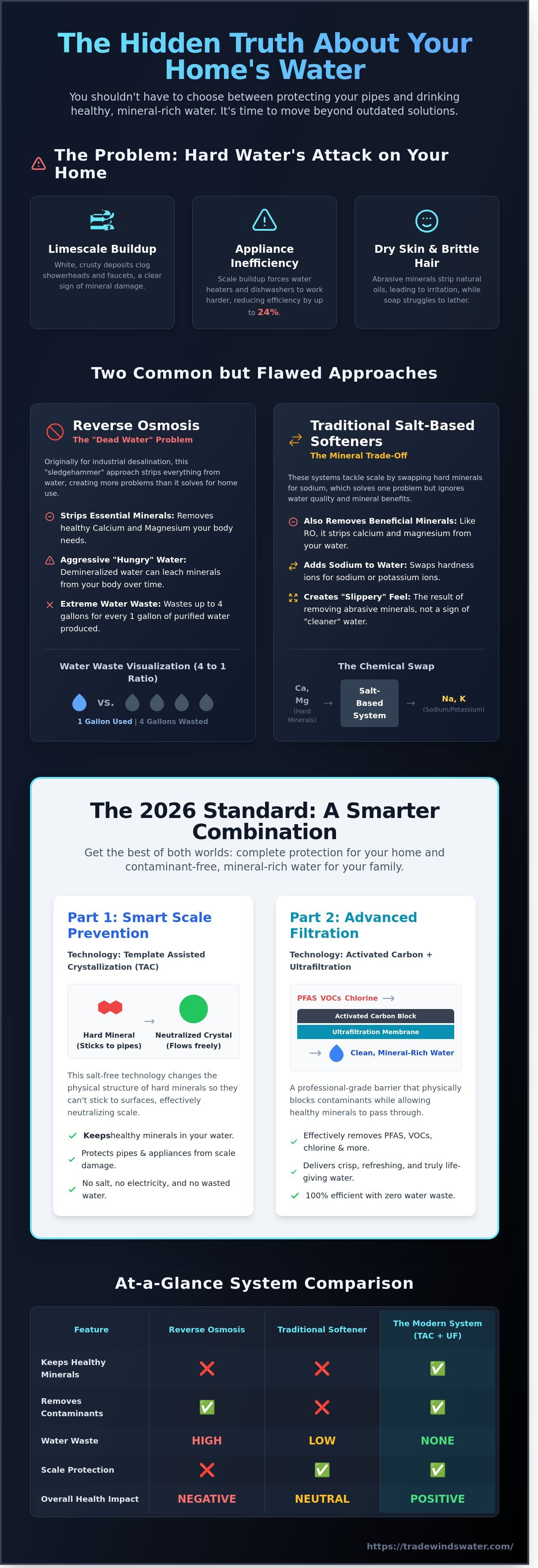
The Best Approach: Activated Carbon Block + Ultrafiltration
True water quality isn't just about preventing scale; it's about ensuring the water your family drinks and bathes in is free from dangerous contaminants. The ultimate modern solution combines a salt-free water conditioner with a powerful two-stage filtration system: an activated carbon block filter and an Ultrafiltration (UF) membrane.
- The Ultimate Combination: This pairing provides comprehensive protection, managing hard water scale while removing a massive range of chemical and biological contaminants.
- Activated Carbon Block: This is the gold standard for removing chemical contaminants, including chlorine, chloramine, VOCs, pesticides, and hard-to-remove PFAS "forever chemicals."
- Ultrafiltration (UF): A UF membrane provides a physical barrier against sub-micron particles, including bacteria, viruses, sediment, and microplastics.
- Sustainable and Efficient: This combination requires no electricity and wastes zero water, making it the most environmentally responsible and cost-effective whole-home solution.
The Power of Ultrafiltration (UF)
Ultrafiltration is a membrane-based technology that filters water at an incredibly fine level, providing a final barrier against microscopic threats.
- The 0.02-Micron Barrier: A UF membrane contains billions of tiny pores that are small enough to block pathogens and microplastics, but large enough to allow healthy minerals to pass through.
- Superior to RO for Mineral Retention: Unlike RO, which strips everything, UF targets physical contaminants while leaving the water's natural mineral composition intact.
- Whole-Home Peace of Mind: Explore our Ultrafiltration systems to see how you can get certified protection for every tap in your house.
Carbon Block vs. Granular Carbon
Not all carbon filters are created equal. Activated carbon block technology offers significantly better performance than older, loose granular activated carbon (GAC) filters.
- No 'Channeling': In GAC filters, water can carve channels through the loose carbon, bypassing the filter media. Solid carbon blocks force water through their entire structure, ensuring 100% contact time for maximum contaminant removal.
- Targeted PFAS Removal: High-grade, catalytically charged carbon blocks are specifically engineered to capture and hold onto stubborn chemicals like PFAS.
- Simplified Maintenance: Servicing a modern system involves a simple, clean cartridge change, a far cry from the messy and complicated process of re-bedding a backwashing GAC tank.
Implementation: Choosing and Installing Your System
Selecting and installing the right whole-home water system is a critical investment in your family's health and your home's longevity.
- Sizing Your System: The most important factor is the flow rate, measured in gallons per minute (GPM). Your system must be sized to meet your household's peak water demand without a drop in pressure.
- Professional Installation is Key: A whole-home system connects directly to your main water line. Professional installation by a licensed plumber is essential to protect your warranty and prevent catastrophic leaks.
- Integrate Smart Technology: Pair your filtration system with a smart leak detector for complete home protection and peace of mind.
- The Tradewinds Difference: We offer a national reach with a neighborly approach to service, connecting you with trusted, licensed installers in your area.
Protecting Your Investment with Smart Tech
A water filtration system protects your family's health; a smart leak detector protects your home itself. Combining them offers the ultimate security.
- Smart Shut-Off Valves: Every whole-home system should include a smart water valve that can automatically shut off the water supply the moment a leak is detected.
- Prevent Catastrophic Damage: A burst pipe or failed appliance can cause tens of thousands of dollars in damage in minutes. Leak detection turns a potential disaster into a minor inconvenience.
- Explore Our Solutions: View our smart leak detection collection to find the right protection for your home.
DIY vs. Professional Installation
While some smaller, point-of-use filters can be a DIY project, a whole-home system requires professional expertise.
- When to Call a Pro: Working on your main water line involves cutting pipes, soldering, and managing pressure regulators. This is a job best left to a licensed and insured professional.
- Simple Maintenance: Once installed, maintaining your system is easy. Most modern systems only require a simple filter cartridge change once a year.
- Long-Term ROI: A properly installed whole-home water system is an investment that pays for itself. A system costing a few thousand dollars can save you over $10,000 in plumbing repairs and premature appliance replacements over its life.
Frequently Asked Questions
Is a whole house water softener worth it if I have city water? A traditional, salt-based water softener is generally not worth it, as it removes healthy minerals and adds sodium to your water. However, a modern whole-house water conditioner (salt-free) combined with a filtration system is an excellent investment. It protects your plumbing from scale while removing chlorine and other chemicals added by the city.
What is the difference between a water softener and a water conditioner? A water softener uses ion exchange to physically remove calcium and magnesium minerals, replacing them with sodium. A water conditioner uses a technology like Template Assisted Crystallization (TAC) to change the structure of the minerals so they can't form scale, but it leaves the healthy minerals in your water.
Do salt-free water softeners really work on very hard water? Yes. High-quality salt-free systems (more accurately called water conditioners) that use Template Assisted Crystallization (TAC) are highly effective at preventing scale formation, even in very hard water conditions. They don't "soften" the water in the traditional sense, but they provide excellent scale protection without the downsides of salt.
Can I drink the water from a whole house water softener? It's not recommended to drink water from a salt-based softener due to the high sodium content. Water from a salt-free conditioner, however, is perfectly healthy to drink as it retains all its natural, beneficial minerals.
How often do I need to change the filters in an Ultrafiltration system? Most residential Ultrafiltration and carbon block systems are designed for annual filter changes. The cartridges are easy to access and replace, typically taking only a few minutes.
Does a whole house water filter remove PFAS and forever chemicals? Yes, but only specific types of filters are effective. The best solution is a system that uses a high-quality activated carbon block filter, which is certified for the reduction of PFAS and other volatile organic compounds (VOCs).
What happens if I use Reverse Osmosis for my entire house? You will be wasting thousands of gallons of water each year, stripping your water of all beneficial minerals, and potentially causing corrosion in your copper pipes due to the water's acidity. It is an extremely inefficient, wasteful, and unhealthy approach for whole-home water treatment.
How much does a whole house water softener cost to install in 2026? The cost for a modern, high-quality whole-house water conditioner and filtration system, including professional installation, typically ranges from $2,500 to $6,000. This is a one-time investment that saves money in the long run by eliminating the need for salt and protecting your appliances.
Upgrade to a mineral-rich, salt-free home with Tradewinds Water
- Industry-leading Ultrafiltration technology
- National network of licensed installers
- Systems designed for health, not just scale