

Discover how UV sterilization provides a chemical-free shield against pathogens while maintaining the essential minerals your body needs for optimal health.
What is a UV Water Sterilization System and Why Do You Need One?
A UV water sterilization system is a home water treatment unit that uses the power of ultraviolet light to make water biologically safe to drink. It acts as a final line of defense, targeting the DNA of microorganisms to neutralize them without adding any chemicals to your water. For health-conscious homeowners, especially those on well water or concerned about aging municipal infrastructure, a UV system offers peace of mind that can’t be achieved with standard filtration alone.
- Definition: A UV water sterilization system uses a specific wavelength of ultraviolet light (254nm) to perform Ultraviolet Germicidal Irradiation (UVGI), a process that deactivates the DNA of bacteria, viruses, and protozoa.
- The Biological Shield: It is the gold standard for neutralizing invisible threats like E. coli, Giardia, and Cryptosporidium, which are notoriously resistant to chlorine.
- Chemical-Free Safety: Unlike municipal treatment that relies on chlorine or chloramines, UV disinfection purifies your water without leaving behind chemical tastes or harmful byproducts.
- Health-Centric Approach: UV technology is preferred by those who want to ensure their water is biologically safe without stripping away beneficial, naturally occurring minerals like calcium and magnesium.
The Difference Between Sterilization and Filtration
It's crucial to understand that sterilization and filtration are not the same—and you need both for a complete home water strategy.
Sterilization targets living organisms (biological contaminants), while filtration targets physical particles like sediment, chemicals, and heavy metals. A UV system is a "disinfector" or "sterilizer," not a filter. It neutralizes pathogens by "zapping" their DNA, but it doesn't physically remove them or any other non-living contaminants from the water.
This is why a UV system should never be used alone. It is the final, powerful step in a holistic system that first uses filtration to physically remove the undesirable particles, ensuring the UV light can effectively reach and neutralize any microorganisms.
Common Biological Threats in Modern Water Supplies
Even treated municipal water isn't always free from risk. Aging pipes and water main breaks can introduce contaminants, and the rise of antibiotic-resistant pathogens is a growing concern. Well water owners are even more vulnerable, as their supply can be affected by agricultural runoff, failing septic systems, and seasonal bacterial blooms.
The goal of a UV system is pathogenic deactivation, a process that renders bacteria, viruses, and other microorganisms unable to reproduce and cause illness.
How UV Sterilization Works: The Science of Pathogen Neutralization
A UV water sterilization system works by channeling water into a stainless steel chamber where it is exposed to a specific wavelength of ultraviolet light. This light, invisible to the human eye, is a powerful germicidal agent.
- The 254nm Wavelength: UV systems use a lamp that emits light in the "germicidal" range of the UV spectrum, specifically at 254 nanometers.
- DNA Deactivation: This UV light penetrates the cell walls of microorganisms and disrupts their DNA. By breaking the molecular bonds in the pathogen’s genetic code, it makes it impossible for them to replicate and cause infection.
- Flow Rates and Dosage: The effectiveness of a UV system depends on the "contact time"—how long the water is exposed to the light. This is a function of the flow rate (gallons per minute) and the lamp's intensity, which together determine the UV dose.
- The Stainless Steel Chamber: The reflective interior of the stainless steel chamber maximizes the UV dose by bouncing the light rays through the water, ensuring comprehensive exposure.
Understanding UV Dosage (mJ/cm²)
The amount of UV energy delivered to the water is measured in millijoules per square centimeter (mJ/cm²). Different pathogens require different doses for deactivation. For example, neutralizing E. coli requires a lower dose than a resilient cyst like Cryptosporidium.
When choosing a system, ensure it meets NSF/ANSI Standard 55, which certifies that the system can deliver a sufficient dose to handle a wide range of common threats. The effectiveness of this dose is also impacted by water clarity, or "transmittance." If water is cloudy with sediment, those particles can shield bacteria from the UV light, reducing the system's effectiveness.
Components of a Residential UV System
A typical whole-house UV system consists of three main parts:
- The UV Lamp: The bulb that produces the germicidal UV light. It typically needs to be replaced annually.
- The Quartz Sleeve: A long, transparent tube made of quartz glass that protects the lamp from the water. It must be kept clean to allow the UV light to pass through unobstructed.
- The Ballast/Controller: The electronic brain of the system that powers the lamp and often includes alarms or sensors to alert you when the lamp needs replacement or if the system is not operating correctly.
UV vs. Reverse Osmosis: Why Mineral Retention Matters for Your Health
Many homeowners mistakenly believe that the "purest" water is the healthiest. This leads them to consider Reverse Osmosis (RO) systems, which strip virtually everything from the water, including beneficial minerals. This creates acidic, "dead water" that offers no nutritional value.
RO was a technology developed for industrial applications like desalination (turning seawater into drinking water), not for creating healthy, everyday drinking water. When you remove essential minerals like calcium and magnesium, the water's pH level drops below 7.0, making it acidic.
- The Acidity Problem: Acidic water is not ideal for the body, which strives to maintain a slightly alkaline state.
- Nutritional Value: Calcium and magnesium are vital electrolytes that support bone health, nerve function, and hydration. A significant portion of our daily mineral intake can come from our drinking water.
- The Myth of 'Pure' Water: Healthy water is "live water," rich with the natural minerals our bodies have evolved to use.
The Downside of Reverse Osmosis (RO)
Beyond stripping minerals, RO systems have other significant drawbacks. Because the demineralized water is acidic, it can be aggressive, potentially leaching metals from your home's plumbing over time. They are also environmentally inefficient, wasting 3 to 5 gallons of water for every gallon of purified water produced. Critically, RO is not the most effective barrier against modern chemical contaminants like PFAS.
UV: The Healthy Alternative for Biological Safety
A UV water sterilization system provides the perfect balance. It powerfully neutralizes biological threats while leaving the water's natural composition intact.
- UV preserves the natural alkalinity and pH of your water.
- It helps you maintain "live" water that is more hydrating and supportive of long-term health.
- Systems from Tradewinds Whole House Water Filtration are designed with a health-first philosophy, prioritizing mineral retention for optimal wellness.
The Best Setup: Combining UV with Ultrafiltration and Carbon
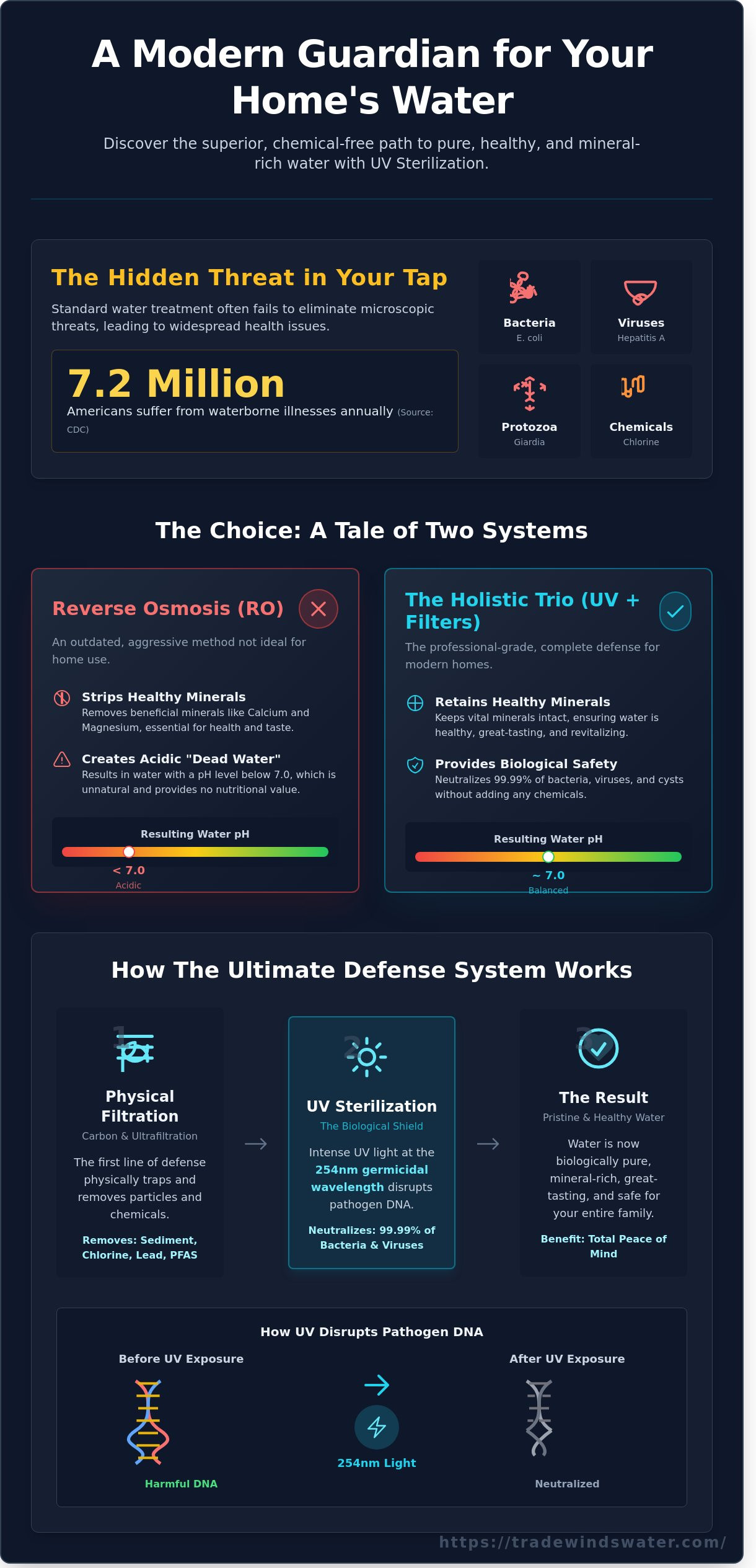
While UV is the ultimate biological safeguard, it cannot work effectively on its own. To achieve 100% effectiveness and protect the system itself, it must be paired with pre-filtration. The most advanced and health-conscious setup combines three technologies: the "Holistic Trio" of Activated Carbon, Ultrafiltration, and UV.
- Activated Carbon Block Cartridge Filters: This is the first line of defense against chemical contaminants. It excels at removing chlorine, chloramines, pesticides, herbicides, and other volatile organic compounds (VOCs) that affect the taste and smell of your water.
- Ultrafiltration (UF): This is the physical barrier. A UF membrane contains microscopic pores that physically block particles as small as 0.02 microns. It removes suspended solids, microplastics, and even bacteria and viruses, all while allowing healthy minerals to pass through.
- Shadowing Prevention: By removing sediment and other particles, Ultrafiltration ensures the water entering the UV chamber is crystal clear. This prevents "shadowing," where bacteria can "hide" behind particles, shielded from the sterilizing UV light.
Removing PFAS and Microplastics
For modern contaminants like "forever chemicals" (PFAS) and microplastics, this combination is unmatched. The powerful duo of activated carbon blocks and an Ultrafiltration membrane work together to capture and remove these threats before they ever reach your tap. UV alone is incapable of removing any chemical contaminants.
For homeowners looking to build a system that can handle these challenges, our Ultrafiltration collections provide the foundational components for the ultimate pre-UV setup.
The Importance of Pre-Treatment
Pre-filtration isn't just a recommendation; it's a requirement for ensuring your UV system functions correctly and lasts its full lifespan. Minerals like iron and manganese can stain the quartz sleeve, blocking the UV light. Hard water can cause scale buildup, which has the same effect. In fact, pre-filtration is not just an 'add-on' but a requirement for UV warranty compliance.
Installation, Maintenance, and System Selection
Choosing and maintaining the right UV system is straightforward when you know what to look for.
- Flow Rate (GPM): Select a system sized for your home's peak water demand, measured in gallons per minute (GPM). This ensures that even when multiple faucets are running, the water has sufficient contact time in the UV chamber.
- Maintenance Schedules: UV lamps have a finite lifespan of about 9,000 hours. They must be replaced annually to guarantee the system is emitting a powerful enough dose. The quartz sleeve should also be cleaned periodically.
- Professional Installation vs. DIY: While some homeowners can install a UV system, professional installation is recommended to ensure it's correctly integrated with your plumbing and pre-filtration for guaranteed performance.
Monitoring Your System Performance
Modern UV controllers do more than just power the lamp. Advanced systems include UV intensity sensors that provide real-time monitoring of the UV dose being delivered, offering a true measure of performance beyond a simple "lamp on" indicator light. For added security, a "fail-safe" solenoid valve can be installed to automatically shut off the water supply if the lamp burns out or the power fails, preventing untreated water from entering your home.
Getting a Professional Water Report
Before investing in any water treatment system, you need to know exactly what's in your water. A professional lab report will reveal bacterial counts, mineral content, and your water's "Transmittance" (UVT) score—a measure of its clarity. This data is essential for sizing your system correctly and ensuring it will perform as expected.
Start your journey to safe, healthy water with a comprehensive water report to design a system customized for your home's unique needs.
Frequently Asked Questions
Does a UV water sterilization system change the taste or smell of my water? No. UV is a physical process that adds nothing to the water. Any improvements in taste or smell would come from the recommended carbon pre-filter, which removes chlorine and other chemicals.
Is UV sterilization more effective than chlorine for killing bacteria? Yes, for certain pathogens. UV is highly effective against protozoa like Giardia and Cryptosporidium, which are extremely resistant to chlorine. It also neutralizes a broad range of bacteria and viruses without creating harmful disinfection byproducts.
Does a UV system remove heavy metals like lead or chemicals like PFAS? No. A UV system only deactivates living microorganisms. To remove lead, PFAS, and other chemicals, you need a comprehensive system that includes activated carbon block cartridge filters and Ultrafiltration.
How much electricity does a whole-house UV water system use? A residential UV system uses about as much electricity as a 40-watt light bulb. The cost is minimal, typically adding just a few dollars to your monthly utility bill.
What happens to the water if the power goes out or the UV bulb burns out? If the UV system loses power, it can no longer disinfect the water. It's recommended to either boil your water during an outage or install a solenoid valve that automatically shuts off the water flow if the system is not active.
Can I use a UV system on its own without any other water filters? It is strongly recommended not to. Without pre-filtration to remove sediment, iron, and other particulates, the UV light cannot work effectively. These particles can shield microorganisms from the light, allowing them to pass through into your home's water.
Do I need a water softener if I am installing a UV sterilization system? If your water is hard (high in calcium and magnesium), a water softener is recommended. Hardness minerals can form scale on the quartz sleeve, which will block the UV light and reduce the system's effectiveness.
How often do I really need to clean the quartz sleeve in my UV system? This depends on your water quality. For most homes with proper pre-filtration, cleaning the quartz sleeve once a year when you change the lamp is sufficient. If you have hard water or high iron levels, you may need to clean it more frequently.