

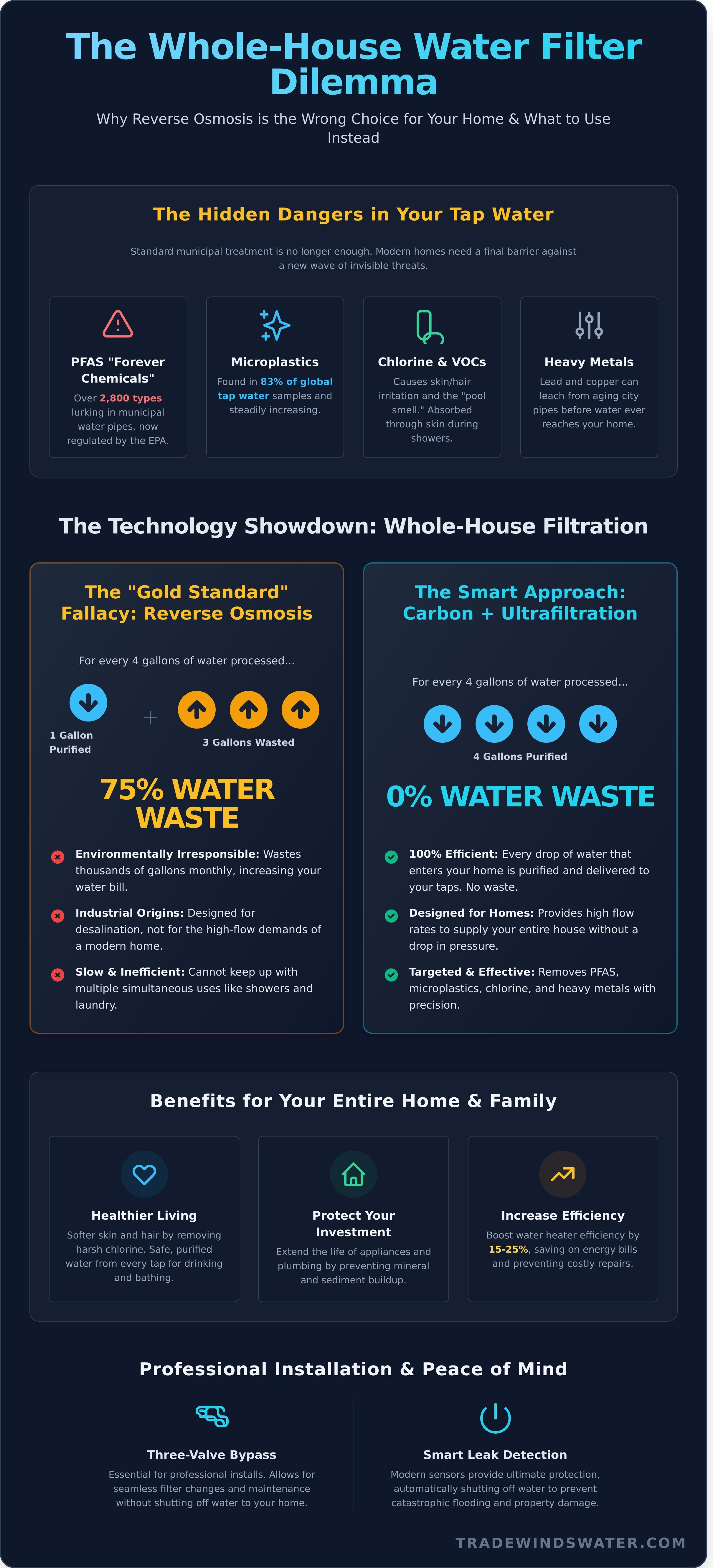
The "gold standard" of Reverse Osmosis is actually a massive drain on your wallet and the environment, wasting up to 75% of the water it processes. While RO works for industrial desalination, it's NOT the right choice for your family's daily needs. You likely feel the weight of responsibility to protect your children from the 2,800 types of PFAS "forever chemicals" lurking in municipal pipes. You want a home where every tap offers crystal-clear safety, but the fear of a botched whole house water filter system installation causing a 50-gallon-per-minute flood keeps you awake at night.
We're here to provide the total peace of mind you've been looking for. You'll learn how to install a professional-grade system using activated carbon block filters and Ultrafiltration to trap microplastics and chemicals without losing a single drop to waste. We'll cover everything from high-flow plumbing connections to 2026-standard leak detection sensors. This guide ensures your home remains a sanctuary of health and safety for years to come.
Key Takeaways
- Understand why standard municipal treatment isn't enough for PFAS and how Point-of-Entry systems provide a foundation for a healthy, happy home.
- Discover why Reverse Osmosis is NOT the right choice for a whole house water filter system installation due to its significant water waste and commercial origins.
- Learn the "best approach" for removing microplastics and chemicals using a superior combination of activated carbon block filters and Ultrafiltration technology.
- Master professional installation techniques, including the essential "Three-Valve Bypass" setup for effortless future maintenance and continuous water flow.
- Explore how to safeguard your property by integrating smart leak detection and automatic shut-off valves for ultimate long-term peace of mind.
Why Whole House Water Filter System Installation is Essential in 2026
Choosing a whole house water filter system installation means you are prioritizing the health of your family and the longevity of your home. This setup is known as a Point-of-Entry (POE) system. It treats every drop of water as it enters your property, ensuring that your shower, laundry, and kitchen taps all deliver purified water. This differs significantly from Point-of-Use (POU) systems, like small filters attached to a single faucet. By 2026, the shift toward POE systems has become a necessity rather than a luxury. With the EPA's 2024 finalized regulations on "forever chemicals" now in full effect, many municipal treatment plants are still playing catch-up to meet the strict limit of 4.0 parts per trillion for PFOA and PFOS.
Standard city treatment is often insufficient for modern chemical loads. While your local utility might meet basic safety standards, it typically focuses on preventing bacterial outbreaks rather than removing complex synthetic compounds. A professional whole house water filter system installation acts as your final, most reliable line of defense. Beyond drinking, filtered water is vital for bathing and cleaning. Your skin is your largest organ; it absorbs chemicals like chlorine and volatile organic compounds during a hot shower. Removing these irritants ensures softer hair, clearer skin, and prevents the "pool smell" that often lingers in modern bathrooms.
Protecting your home's infrastructure is another practical benefit. Hard water minerals and residual chlorine are aggressive on plumbing. Research shows that sediment buildup can reduce the energy efficiency of a $1,500 water heater by 15% to 25% over just a few years. By filtering water at the source, you extend the life of your dishwasher, washing machine, and high-end fixtures, saving thousands in premature replacement costs.
Modern Contaminants Your System Must Address
In 2026, we are dealing with microscopic threats that weren't on the radar a decade ago. PFAS and PFOA require specific activated carbon block cartridge filters with high density to effectively trap these stubborn molecules. Microplastics are another growing concern. A 2018 study by Orb Media found microplastics in 83% of tap water samples globally; a figure that has only risen. Your system must also tackle heavy metals like lead or copper that might leach from aging city pipes before the water reaches your home. Using advanced water filtration methods like Ultrafiltration ensures these particles are physically blocked, providing you with true peace of mind.
Whole Home Protection vs. Under-Sink Filters
Many homeowners start with pitcher filters or small Reverse Osmosis (RO) units under the sink. While RO is often called a "gold standard" for purity, it is NOT the right choice for whole-home use. RO systems were originally designed for industrial desalination. They are incredibly wasteful, often dumping 3 to 4 gallons of water down the drain for every 1 gallon of clean water produced. In a whole-home application, this waste is unsustainable and expensive.
A smarter strategy involves checking your local water report to see exactly what contaminants are present in your area. This data allows you to customize a setup using activated carbon and Ultrafiltration. This combination is the best approach for residential needs because it offers high flow rates and zero water waste. While the initial cost of a whole-home setup is higher than a single pitcher, the cost-per-gallon is significantly lower over a five-year period, especially when you factor in the protection of your expensive home appliances.
The Great Debate: Why RO is NOT for Whole House Installation
Many homeowners assume that Reverse Osmosis (RO) is the pinnacle of water purification. While it's true that RO is a gold standard for removing dissolved solids, it's NOT the right choice for a whole house water filter system installation. This technology was originally engineered for industrial desalination and large-scale commercial use. Scaling it down for a residential Point of Entry (POE) creates a series of logistical and environmental nightmares that most sales brochures conveniently forget to mention.
The biggest issue is efficiency. Traditional RO systems are notorious for their waste. Even in 2026, high-efficiency residential RO units often discard 3 to 5 gallons of water down the drain for every single gallon of purified water produced. If your family uses 300 gallons a day, an RO system could waste up to 1,500 gallons daily. This is ecologically irresponsible and expensive for anyone on a metered city line. Understanding the health effects of contaminants is vital; however, you shouldn't have to triple your water bill to protect your family from local pollutants.
Flow rate is the second dealbreaker. RO membranes work slowly; they produce water drop by drop. To run a whole house, you'd need a massive atmospheric storage tank, often 200 to 500 gallons in size, just to ensure you don't run out of water during a morning shower. Without this expensive infrastructure, your household water pressure would drop to a trickle the moment two faucets open at once. It's a system built for a single tap, not a busy household.
The Hidden Costs of Whole-Home Reverse Osmosis
Installing RO for the entire house requires more than just a filter. You'll need a dedicated booster pump to maintain the high pressure required for the membrane to function. This adds significantly to your monthly energy bill. Maintenance is another burden. Those large pressurized storage tanks are breeding grounds for bacteria if they aren't sanitized perfectly every six months. The constant discharge of wastewater also puts unnecessary strain on your septic system or local sewer infrastructure. It's a complex, high-maintenance path that rarely pays off for the average homeowner.
The Superiority of Ultrafiltration (UF) Systems
If you want safe water without the headache, Ultrafiltration is the clear winner. UF systems use a hollow fiber membrane with a 0.02 micron rating. This is fine enough to remove 99.9% of pathogens, bacteria, and particulates without wasting a single drop of water. Unlike RO, UF operates at standard household water pressure. You can maintain a flow rate of 12 to 15 gallons per minute (GPM). This means your showers stay hot and your appliances run efficiently even during peak usage hours.
The true gold standard for modern residential health is a combination of Activated Carbon Block filters and Ultrafiltration. This pairing is specifically designed to tackle modern threats like pfas and chlorine while keeping your healthy minerals intact. It's a smarter, more sustainable approach to your whole house water filter system installation. If you're ready to upgrade your home's safety, consider an expert water filtration consultation to find the right fit for your specific local water profile. We focus on solutions that protect your family without wasting your resources.
Step-by-Step Guide to Professional Installation
Success starts with the right location. You must install your system near the main water shut-off valve, ideally in a basement or garage where it's protected from freezing temperatures. It's vital to place the unit before the water heater. This positioning ensures that every appliance in your home, including your boiler and dishwasher, receives treated water. When planning your whole house water filter system installation, verify your pipe size. Most modern homes use 1-inch or 3/4-inch copper or PEX lines. Matching your filter’s ports to your home's diameter prevents a drop in your 15-gallon-per-minute flow rate, which keeps your showers strong and your toilets filling quickly.
A professional setup always includes a three-valve bypass loop. This configuration uses three separate ball valves to redirect water. One valve sits on the inlet, one on the outlet, and the third on a bypass pipe connecting the two. If you need to change a filter or perform maintenance, you simply open the bypass and close the unit valves. This keeps your family's water running without a single minute of downtime. Don't skip the mounting process. A triple-stage system can weigh over 50 lbs when full of water. You must secure the housings to wall studs using heavy-duty lag bolts to prevent stress on your plumbing joints.
We need to be clear about technology choices. Many homeowners assume Reverse Osmosis (RO) is the ultimate solution for the whole house. It isn't. RO systems were designed for commercial desalination and are NOT the most effective way to remove PFAS from a residential supply. They're incredibly wasteful; they often dump 3 gallons of water down the drain for every 1 gallon of purified water produced. For a healthy home, the best approach is combining activated carbon block cartridge filters with Ultrafiltration. This pairing removes chemicals and pathogens without the environmental guilt or the massive drop in water pressure typical of RO units.
Pre-Installation Checklist and Tools
Gather your pipe cutters, a soldering kit, or a ProPress tool before you begin. You'll also need two liquid-filled pressure gauges to monitor the system's performance. Test your raw water pressure first. It should fall between 40 and 80 PSI. If your home's pressure exceeds 80 PSI, you must install a pressure-reducing valve to protect the filter housings from bursting. Finally, have 2 ounces of unscented bleach ready to sanitize the housings during the initial setup to ensure a sterile environment for your family's water.
The Plumbing Sequence
Start by shutting off the main valve and opening the lowest faucet in the house to drain the lines completely. Once dry, cut the main line and sweat or press your bypass loop into place. This is where your whole house water filter system installation takes shape. Connect the sequence in this order: the sediment pre-filter first, followed by the activated carbon block, and finally the Ultrafiltration membrane. This order protects the delicate UF fibers from large particles. When you're ready to start, open the inlet valve only a quarter turn. Slow-filling prevents air hammers, which can exert over 300 PSI of instantaneous pressure and shatter your seals. Once the air stops hissing and the water runs clear, you've secured your home's health for years to come.
Integrating Smart Leak Detection and Maintenance
A whole house water filter system installation represents a significant commitment to your family's health and your home's infrastructure. Protecting this investment requires more than just high-quality filters; it demands a proactive defense against the unexpected. Plumbing failures cause billions in property damage annually across the United States. By pairing your filtration setup with a smart leak detector, you gain a digital sentry that monitors your home 24/7. These devices detect micro-leaks that standard visual inspections miss, ensuring a small drip doesn't turn into a catastrophic flood while you're at work or sleeping.
Modern systems utilize automatic shut-off valves that trigger the moment a pipe bursts or a fitting fails. This is crucial because a whole house water filter system installation adds new connection points to your main line. According to industry data from 2024, smart shut-off valves can reduce the risk of water damage claims by up to 96 percent. You can monitor flow rates directly via smartphone apps, which help identify silent leaks in toilets or irrigation lines. Once your system is active, verify its performance with a 3rd-party lab test. Don't rely on basic TDS meters; they don't track chemical contaminants. A proper test confirms your activated carbon block and Ultrafiltration membrane are successfully stripping away PFAS and lead.
Smart Home Synergy
Effective protection starts with strategic sensor placement. Position wireless sensors near the filter bank and the water heater, as these areas experience the highest pressure fluctuations. Set your system to "Away" mode when traveling to lower the sensitivity threshold for automatic shut-offs. This integration ensures your filtration maintenance schedule aligns with your home's safety protocols. If the flow rate drops by 15 percent, your app should alert you to a potential clog or a needed filter change immediately.
Long-Term System Maintenance
Maintaining peak performance means staying ahead of the curve. While some suggest Reverse Osmosis (RO) for whole-home use, we advise against it. RO systems are NOT the most effective way to remove PFAS for an entire house. They were designed for commercial desalination and waste roughly 3 to 4 gallons of water for every gallon produced. This inefficiency is unacceptable for modern eco-conscious households. Instead, focus on your activated carbon block cartridge filters. Replace these every 6 to 12 months to ensure 99 percent PFAS removal and keep your water tasting fresh.
For your Ultrafiltration membrane, choose automatic flushing options over manual ones. This process clears accumulated sediment every 24 hours, extending the membrane life to 3 or 5 years depending on your local water quality. Always perform a visual inspection of the filter housings every quarter to check for hairline cracks or O-ring wear. Small maintenance steps today prevent expensive repairs tomorrow. If you notice a drop in water pressure, it's usually the first sign that your carbon blocks have reached their capacity and need a quick swap.
Ready to secure your home's water supply with professional-grade technology and reliable protection? Explore our leak detection and filtration solutions here.
Choosing the Right System for Your Home
Selecting the ideal setup for your whole house water filter system installation isn't a guessing game. It's a technical calculation based on your home's peak demand and specific contaminants. If you have four residents and three bathrooms, your system must handle a flow rate of at least 12 to 15 gallons per minute (GPM). Anything less results in a frustrating drop in water pressure when the dishwasher and shower run simultaneously. We focus on matching the system capacity to your lifestyle so your family never notices the filtration process, only the results.
The Tradewinds Water Filtration approach prioritizes health over simple clarity. While many basic filters focus on making water look clear, we target the invisible threats. This requires a shift away from outdated industry standards. Many homeowners assume Reverse Osmosis (RO) Systems are the ultimate solution for every problem. This is a misconception we work hard to correct. RO was designed for industrial desalination and commercial applications. For a residential whole-home setup, RO is inefficient and wasteful. Modern RO units still waste between 3 and 10 gallons of water for every single gallon of purified water produced. This is NOT an environmentally or financially sound choice for a 2026 home upgrade.
Tradewinds Water Filtration Whole House Solutions
Our flagship filtration systems utilize a sophisticated multi-stage process. We combine high-capacity activated carbon block cartridge filters with advanced Ultrafiltration. This pairing is the best approach for removing pfas and chemical residues without the massive water waste associated with RO. To protect your investment, we integrate salt-free anti-scale technology. This prevents mineral buildup in your pipes and extends the life of your filter membranes by up to 25 percent. Our authorized installer network provides a 'done-for-you' experience, ensuring every connection is secure and code-compliant.
The Path to Crystal Clear, Safe Water
The debate between Carbon + UF and RO is settled by the data. Ultrafiltration provides a physical barrier down to 0.02 microns. This captures bacteria, cysts, and viruses that standard carbon filters might miss, all while maintaining your home's natural mineral balance. Unlike RO, Ultrafiltration doesn't leave your water "hungry" or corrosive to your copper plumbing. It's a smarter, more durable solution for the modern household. Before you commit to a whole house water filter system installation, run through this final checklist:
- Water Profile: Have you reviewed a recent lab report for pfas and heavy metals?
- Flow Rate: Does the system GPM match your bathroom count?
- Space: Is there adequate room near your main shut-off valve for the filter housings?
- Warranty: Are you using a professional to ensure your manufacturer's warranty remains valid?
Professional coordination is the only way to guarantee your system performs as advertised. DIY attempts often lead to bypassed valves or improper pressure regulation, which can void warranties instantly. We take that burden off your shoulders by managing the technical details from start to finish. You get the peace of mind that comes with a system designed for your specific zip code and water chemistry. It's about more than just plumbing; it's about the long-term health of your family. Ready to upgrade your home? Contact Tradewinds Water Filtration for a professional installation consultation and get a customized plan for your specific water profile.
Take Control of Your Home’s Water Quality Today
Choosing the right protection for your family means moving past outdated myths. While many still view Reverse Osmosis as a catch-all solution, it's simply NOT the right tool for your entire property. These systems were originally built for industrial desalination and often waste 4 gallons of water for every 1 gallon they clean. Instead, your 2026 strategy should focus on the powerful combination of activated carbon block cartridge filters and Ultrafiltration. This setup provides a 99.9% reduction in contaminants like pfas without the environmental cost or the pressure drops associated with RO systems.
A professional whole house water filter system installation gives you more than just clean taps; it provides total peace of mind. By leveraging our Professional Installer Network and Smart Leak Detection Integration, you'll protect your home from the 10,000 gallons of water typically lost to household leaks each year. Our Specialized PFAS Removal Tech ensures every drop meeting your family's skin is as safe as the water they drink. You deserve a home where safety is built into the foundation. Secure your home with a Tradewinds Whole House System today and enjoy the refreshing clarity of truly pure water.
Frequently Asked Questions
Is whole house water filter system installation a DIY project?
You can install basic sediment filters yourself, but a full whole house water filter system installation usually requires a licensed plumber to ensure your home's 50 to 80 PSI pressure remains stable. DIY errors account for 15% of household leaks according to 2024 insurance data. Professional setup ensures your bypass valves and pressure gauges work correctly from day one. It gives your family peace of mind knowing the plumbing is secure.
How much does it cost to have a whole house water filter professionally installed?
Professional installation typically costs between $600 and $2,400 based on 2025 labor rates. This price varies depending on your existing pipe material and the specific system configuration you choose. A standard carbon block setup might take 3 hours, while complex multi-stage systems require 5 to 7 hours of labor. Investing in professional labor protects your home from the $10,000 average cost of a major water damage claim.
Can a whole house filter remove PFAS and microplastics?
You can remove 99% of PFAS and microplastics by using a combination of activated carbon block cartridge filters and Ultrafiltration. While some suggest Reverse Osmosis (RO) Systems, these are NOT the best approach for whole-home use because they waste up to 4 gallons of water for every gallon produced. RO was designed for industrial desalination, not your family's daily showers. Ultrafiltration provides a 0.02-micron barrier that catches contaminants without wasting a single drop.
Will installing a whole house filter reduce my water pressure?
A correctly sized system only causes a 2 to 5 PSI drop in your home's water pressure. We select filters based on your household's peak flow rate, which for a four-person home is typically 12 to 15 gallons per minute. If you notice a 10 PSI drop, it usually means the filter is clogged or the unit is undersized for your plumbing. Keeping your family's morning showers powerful is a top priority during our design process.
Where is the best place to install a whole house water filter?
The best location for your whole house water filter system installation is on the main water line before it enters your water heater. This spot is usually in a garage, basement, or utility closet within 5 feet of the main shut-off valve. Placing it here ensures every tap in your home receives treated water. You need at least 3 square feet of wall space to allow for easy maintenance and filter swaps.
Do I need a water softener if I have a whole house filtration system?
You need a water softener if your water hardness exceeds 7 grains per gallon, as standard filters don't remove calcium or magnesium. While your filtration system removes chemicals and PFAS, a softener prevents scale buildup in your $1,200 water heater. Combining these two systems provides the ultimate protection for your appliances and your family's skin. We often install them side-by-side to create a complete home water treatment center.
How often do I need to change the filters in a whole house system?
Most families need to replace their activated carbon block cartridge filters every 6 to 12 months depending on usage. If your household consumes 100,000 gallons of water annually, you'll likely hit the filter's capacity by the 9-month mark. You can tell it's time for a change when you notice a 20% decrease in flow at the kitchen faucet. Regular maintenance keeps your water's taste and safety at peak levels for your children.
Can I install a whole house filter if I have a well?
You can definitely install a whole house filter on a well system, provided you include a 5-micron sediment pre-filter. Well water often contains 30% more particulates than city water, which can clog advanced filters quickly. We recommend testing your water for iron and sulfur before choosing your final setup. A tailored approach ensures your well water feels as fresh and clean as a mountain spring for your entire household.