

Learn the exact timelines and warning signs for replacing your home water filters to ensure your family enjoys mineral-rich, contaminant-free water.
The Standard Timeline vs. High-Capacity Systems
When asking, "How often to change a whole house water filter?" you'll often hear a generic "3 to 12 months" answer. This advice, however, is based on outdated, smaller filter cartridges that fail homeowners, especially those in areas with high sediment or complex water chemistry.
Modern, high-capacity systems have completely changed the maintenance schedule. The key difference lies in the filter's size and surface area, which dictates its lifespan. A standard filter might be time-based, but a high-performance system is based on the volume of water it can effectively treat.
- Time-Based Triggers: Common for smaller, disposable filters that degrade over a few months regardless of usage.
- Gallon-Based Triggers: The gold standard for large-capacity systems, where the filter is rated for a specific volume (e.g., 300,000 gallons) before its filtration media is exhausted.
Typically, a sediment pre-filter has the shortest lifespan, while the main treatment tank or carbon block cartridge lasts significantly longer, often for several years.
Beyond the 3-Month Myth: The High-Capacity Pre-Filter
The first line of defense for your plumbing and appliances is the sediment pre-filter. For common "Big Blue" style filters, this often means a replacement every 1 to 3 months. However, this is not the case for advanced systems.
High-capacity sediment filters feature vastly more surface area—up to 100 sq. ft. compared to the 16 sq. ft. in a typical 20" filter. This massive increase in open area extends the service life dramatically. Instead of frequent replacements, a simple check every 9 months is all that's needed. Furthermore, many of these durable, US-made filters can be gently hosed off and reused, unlike their cheap, disposable counterparts. Delaying this crucial check can still risk damage to downstream appliances and sensitive smart valves.
The 300,000-Gallon Standard for Main Filtration
The core of your filtration system, typically an activated carbon block, is responsible for removing chemical contaminants. While some systems require annual changes, high-capacity cartridges are engineered for a much longer service life, often rated for 300,000 gallons. For a typical family, this translates to 24-36 months of reliable performance.
This extended lifespan doesn't eliminate risk. Eventually, any filter can experience "breakthrough," where it becomes so saturated that it begins releasing the very contaminants it captured. Adhering to the gallon rating is a critical ritual for ensuring your family’s long-term health and peace of mind.
4 Crucial Factors That Determine Your Filter Replacement Schedule
Your home’s unique conditions dictate the real-world lifespan of your filters. Even with a high-capacity system, these four factors can accelerate your replacement schedule.
- Water Quality: Water with high levels of sediment, turbidity, iron, or other heavy metals will clog filters faster.
- Household Usage: A family of six will exhaust a filter's gallon capacity much more quickly than a retired couple.
- Contaminant Load: Homes battling specific contaminants like high concentrations of PFAS, chlorine, or microplastics place a greater demand on the filtration media.
- Filter Micron Rating: A filter with a smaller micron rating (e.g., 5-micron) captures finer particles but may clog sooner than a larger one (e.g., 20-micron) if not paired with an appropriate pre-filter.
Analyzing Your Local Water Report
Your first step is to understand what’s in your water. Municipal water reports detail metrics like water "hardness," "total dissolved solids" (TDS), and chlorine levels. High levels of chlorine, used for disinfection, can degrade carbon filters more rapidly.
You can get a clear picture of your local water profile by using a localized water report tool to see what contaminants are common in your area. This data empowers you to create a maintenance schedule based on facts, not guesswork.
Measuring Daily Water Consumption
Since high-performance filters are rated by gallons, knowing your consumption is key. You can estimate usage based on the number of occupants, appliances, and any outdoor irrigation.
For precise tracking, a smart water leak detector can monitor your home's water flow in real time. This technology not only protects against leaks but also provides the data needed to predict exactly when your filter will reach its capacity, eliminating any uncertainty.
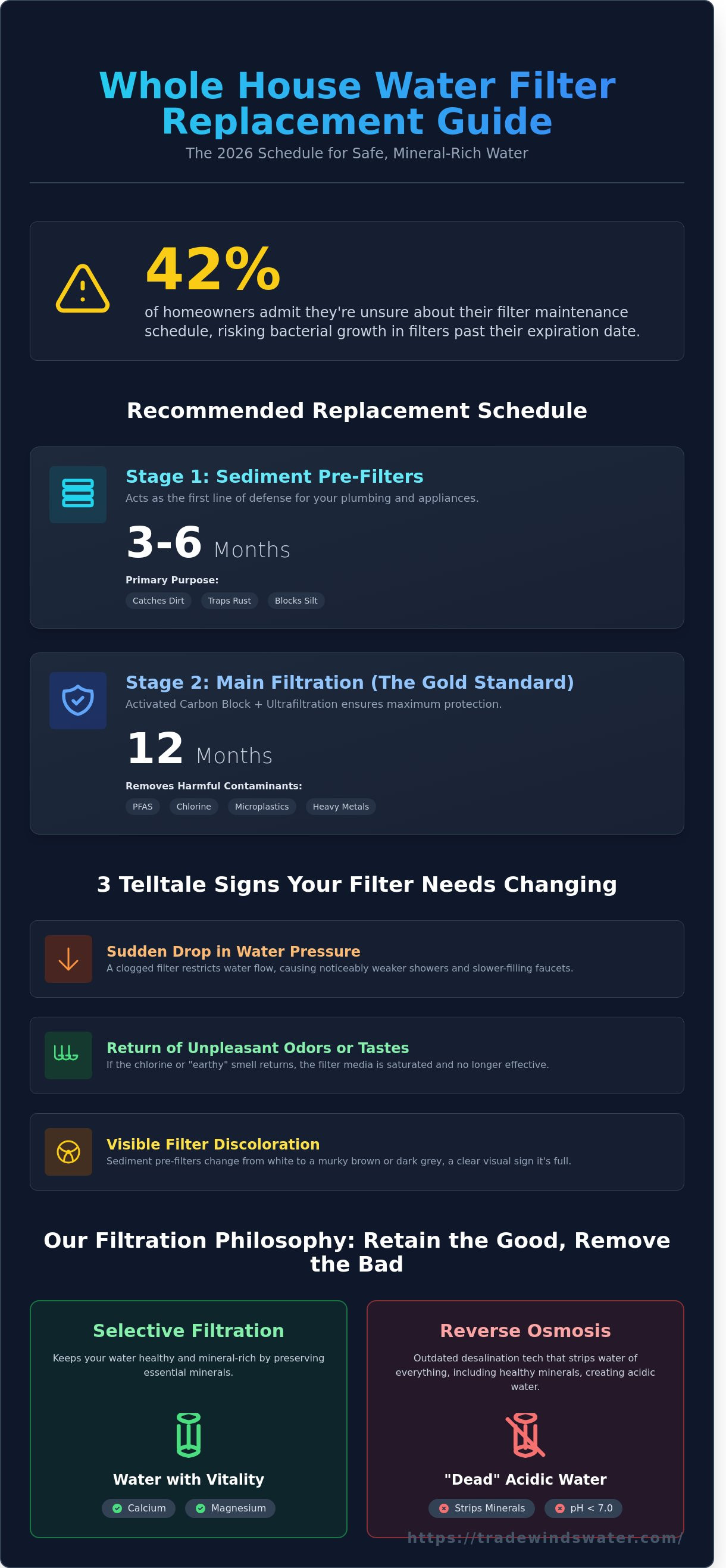
Filter Type Matters: Activated Carbon vs. Ultrafiltration Lifespans
Not all filtration technologies are created equal, and their maintenance needs vary significantly. The most effective approach for home water health combines different methods to remove contaminants while preserving the water's natural quality.
This is why it's crucial to look beyond outdated technologies like Reverse Osmosis (RO) and focus on a modern, holistic solution that maintains essential minerals like calcium and magnesium.
The Superiority of Carbon Block and Ultrafiltration
The gold standard for healthy, pH-balanced water is a system that pairs an activated carbon block filter with an Ultrafiltration (UF) membrane.
- Activated Carbon Block Filters: These are the workhorses for chemical and aesthetic contaminant removal. They excel at adsorbing chlorine, chloramines, pesticides, and modern threats like PFAS, dramatically improving your water's taste and smell.
- Ultrafiltration (UF) Systems: A UF membrane acts as a physical barrier against microscopic particles. With pores as small as 0.02 microns, Ultrafiltration systems block sediment, bacteria, viruses, and microplastics without stripping the water of its beneficial minerals. These membranes often have a very long lifespan, sometimes lasting for years with minimal maintenance.
The RO Maintenance Trap: Why More Isn’t Better
Reverse Osmosis was a technology designed for industrial applications like desalination, not for optimizing the health of a home's drinking water. The RO process is aggressive, stripping everything out of the water—including essential minerals.
This creates acidic, "dead water" with a pH below 7.0, which offers no nutritional benefit. The complex multi-stage filters and membranes in RO systems require frequent, costly replacement and generate significant wastewater, making them an inefficient and unhealthy choice for modern homes. For a deeper dive, you can explore how to effectively remove PFAS from water at home with superior methods.
Warning Signs: How to Tell if Your Whole House Filter is Clogged
Even with a long-lasting filter, it’s important to recognize the signs that it’s nearing the end of its service life. These indicators are your system’s way of telling you it’s time for a change.
- A noticeable drop in water pressure across the home.
- The return of unpleasant tastes or a "swimming pool" chlorine smell.
- Visible cloudiness or sediment in a glass of water after it settles.
- Strange sputtering or noises from the filtration unit.
Physical Indicators and Sensory Changes
The most common sign of a clogged filter is a gradual loss of water pressure. If your showers feel weaker or faucets flow slower, your filter is likely impacted with sediment. Similarly, if you start tasting or smelling chlorine again, it means the activated carbon has reached its absorption limit and can no longer effectively treat your water. Another subtle sign can be a change in the feel of the water; for instance, a "slippery" feel might indicate issues with filtration or softening components.
The Role of Smart Monitoring
Modern technology offers a proactive solution. Smart water monitoring systems track your home's flow rate 24/7. They can alert you to a gradual pressure drop long before it becomes an inconvenience, effectively giving you a data-driven notification that your filter's lifespan is coming to an end. This provides invaluable peace of mind and allows you to schedule maintenance on your terms.
Simplifying Maintenance for Long-Term Home Water Health
Proper maintenance is the key to ensuring your water remains pure and your system runs efficiently for years to come. By choosing the right equipment and establishing a simple routine, you can protect your investment and your family’s health.
Keeping a log—either in a notebook or a digital reminder—of when you last checked or changed your filter is a simple but powerful habit. When it's time for a change, choosing high-quality Replacement Cartridge Filters ensures you get the performance and longevity you paid for, saving you money and hassle in the long run.
DIY Filter Change Checklist
Changing a cartridge filter is a straightforward task most homeowners can handle.
- Shut Off the Water: Locate the bypass valve on your system or the main shutoff for the house and turn it off.
- Depressurize the System: Press the red pressure-relief button on top of the filter housing to release trapped pressure.
- Unscrew and Clean: Use the provided wrench to unscrew the filter housing (sump). Clean the inside with warm, soapy water.
- Swap the Filter: Remove the old cartridge and check the O-ring for cracks or dryness. Replace it if needed. Insert the new (or cleaned) cartridge.
- Reassemble: Screw the housing back on, being careful not to over-tighten.
- Restore Water: Slowly turn the water back on and check for leaks. Depress the relief button again to purge any trapped air.
If you are ever unsure, it’s always best to call an authorized installer for a system health check.
Investing in the Right Hardware
Generic, off-the-shelf filters may seem like a bargain, but they rarely offer the same level of protection or longevity as a certified, high-capacity system. Investing in a system engineered to preserve essential minerals while effectively removing contaminants provides a significant long-term return. It protects your plumbing, enhances your family's health, and delivers pure, great-tasting water from every tap.
Ready to ensure your home water stays healthy and tastes great? Browse our high-performance filtration solutions.
Frequently Asked Questions
Is it okay to wait until water pressure drops to change my filter? No, a drop in water pressure is a late-stage sign that the filter is already severely clogged. Changing it proactively based on the manufacturer's gallon rating or time-based recommendation prevents stress on your plumbing and ensures consistent water quality.
Can a dirty water filter make you sick? Yes. An old filter can become a breeding ground for bacteria. It can also fail and release all the contaminants it has captured back into your water supply, a phenomenon known as "breakthrough."
How much does it cost to replace a whole house water filter? The cost varies widely, from $25 for a basic disposable sediment filter to over $200 for a high-capacity, specialized carbon block cartridge. While high-capacity filters have a higher upfront cost, their significantly longer lifespan often makes them more economical over time.
What happens if I don’t change my water filter for a year? For a standard 3-6 month filter, waiting a year is risky; it will likely be clogged, ineffective, and potentially growing bacteria. For a high-capacity filter rated for 24-36 months, one year is well within its service life, but you should still monitor performance and track your water usage against its gallon rating.
Does a whole house filter remove PFAS forever? No filtration media lasts forever. Activated carbon block filters are highly effective at adsorbing PFAS, but once the media is saturated, the filter must be replaced to continue removing these "forever chemicals."
Can I clean and reuse my whole house water filter cartridge? It depends on the type. Some high-quality pleated sediment pre-filters are durable enough to be gently hosed off and reused a few times. However, activated carbon block filters cannot be cleaned; once their media is exhausted, they must be replaced.
Is a 5-micron filter better than a 20-micron filter for lifespan? All else being equal, a 5-micron filter captures finer particles and will clog faster than a 20-micron filter. However, the most important factor for lifespan is the filter's total surface area. A large-capacity 5-micron filter will dramatically outlast a small 20-micron filter.
Do I need to turn off the water to change the filter? Yes, you must always turn off the water supply to the filter and release the pressure in the housing before attempting to unscrew it. Failure to do so can result in significant water damage.