

The common belief that reverse osmosis is the peak of home water technology is a costly misconception that wastes up to 75% of the water you pay for. While RO was originally designed for industrial desalination, it's often pushed onto homeowners despite its inefficiency and sluggish flow. If you're looking for an under sink water filter in 2026, you deserve a system that protects your family without flushing your utility budget down the drain.
We understand the worry that comes with news reports like the 2023 EPA findings regarding PFAS and lead levels in local supplies. You want the peace of mind that comes with bottled-quality water, but you shouldn't have to tolerate a 50% reduction in tap pressure or environmental waste to get it. This guide will show you why the combination of activated carbon blocks and ultrafiltration has replaced RO as the true gold standard for safety and speed. You'll learn how this zero-waste approach removes 99.9% of common contaminants while keeping your kitchen running efficiently and your family healthy.
Key Takeaways
- Learn why basic pitcher filters no longer meet modern safety standards and why a dedicated filtration system is now the foundation of a healthy home.
- Discover the hidden costs and environmental impact of water waste that make traditional reverse osmosis an outdated choice for your under sink water filter.
- Understand how the powerful combination of 0.02-micron Ultrafiltration and Activated Carbon blocks provides a superior barrier against pathogens and chemicals.
- Gain expert insights on evaluating flow rates and long-term maintenance costs to ensure your family enjoys high-quality water without technical frustrations.
- Explore how to integrate smart leak detection with your filtration system to provide the ultimate peace of mind and total protection for your household.
Why an Under Sink Water Filter is the Foundation of a Healthy Home
By 2026, the way Sheridan homeowners view their tap water has fundamentally changed. Clean water is no longer a luxury or a matter of simple convenience; it's a vital necessity for residential safety. While many people initially look for a reverse osmosis system because of its reputation, it's a common misconception that RO is the best choice for a family home. Reverse osmosis technology was originally designed for industrial applications and commercial desalination. When used in a kitchen, these systems are notoriously wasteful. Most residential RO units dump between 3 and 10 gallons of water down the drain for every single gallon of purified water they produce. This inefficiency is a significant flaw that persists even in the newest models. Families in our community deserve a solution that protects their health without wasting our precious local resources.
A dedicated under sink water filter using a combination of activated carbon block cartridges and ultrafiltration is the superior approach. Unlike simple pitcher filters or refrigerator inserts that often fail to meet 2026 safety standards, a fixed point-of-use system offers a robust barrier against modern contaminants. Pitchers are slow and have limited contact time with the filtration media. An under-sink system provides much higher flow rates, often delivering 1.5 to 2.0 gallons of purified water per minute directly to your faucet. This ensures you have plenty of water for cooking, boiling pasta, and filling large pots without the frustrating wait. There's a profound psychological peace of mind that comes from knowing every drop of water used for your family's meals is treated by a professional-grade system right at the source.
Identifying Modern Threats in Your Tap Water
The primary concern for modern homeowners is the "forever chemicals" problem. PFAS removal has become the top priority because these substances don't break down in the environment or the human body. In April 2024, the EPA set legally enforceable limits for several PFAS at just 4 parts per trillion. Achieving this level of purity requires more than just a basic filter. Beyond chemicals, aging municipal infrastructure often introduces microplastics and heavy metals like lead or copper into the water as it travels to your home. Studies show that 93% of bottled water contains microplastics, making home filtration a much safer and more sustainable choice. To understand what's specifically in your pipes, Check your local water report details here as the essential first step for any homeowner. Understanding common water filtration methods helps you see why a multi-stage carbon and ultrafiltration setup is the most effective way to address these invisible risks.
Point-of-Use vs. Whole-House Filtration
We view water safety as a multi-layered defense strategy for the home. While whole-house systems are excellent for protecting your plumbing and appliances from hard water scale, the kitchen faucet is the most critical battleground for purity. This is where you prepare food and fill drinking glasses. Treating all the utility water used for flushing toilets or watering the lawn to the same high standard as your drinking water is unnecessarily expensive. A targeted under sink water filter allows you to focus your investment where it matters most. This approach offers several advantages for the average household:
- Cost Efficiency: You only replace high-performance filters for the water you actually consume.
- Targeted Protection: Ultrafiltration membranes can remove particles as small as 0.02 microns, which is far more precise than most whole-house sediment filters.
- Space Saving: Modern systems fit neatly under the cabinet, leaving plenty of room for your cleaning supplies.
- Zero Waste: Unlike RO systems, carbon and ultrafiltration setups don't send gallons of water into the sewer during the process.
Choosing the right system means looking past the marketing hype of reverse osmosis and focusing on what actually works for a Sheridan home. By combining high-grade carbon blocks with ultrafiltration, you create a reliable "safety zone" in your kitchen. This setup ensures your family enjoys water that isn't just clear, but is truly healthy and safe for every member of the household.
The Reverse Osmosis Myth: Why RO is Not the Best Choice for Your Home
Many families believe that a reverse osmosis (RO) system is the pinnacle of water purity. It's a common misconception that has been fueled by decades of industrial marketing. In reality, RO technology was originally developed in 1962 for large-scale commercial desalination and maritime use. It was never intended to be the primary source of drinking water for a family kitchen. While it's marketed as a premium choice, it's actually a "brute force" method that ignores the delicate balance of healthy hydration. By stripping every single particle from the water, it creates what experts call "dead water." This process removes essential minerals like calcium and magnesium that your body needs for bone health and electrolyte balance. Drinking demineralized water for long periods can lead to mineral deficiencies, making it a poor choice for a health-conscious home.
Scientific reviews regarding the Effectiveness of Point-of-Use Filtration show that there are far more sophisticated ways to protect your family. Modern filtration doesn't need to be destructive to be effective. Instead of stripping your water of its life-sustaining properties, the best approach involves a combination of activated carbon block cartridges and Ultrafiltration. This pairing provides a surgical level of protection, removing harmful contaminants like PFAS, lead, and cysts while allowing beneficial minerals to remain in your glass. It's a more intelligent way to manage your home's water quality without turning your kitchen into a miniature industrial plant.
The Environmental and Financial Impact of RO Waste
The hidden cost of an RO system shows up clearly on your monthly utility bill and your local environmental footprint. Traditional RO units operate on a staggering 4-to-1 waste ratio. For every single gallon of filtered water you actually drink, four gallons are flushed directly down the drain. This inefficiency is particularly concerning for Sheridan residents who value local ecosystem sustainability. Even modern units claiming "high efficiency" often only reach a 1-to-1 ratio under perfect laboratory conditions; in a real-world under sink water filter setup, the waste remains significant. This constant drainage doesn't just waste money; it puts unnecessary strain on municipal sewer systems and depletes local water resources. Over a 10-year period, a single household can waste over 50,000 gallons of water just to get a few glasses of clean drinking water each day.
Maintenance Nightmares and System Complexity
RO systems are notoriously fragile and complex. The thin-film composite membranes are easily damaged by the chlorine used in municipal water treatment, which can cause the system to fail in less than 12 months if the pre-filters aren't changed religiously. Beyond the membrane, the required storage tanks present a significant hygiene risk. These tanks hold stagnant water in a dark environment for hours or days, creating a perfect breeding ground for biofilm and bacterial growth. Because the water is "hungry" after being stripped of minerals, it becomes more aggressive and can even pick up tastes from the rubber bladder inside the tank.
Choosing a modern under sink water filter that utilizes Ultrafiltration avoids these maintenance headaches entirely. These systems don't require bulky storage tanks or complex tubing that increases the risk of leaks at one of the 7 to 10 connection points found in typical RO setups. Instead, you get a streamlined, high-flow solution that provides fresh water on demand. If you want to ensure your family's safety without the waste or the "dead water" problem, you can explore our high-performance filtration alternatives designed specifically for the needs of our community.
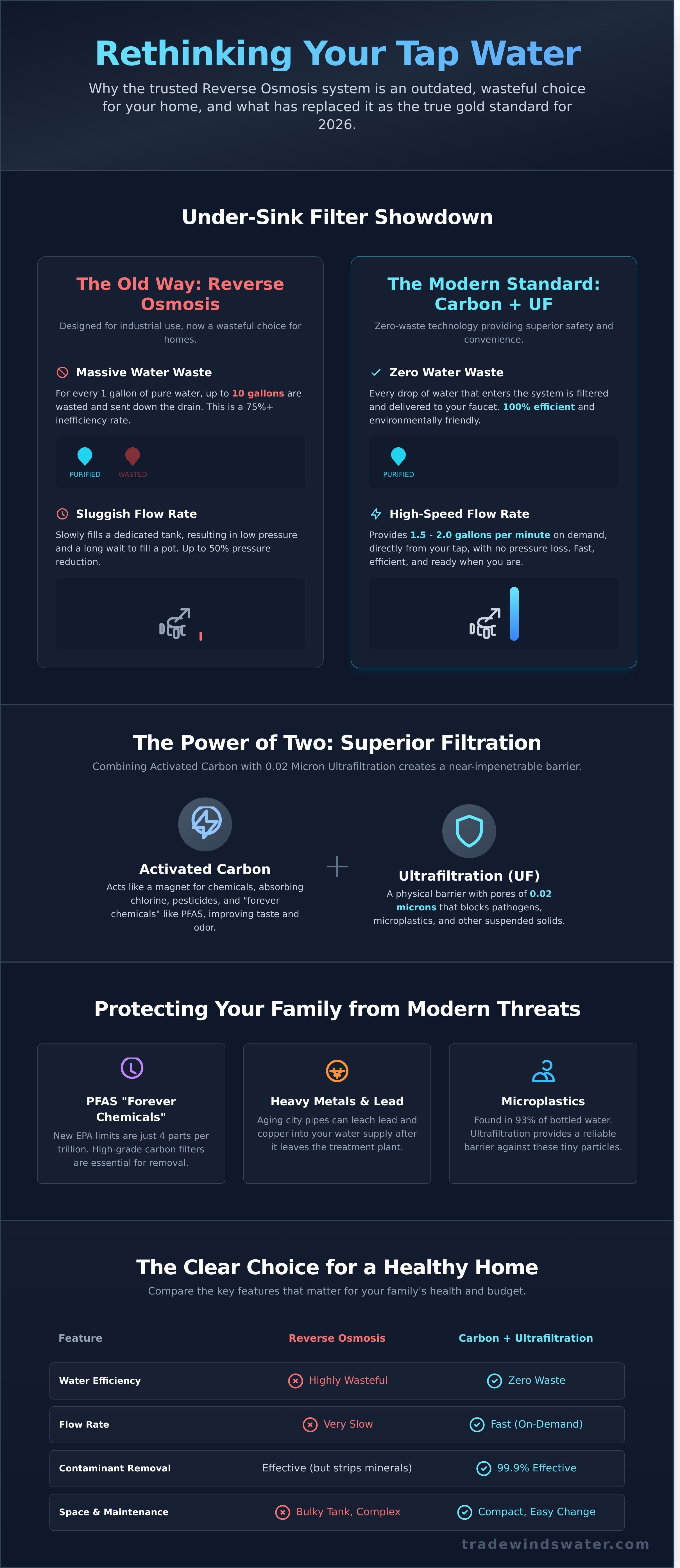
The Superior Alternative: Combining Activated Carbon and Ultrafiltration
Many homeowners in Sheridan look for an under sink water filter expecting Reverse Osmosis to be the only answer. That's a common misconception we help families navigate every day. While RO technology serves a purpose in industrial desalination, it's often a poor fit for your kitchen. Standard RO units waste up to 4 gallons of water for every single gallon they purify. By 2026, the industry gold standard has shifted toward a more efficient, dual-stage approach. We recommend pairing high-density activated carbon blocks with Ultrafiltration (UF) technology. This combination provides the highest level of safety without the environmental guilt or the "flat" taste of stripped water.
Ultrafiltration removes 99.9% of bacteria and viruses while retaining the healthy minerals RO systems discard. This 0.02-micron physical barrier acts as a microscopic sieve. It catches pathogens like Giardia and Cryptosporidium that are often resistant to chemical disinfection. By choosing this path, you're not just filtering your water; you're securing your family's health with a system that works as hard as you do. It provides the literal foundation for a healthy home, ensuring every glass of water is as safe as it is refreshing.
How Ultrafiltration Outperforms Traditional Filters
Ultrafiltration relies on a hollow fiber membrane. Think of it as thousands of tiny straws with microscopic pores. Unlike simple sediment filters that only catch large dirt particles, UF provides a mechanical barrier against colloidal silica and fine particulates as small as 0.02 microns. This is a significant jump from the 5-micron standard found in basic hardware store units. You can explore our professional-grade Ultrafiltration systems to see how this technology provides peace of mind for your home.
The Critical Role of Activated Carbon Blocks
If Ultrafiltration is the shield, the activated carbon block is the magnet. We specifically use solid blocks because they prevent "channeling," a common flaw in granular carbon filters where water creates a path of least resistance and bypasses the filtration media. These solid blocks utilize adsorption to pull chemicals directly out of the water stream. This process is far more effective than simple absorption, as it creates a molecular bond between the carbon and the contaminants.
- VOCs and PFAS: Carbon blocks are the most effective way to trap "forever chemicals" and volatile organic compounds that may linger in local supplies.
- Chlorine Removal: They eliminate the harsh chemical smell and taste of municipal treatments, protecting your skin and your palate.
- Sensory Experience: The result is the crisp, refreshing taste of mountain spring water right from your tap.
This dual-stage system ensures your under sink water filter delivers more than just "clean" water. It gives you a professional solution that treats your home with the respect it deserves. You get the protection of a 0.02-micron barrier and the chemical-stripping power of carbon, all without wasting a single drop of Sheridan's precious water supply. It's the most responsible and effective way to guarantee purity for your loved ones.
Key Features to Evaluate Before Buying Your Under Sink System
Choosing an under sink water filter involves more than just picking a box off a shelf. Many homeowners in Sheridan are told that Reverse Osmosis (RO) is the only way to achieve pure water; however, RO technology was built for industrial desalination, not your kitchen. These systems are notoriously inefficient, often wasting 4 gallons of water for every 1 gallon they produce. Even the most "efficient" modern RO units still maintain a 1:1 waste ratio. We believe your home deserves better than a system that literally pours your money down the drain. The best approach for removing modern contaminants like PFAS is a combination of high-density activated carbon block filters and ultrafiltration. This setup provides the same level of safety without the environmental or financial sting of wasted water.
- Flow Rate (GPM): A quality filtration system shouldn't turn your faucet into a slow trickle. You want a system that maintains a flow rate of at least 0.75 to 1.5 gallons per minute (GPM). This ensures you can fill a 2-quart pitcher in less than 30 seconds. Systems using ultrafiltration membranes offer high-speed flow while still catching particles as small as 0.02 microns.
- Filter Life and Replacement Costs: Don't just look at the initial price tag. Evaluate the total cost of ownership over a 3-year period. A $150 "big box" system might require $60 filter changes every 3 months. Conversely, a professional-grade under sink water filter often uses high-capacity cartridges that last 12 months or 1,000 gallons. This reduces your maintenance frequency and your long-term expenses.
- Certification Standards: Always verify third-party testing. Look for NSF/ANSI 53 certification, which specifically addresses health-related contaminants like lead and PFAS. In 2024, the EPA set strict new limits on PFAS at 4 parts per trillion, making this certification more vital than ever. You should also look for NSF/ANSI 42, which ensures the system removes chlorine and particulates that ruin the taste and smell of your water.
- Ease of Maintenance: You shouldn't need a plumbing degree or a massive pipe wrench to keep your water clean. Modern professional systems utilize "twist-and-lock" designs. These allow you to swap a cartridge in less than 60 seconds without even turning off the main water supply in many cases.
The Importance of Professional Grade Hardware
Cheap plastic housings found in retail stores are prone to "creep," a process where the plastic stretches and eventually cracks under constant 60-80 PSI pressure. This leads to catastrophic leaks in your kitchen cabinets. Professional hardware utilizes reinforced housings and lead-free dedicated faucets that stand up to decades of use. You can browse our curated collection of residential filtration hardware to see the difference that heavy-duty components make for your family's safety.
Addressing the Scale Problem
Sheridan water is often heavy with minerals, frequently exceeding 15 grains per gallon of hardness. This scale doesn't just spot your glasses; it can coat the delicate membranes of a filter, cutting its lifespan by 50% or more. Pairing your point-of-use filter with anti-scale technology creates a powerful synergy. You can learn how the Flow-Tech MAX protects your home's plumbing by keeping minerals in suspension so they don't ruin your new filtration system.
Ready to upgrade your home with a system that actually works for your lifestyle? Contact our local experts today to find the perfect filtration solution for your Sheridan home.
Beyond the Faucet: Integrating Filtration with Total Home Protection
Installing a high-quality under sink water filter is a significant step toward a healthier lifestyle, but it shouldn't be the final step in your home water strategy. Every time a new pressurized connection is added under a cabinet, you're introducing a potential point of failure. Statistics from the insurance industry show that water damage is the second most frequent claim for homeowners, with the average leak causing over $11,000 in property loss. We don't want your journey toward cleaner water to end with a ruined kitchen floor. That's why we view filtration as one piece of a "Total Home Water Security" stack.
A complete security stack protects your family from three distinct angles. First, filtration removes chemical contaminants like PFAS and chlorine. Second, scale control prevents hard water from destroying your expensive appliances. Third, leak detection acts as the silent sentry for your plumbing. This holistic approach is what provides the peace of mind that a standalone filter simply cannot offer. By layering these technologies, you ensure that your water is as safe for your home's structure as it is for your body.
Smart Leak Detection: The Essential Companion
A standard under sink water filter install involves tapping into your cold water line, which remains under constant pressure. If a fitting loosens or a housing cracks while you're at work, the results are catastrophic. We recommend pairing every filtration system with a smart monitor. These devices detect moisture instantly and can trigger an automatic shut-off valve to kill the water supply before the first gallon hits your basement. You can view our smart leak detection and automatic shut-off solutions to see how this technology integrates with your existing plumbing to prevent 90% of common water damage scenarios.
The Tradewinds Commitment to Pure Water and Home Safety
Our Sheridan-born values mean we treat every customer like a neighbor, and neighbors don't let neighbors waste water. While many retailers still push Reverse Osmosis (RO) systems as the gold standard, we've taken a firm stand against them for residential use. Traditional RO units are notoriously inefficient, often wasting 4 gallons of water for every 1 gallon of purified water produced. In our local climate, where water conservation is a community priority, that level of waste is unacceptable. RO technology was originally designed for industrial desalination, not for the modern American kitchen.
Instead, we advocate for the combination of high-capacity Carbon Block filtration and Ultrafiltration (UF). This pairing is the smartest health decision for 2026 because it removes 99.9% of viruses, bacteria, and "forever chemicals" like PFAS without wasting a single drop of water. It also keeps the essential minerals in your water, providing a crisp, natural taste that RO systems strip away. To ensure these systems perform as promised, Tradewinds prioritizes professional installation through our national network of licensed plumbers. This isn't just about convenience; it's about warranty compliance and ensuring your home remains a safe, dry sanctuary for your family.
Secure Your Family’s Health for 2026 and Beyond
Your home deserves a water strategy that prioritizes health without the environmental cost of outdated technology. Traditional Reverse Osmosis systems waste 3 to 4 gallons of water for every single gallon produced; that's a 75% loss that has no place in a modern household. By 2026, the industry standard has shifted toward the high-efficiency combination of activated carbon blocks and 0.02-micron Ultrafiltration. This pairing effectively targets 99.9% of lead and "forever chemicals" like PFAS while keeping your drains dry.
Selecting an under sink water filter is the first step toward total peace of mind for your family. We focus on professional-grade hardware designed to last 10+ years, paired with zero-waste technology that respects your utility bill. Our national network of 500+ licensed expert installers ensures your system is set up perfectly the first time. You don't have to settle for industrial leftovers when you can have a solution built specifically for your kitchen.
Upgrade your home to the 2026 Gold Standard of Water Purity with Tradewinds
Your journey to crystal-clear, safe water starts with a single, smart decision today.
Frequently Asked Questions
Is an under sink water filter better than a Reverse Osmosis system?
Yes, a high-quality under sink system using carbon and ultrafiltration is superior for residential use because Reverse Osmosis (RO) systems waste up to 4 gallons of water for every 1 gallon produced. RO is a commercial technology designed for industrial desalination, not for the average Sheridan kitchen. Our carbon block systems provide the purity your family deserves without the 75% water waste common in outdated RO membranes.
Does an under sink filter remove PFAS and 'forever chemicals'?
Yes, a specialized under sink water filter utilizing a 0.5-micron activated carbon block is the most effective way to capture PFAS. While some claim RO is the gold standard, it doesn't outperform the combination of carbon and ultrafiltration for these specific toxins. Our systems target the 4,700 known PFAS compounds to ensure your home's drinking water remains safe and healthy for your children.
How often do I realistically need to change under sink filter cartridges?
You should replace your filter cartridges every 6 to 12 months depending on your household's daily consumption. In a typical home using 2,000 gallons annually, a high-capacity carbon block will maintain peak performance for the full year. Waiting longer than 365 days allows bacteria to colonize the media; this compromises the safety and fresh taste of your water.
Can I install an under sink water filter myself or do I need a plumber?
Most homeowners can complete a DIY installation in about 45 minutes using basic tools like an adjustable wrench. Our systems feature quick-connect fittings that eliminate the need for soldering or complex plumbing. If you feel unsure about tapping into your cold water line, a professional can handle the setup in under 30 minutes to give you total peace of mind.
What is the difference between ultrafiltration and standard carbon filters?
Ultrafiltration uses a hollow fiber membrane to block particles as small as 0.02 microns, while standard carbon filters primarily focus on chemical tastes and odors. Think of carbon as the sponge that soaks up chlorine; ultrafiltration is the microscopic shield that stops 99.9% of bacteria and viruses. Combining both technologies creates a barrier that outperforms commercial RO systems without wasting a single drop of water.
Do under sink water filters reduce water pressure at the faucet?
You'll notice a slight reduction of approximately 10% in flow rate because the water must pass through dense filtration media to ensure purity. A standard kitchen faucet delivers 2.2 gallons per minute, and a high-quality filter might bring that to 2.0 gallons per minute. This minor change is a small trade-off for removing 95% of the contaminants found in local groundwater supplies.
Will an under sink filter help with hard water spots and scale?
An under-sink filter is designed for purification rather than softening, so it won't eliminate the calcium and magnesium that cause scale. Since Sheridan water often exceeds 15 grains of hardness, you need a dedicated water softener for scale issues. The filter focuses on your health by removing chemicals, while a softener protects your appliances from the white, crusty buildup.
Is it worth getting a water filter if I have 'safe' city water?
Yes, because city water often contains chlorine and aging pipe residues that meet minimum EPA standards but aren't ideal for long-term health. Even if your 2023 water quality report shows compliance, an under sink water filter removes the swimming pool taste and prevents 100% of lead leaching from older home plumbing. It's a simple way to provide your family with the highest quality water possible.