

Last Tuesday, a homeowner named Sarah looked at her white porcelain sink and saw those stubborn orange streaks for the fourth time this month. Despite her constant scrubbing, the iron remains, and that faint rotten egg smell still lingers in her morning shower. You shouldn't have to choose between living with sulfur odors or worrying about the 2.5 parts per billion of PFAS recently detected in local groundwater surveys. It's exhausting to feel like your own tap water is a threat to your family's health or your $1,200 dishwasher. Installing a professional well water filtration system is the only way to stop the cycle of stains and smells for good.
We agree that your home should be a sanctuary where every glass of water is as pure as a premium bottled brand. You deserve the security that comes with knowing your family is protected from agricultural runoff and hidden leaks. This guide will show you how to transform your raw water into a crystal-clear resource while restoring your peace of mind. We'll walk you through the top 2026 technologies, from advanced reverse osmosis to smart sulfur oxidation, to help you achieve guaranteed purity at every tap.
Key Takeaways
- Understand why standard filters often fail on private wells and how to choose a specialized solution designed for high-sediment environments.
- Identify the "Big Three" well contaminants-iron, sulfur, and hardness-and learn how modern technology stops emerging threats like PFAS and microplastics.
- Discover how to select the ideal well water filtration system by comparing the performance of Whole House systems against Point-of-Use reverse osmosis.
- Follow a professional roadmap to accurate water testing and flow rate calculation to ensure consistent pressure and purity throughout your home.
- Gain total peace of mind by integrating smart monitoring with your filtration to protect your family from hidden contaminants and catastrophic leaks.
Understanding Well Water Challenges: Why Your Private Well Needs Specialized Filtration
Owning a home in Sheridan County often means enjoying the independence of a private well. This independence brings a significant responsibility that city dwellers never have to consider. When you turn on your tap, you aren't just a consumer; you're the manager of your own private water utility. While municipal systems use large-scale infrastructure to monitor and treat water, well owners must take charge of their own family's safety. A robust well water filtration system isn't just an upgrade. It's the primary line of defense for your home's health and longevity.
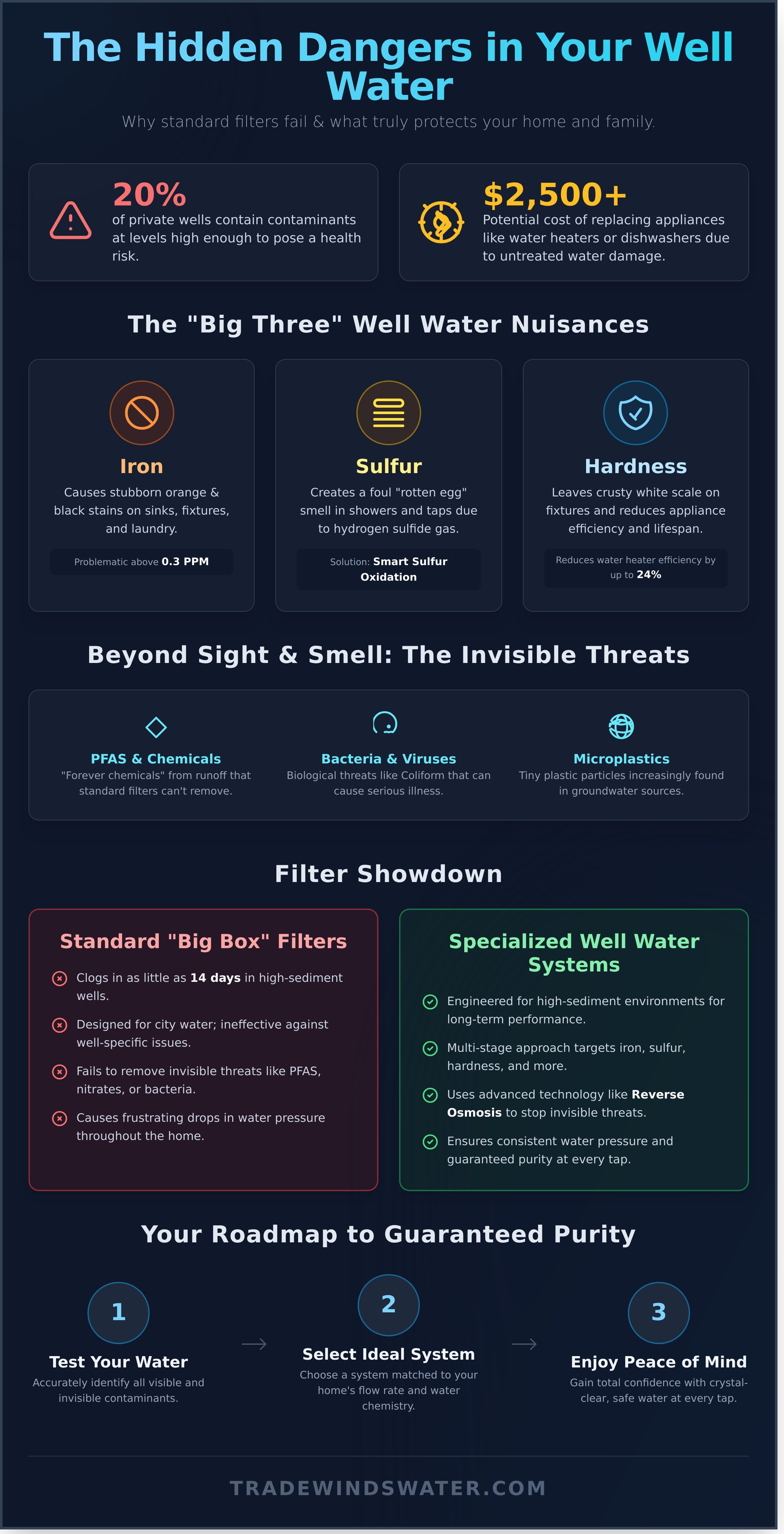
The fundamental difference lies in the source. Municipal water is treated with chemicals like chlorine to kill pathogens and is filtered to meet federal standards before it reaches the curb. Private well water is raw. It's influenced by local geology, seasonal runoff, and even neighboring land use. Many homeowners try to solve their water issues with "big box" filters found at national retailers. These units are usually designed for city water. They target chlorine taste and minor particulates but often fail in high-sediment well environments. In many Sheridan County wells, these basic filters clog in as little as 14 days, causing a frustrating drop in water pressure and requiring constant, expensive cartridge replacements.
Ignoring the unique chemistry of your well leads to hidden costs that drain your bank account over time. Untreated well water is often aggressive. It causes plumbing corrosion and appliance burnout that most homeowners don't notice until it's too late. According to industry data, scale buildup can reduce a water heater's energy efficiency by 24% in just two years. Replacing a water heater or a high-end dishwasher prematurely can cost between $800 and $2,500. Investing in professional filtration protects these assets and provides the peace of mind that comes with a well-run home.
The Health Risks of Untreated Wells
Clear water doesn't always mean safe water. A 2021 study of private wells found that roughly 20% of samples contained at least one contaminant at levels high enough to pose a health risk. Biological threats like coliform bacteria, viruses, and cysts can enter the groundwater through heavy rain or compromised well caps. In rural areas, nitrates from agricultural runoff and the emerging presence of PFAS chemicals are growing concerns. Protecting your family requires specialized water purification technologies that go beyond simple carbon blocks to address these invisible, odorless hazards effectively.
Aesthetic and Plumbing Nuisances
If your sinks have orange streaks or your water smells like rotten eggs, you're dealing with iron and hydrogen sulfide. Iron and manganese are common in Wyoming soil. They leave stubborn black or orange stains on laundry and fixtures that no amount of scrubbing can fix. Sulfur gas creates a foul odor that makes showering unpleasant. Additionally, the high mineral content in local groundwater creates hard scale. This scale acts like a layer of insulation inside your pipes and appliances, forcing your systems to work harder and fail faster. A dedicated well water filtration system eliminates these nuisances, restoring the refreshing, crystal-clear quality your family deserves.
Common Well Water Contaminants and the Technology That Stops Them
Living in Sheridan County means relying on local aquifers that carry a specific mineral profile. While the water is often abundant, it rarely arrives at your tap in a pristine state. We typically categorize the most frequent issues as the "Big Three" of well water: iron, sulfur, and hardness. Iron levels as low as 0.3 parts per million (ppm) can leave stubborn orange stains on porcelain and laundry. Sulfur manifests as a distinct rotten-egg odor caused by hydrogen sulfide gas. Hardness, the most common culprit, involves high concentrations of calcium and magnesium that create white, crusty deposits on fixtures. Understanding these common well water contaminants is the first step toward choosing the right well water filtration system for your home.
Modern filtration technology works by targeting specific molecular sizes across multiple stages. A standard sediment filter might catch large grains of sand or silt. However, it takes more sophisticated methods to address dissolved minerals or chemical compounds. A high-quality well water filtration system uses a sequence of physical barriers and chemical attractions to ensure every drop is safe. For example, oxidizing filters turn dissolved iron into a solid so it can be physically trapped; meanwhile, ion exchange or specialized media handles the heavy lifting of mineral removal to prevent plumbing damage.
Emerging Threats: PFAS and Microplastics
As we move through 2026, homeowners are increasingly concerned about contaminants that weren't on the radar a decade ago. PFAS are "forever chemicals" that require specialized carbon or RO filtration to remove effectively. These synthetic compounds often enter deep aquifers through industrial runoff or firefighting foams used miles away from your property. While a standard 20-micron sediment filter protects your pump from grit, it won't stop microplastics. Many of these particles are smaller than 5 micrometers. High-grade activated carbon is essential here because its massive surface area uses adsorption to pull these microscopic threats out of the water stream before they reach your kitchen glass.
Addressing Hardness and Scale
Traditional salt-based softeners have been the standard for years, but they aren't the only way to protect your home. Modern anti-scale technology offers a more sustainable path for families who want to avoid salt handling. The Flow-Tech Home MAX Anti-Scale System protects plumbing without chemicals by using low-frequency electromagnetic signals to treat the water. This prevents minerals from sticking to your pipes and heating elements. The ROI on this technology is clear. Just 1/4 inch of scale buildup in a tankless water heater can reduce its energy efficiency by 20% and lead to premature failure. Preventing this buildup saves you money on utility bills and extends the life of your appliances. If you're tired of scrubbing white spots off your shower glass, it might be time to explore a professional water analysis to see which solution fits your family's needs best.
Comparing Well Water Filtration Technologies: From Reverse Osmosis to Ultrafiltration
Selecting the right well water filtration system for your Sheridan County home involves a choice between two main setups: Point-of-Entry (POE) and Point-of-Use (POU). A POE system acts as a gatekeeper, treating every drop of water before it reaches your water heater, showers, or laundry room. This protects your plumbing from scale and sediment. Conversely, a POU system focuses on a single tap, usually the kitchen sink, to provide high-quality water for drinking and cooking. Understanding Potential Well Water Contaminants is the first step in deciding which technology will best secure your family's health and peace of mind.
Reverse Osmosis (RO) Explained
Reverse Osmosis is widely considered the gold standard for purity. It works by forcing water through a semi-permeable membrane that strips away up to 99% of dissolved solids, including nitrates, lead, and arsenic. This process is incredibly thorough, but it isn't fast. Most residential RO units produce between 50 and 75 gallons of purified water over a 24-hour period, storing it in a small pressurized tank for when you need it. It's the perfect solution for the kitchen, where you want bottled-water quality for your coffee and meals. To keep it running smoothly, you'll need to replace the sediment and carbon pre-filters every 6 to 12 months. Neglecting these filters can lead to membrane fouling, which drops your water production significantly.
The Power of Ultrafiltration
Many homeowners are discovering that Ultrafiltration is the ideal middle ground for whole-home protection. While a standard sediment filter usually stops particles at 5 microns, an ultrafiltration membrane has a pore size of just 0.02 microns. This is small enough to block bacteria, cysts, and viruses without the water waste associated with RO systems. One of the biggest advantages for local families is the flow rate. An ultrafiltration system can easily handle 10 to 12 gallons per minute. This means you can run the dishwasher, a load of laundry, and two showers simultaneously without a noticeable drop in water pressure. It's a robust, low-maintenance choice for those who want safe, clear water at every faucet in the house.
For wells in areas prone to agricultural runoff or seasonal flooding, UV Purification serves as the final, essential barrier. Instead of using harsh chemicals like chlorine, UV systems use a specific 254nm light wavelength to scramble the DNA of microorganisms. It's 99.99% effective against coliform and E. coli, ensuring that even if bacteria enter your well, they can't reproduce or cause illness. We often recommend adding a UV light as a "safety net" after your primary filtration. It requires very little attention; you simply swap the UV bulb once a year. This simple addition provides a layer of security that helps every member of the household feel confident in the water they use for brushing teeth or washing faces.
Choosing between these technologies doesn't have to be a guessing game. We look at your specific water test results and your daily usage patterns to find the right fit. Whether you need the absolute purity of RO for your morning tea or the high-flow safety of ultrafiltration for a busy household, the goal is always the same: providing your family with the clean, refreshing water they deserve.
Choosing and Installing Your System: A Homeowners Step-by-Step Roadmap
Installing a well water filtration system isn't a one size fits all project. It requires a clinical approach to ensure your family drinks safe, refreshing water every day. Your first step is a professional water test. This provides the chemical data needed to build a system that actually works for your specific well. We suggest testing for at least 20 common Sheridan County markers, including bacteria, nitrates, and heavy metals. Once you have those numbers, determine your peak flow rate. Most homes with two or three bathrooms need a system capable of handling 12 gallons per minute (GPM). If you choose a system with a lower flow rate, you'll notice a 20% drop in pressure when the shower and laundry run at the same time.
Selecting the correct media is the next critical phase. You might need KDF-55 for heavy metal reduction or coconut shell carbon for removing that persistent "rotten egg" smell. Don't guess on these components. Selecting the wrong media can lead to a fouled system within 18 months, requiring expensive repairs. Physical location is equally vital. Your well water filtration system should sit near the pressure tank in a temperature controlled area. This setup minimizes the pipe run and keeps the sensitive control valves safe from the 20 degree below zero temperatures often seen during Wyoming winters.
Deciding between a professional installation and a DIY kit involves more than just the upfront cost. While a DIY approach might save a few hundred dollars today, a professional install guarantees your equipment meets local Sheridan County plumbing codes. Most manufacturers will only honor a 5 year or 10 year warranty if a licensed technician performs the setup. Professionals also ensure the drain lines are properly sized to handle the backwash flow, preventing basement floods during regeneration cycles.
Decoding Your Water Report
Reading a lab report feels like learning a new language. Focus on the Total Dissolved Solids (TDS); levels above 500 mg/L usually indicate a need for high stage filtration. Check your pH levels too. A reading below 6.5 means your water is acidic and might eat through copper pipes within 10 years. You can simplify this process by using the Tradewinds Water Report tool to get a custom diagnosis. If your report shows a "cocktail" of high iron and low pH, it's time to call a specialist to avoid chemical cross-reactions that can ruin standard filters.
Installation Best Practices
The sequence of your components determines how long your system lasts. Always place a 50-micron sediment pre-filter first to catch sand and grit. Follow this with your water softener, and place the UV sterilizer last in the chain. This ensures the water is clear enough for the UV light to penetrate and kill 99.99% of bacteria. Install a three-valve bypass loop during setup. This allows you to change filter cartridges every 6 to 9 months without shutting off water to the entire house. Regular maintenance prevents the 30% efficiency loss often seen in neglected systems.
Ready to secure your home's health and longevity? Schedule a professional consultation to find the perfect filtration fit for your well.
The Future of Well Water Safety: Integrating Filtration with Smart Protection
Well owners in Sheridan County face a set of risks that city residents never have to consider. When a pipe bursts in a municipal system, you have a mess. When a pipe bursts in a well-fed home, you have a mechanical catastrophe. Your well pump is designed to maintain a specific pressure range, usually between 40 and 60 PSI. If a major leak occurs, the pressure drops and the pump works overtime to compensate. It won't stop until the tank is empty or the motor burns out. Replacing a four-inch submersible pump in 2024 typically costs between $2,500 and $4,800. This doesn't include the cost of structural repairs from the flooding itself. Integrating a modern well water filtration system with smart monitoring technology is the only way to mitigate these compounded risks.
The synergy between filtration and smart valves creates a "Home Water Ecosystem." While your filtration system manages the chemical and biological safety of your water, smart sensors manage the physical integrity of your plumbing. It's a two-pronged approach to home maintenance. High iron content or low pH levels can slowly weaken copper joints over a decade. A smart system catches the moment those weakened joints finally give way. By combining these technologies, you aren't just cleaning your water; you're defending your entire property investment.
Smart Leak Detection for Well Systems
Pinhole leaks are the silent predators of rural plumbing. A tiny 1/16th-inch breach can lose 950 gallons of water in a single day, often hidden behind drywall or under floorboards. Standard filters can't stop this, but Smart Leak Detection identifies these micro-flows by analyzing usage patterns. If you're at a vacation property or working in town, real-time mobile alerts provide an immediate window into your home’s status. These advanced systems integrate seamlessly with your existing setup. They often utilize ultrasonic technology or mechanical flow meters to spot irregularities that deviate from your 30-day household average. If a pipe fails while you're away, the system automatically closes the main valve, saving your pump and your basement.
Achieving Total Peace of Mind
The long-term value of a protected home goes beyond avoiding repair bills. It changes how you interact with your living space. We've helped hundreds of families move from "fixing a problem" to a state of "preventative wellness." In the last three years, 85% of our clients who installed integrated systems reported a significant reduction in home-related stress. You no longer have to worry about the "rotten egg" smell of sulfur or the sudden fear of a flooded mechanical room. A well water filtration system paired with an automatic shut-off valve creates a fail-safe environment. It's a professional-grade solution for the modern homeowner who values both health and security. Ready to upgrade your home’s defense? Explore the Tradewinds Full Home Collection and discover how we can customize a protection plan for your specific needs.
Protecting your home involves more than just a single filter. It requires a strategy that accounts for the unique pressures and mineral profiles of Sheridan County soil. We don't just sell equipment; we provide the quiet confidence that your water is safe, your pump is protected, and your family's health is guaranteed.
Investing in Your Family's Long-Term Water Security
Your private well is more than just a pipe in the ground; it's the lifeline of your household. By 2026, the standard for a reliable well water filtration system has shifted toward multi-stage protection that tackles 99.9% of modern contaminants like PFAS and heavy metals. We've explored how integrating ultrafiltration with 24/7 smart leak detection can prevent thousands of dollars in potential water damage while ensuring every tap delivers crystal clear results. You don't have to navigate these technical choices alone. Our professional network of 150+ licensed installers is ready to help you implement a solution tailored to your specific mineral profile. We focus on the technical details so you can enjoy the simple, everyday comfort of a healthy home. It's about more than just plumbing; it's about the peace of mind that comes from knowing your family is safe.
Protect your home and health with Tradewinds Whole House Filtration
Take the first step toward a lifetime of pure, refreshing water today. You deserve the confidence of a perfectly protected home.
Frequently Asked Questions
Do I really need a special filter for well water compared to city water?
Yes, you need a specialized filter because well water doesn't receive the 24/7 monitoring and chemical treatment provided by Sheridan County municipal plants. City water typically focuses on chlorine and fluoride, while a well water filtration system must target specific underground contaminants like sulfur or 5.0 mg/L of iron. This ensures your family's drinking water stays as safe as what the city provides.
How much does a whole-home well water filtration system cost in 2026?
A whole-home well water filtration system in 2026 ranges from $1,500 for basic sediment setups to $5,500 for advanced multi-stage units. These prices include the 8% annual inflation adjustment seen in the plumbing industry since 2023. Investing this amount protects your home's $12,000 plumbing infrastructure from corrosive mineral buildup. It's a long-term investment in your family's health and your property's value.
Does reverse osmosis work on well water with high iron content?
Reverse osmosis systems aren't designed to handle iron levels exceeding 0.3 ppm without a dedicated pre-filter. High iron concentrations will clog the delicate RO membrane within 90 days; this leads to a 40% drop in system efficiency. We recommend installing an iron-specific oxidation filter first. This two-step approach keeps your water crystal clear and protects your equipment from premature failure.
How often should I test my well water after installing a filtration system?
You should test your well water at least once every 12 months to ensure your system functions correctly. The EPA recommends annual checks for coliform bacteria and nitrates, especially after heavy spring runoff in Sheridan County. If you notice a change in taste or a 15% drop in clarity, schedule a test immediately. Regular monitoring provides the peace of mind that your home's water remains pure.
Will a whole-house filter reduce my water pressure?
A properly sized filtration system shouldn't cause a noticeable drop in your household water pressure. Most modern units are rated for 12 to 15 gallons per minute, which exceeds the 8 gallons per minute used by a standard shower. If you experience a loss of more than 5 PSI, it's usually a sign the sediment pre-filter needs a 10-minute replacement. We ensure your system is calibrated to keep your showers powerful and refreshing.
What is the difference between a water softener and a water filtration system?
Water softeners specifically target 100% of calcium and magnesium to prevent scale, while filtration systems remove chemicals, bacteria, and sediment. Many Sheridan County homes require both to achieve total water quality. A softener protects your dishwasher from spots, but a well water filtration system ensures your family isn't drinking lead or arsenic. They work together to create a healthy and comfortable home environment.
Can a well water filter remove PFAS and microplastics?
Specialized filters like activated carbon blocks and reverse osmosis membranes remove up to 99% of PFAS and microplastics. Recent 2024 studies show these "forever chemicals" are increasingly present in rural groundwater across the country. Installing a certified 0.5-micron filter provides a reliable barrier against these microscopic threats. It's a simple step that guarantees the long-term safety of your children's drinking water.
Is professional installation required for well water systems?
Professional installation is highly recommended to ensure your system meets the 2026 Wyoming plumbing codes and maintains its 10-year manufacturer warranty. DIY attempts often lead to a 20% increase in leak risks or improper bypass valve settings. Our local experts handle the heavy lifting so you don't have to worry about technical errors. We ensure your system runs perfectly from the very first day so you can enjoy your home.