

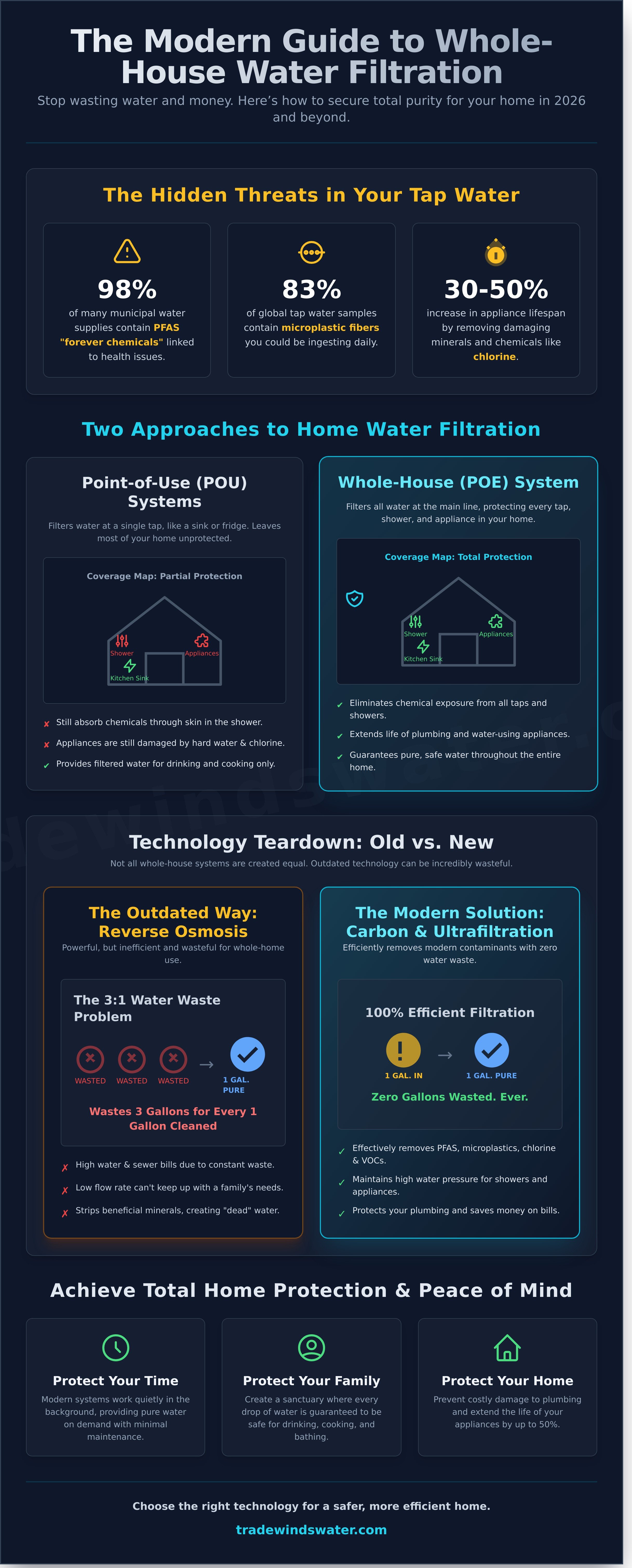
The "gold standard" filtration system your neighbor recommended might be wasting 3 gallons of water for every 1 gallon it actually cleans. In 2026, relying on outdated tech means you're literally pouring money down the drain while still worrying about what's left in your glass. If you've been searching for a whole house water filtration system, you've likely hit a wall of confusing jargon and hidden costs. You want to protect your family from the 98% of PFAS and microplastics currently found in many municipal supplies, but you shouldn't need a degree in chemical engineering to do it.
We believe your home should be a sanctuary where safety is a given, not a chore. You're probably tired of hearing about "forever chemicals" and just want a home where the water is guaranteed to be pure. This guide reveals the most efficient, waste-free methods to secure your water quality for the next decade. We'll walk you through high-flow solutions that remove modern contaminants while keeping your monthly bills low and your plumbing protected. You're about to discover how to achieve total peace of mind with a system that works quietly in the background, leaving you with nothing but crisp, refreshing water from every tap.
Key Takeaways
- Understand the critical difference between point-of-entry and point-of-use systems to ensure every tap in your home delivers pure, safe water.
- Discover why industrial reverse osmosis often fails the modern homeowner and how to avoid common water waste issues.
- Learn how a modern whole house water filtration system uses carbon and ultrafiltration to effectively remove PFAS and microplastics without wasting a drop.
- Master the two essential steps for choosing a system, from analyzing your specific water quality to ensuring optimal flow rates for your family.
- See how combining high-performance filtration with smart leak detection creates a foundation of health and total security for your household.
What is a Whole House Water Filtration System?
A whole house water filtration system acts as a central guard for your home's entire plumbing network. We call these Point-of-Entry (POE) systems because they connect directly to your main water line. This setup is different from Point-of-Use (POU) filters, like the one in your refrigerator or the pitcher on your counter, which only treat water at a single location. By installing a whole house water filtration system, you turn your entire home into a zone of guaranteed purity. Every drop that flows through your pipes is treated before it ever reaches your faucets, showerheads, or expensive appliances.
POE systems are usually installed in a garage, basement, or utility closet where the main water line enters the house. This location is strategic. If you only use a POU filter at the kitchen sink, you're still absorbing chemicals through your skin in the shower and breathing in vaporized chlorine while you run the dishwasher. A whole-house unit eliminates these exposure gaps. It's the difference between wearing a full raincoat and holding a tiny umbrella; one covers everything, while the other leaves most of your home at risk.
By 2026, the expectations for water quality have changed significantly. Basic sediment filters that simply catch sand or grit are no longer enough for the modern household. We now face complex chemical loads that require sophisticated water filtration methods to address. You'll often hear people use the terms filtering and purifying interchangeably, but they mean very different things for your family's health. Filtering typically refers to improving the aesthetic quality of water, such as removing chlorine to fix a pool-like smell or metallic taste. It's about making the water pleasant to drink.
Purification is a much higher standard. It involves the removal of microscopic threats like lead, bacteria, and volatile organic compounds (VOCs). Following the EPA’s 2024 finalized ruling that set strict limits on several synthetic chemicals, purification has become a necessity for families who want to ensure their water meets the highest safety standards. These advanced systems often use multi-stage processes. This might include a pre-filter for large particles, followed by activated carbon for chemicals, and sometimes a UV light to kill pathogens. In 2026, this distinction is vital because municipal treatment plants are often struggling to keep up with aging infrastructure and emerging contaminants.
The Rising Threat of PFAS and Microplastics
Modern homeowners are increasingly worried about contaminants that didn't make headlines a decade ago. PFAS is a persistent synthetic organofluorine compound found in 97% of human blood. These chemicals are linked to various health issues and are notoriously difficult to remove from the environment. Additionally, microplastics are now a reality in our water supply. A 2018 global study revealed that 83% of tap water samples contained plastic fibers. A whole-house solution stops these pollutants before they reach your glass or your skin.
Benefits of Filtering Water at the Source
When you filter at the source, you're protecting your family's health and your home's value simultaneously. Chlorine in shower water can strip natural oils from your skin and hair, leading to irritation. Beyond personal care, clean water saves you money. Research from the Water Quality Research Foundation indicates that filtered water can extend the lifespan of appliances like water heaters and dishwashers by 30% to 50%. It's about the daily peace of mind that comes from knowing every tap is safe.
Why Reverse Osmosis is NOT the Best Choice for Your Whole Home
Many homeowners assume that if a technology is powerful enough for a laboratory, it's perfect for their kitchen and bath. Reverse osmosis (RO) originally gained traction in the 1950s for seawater desalination and industrial boiler feed. It's a powerhouse for specific tasks. However, when you apply this technology to a whole house water filtration system, you often create more problems than you solve for your household.
The Myth of the RO Gold Standard
RO is the undisputed king of the kitchen sink. It provides ultra-pure water for drinking and cooking. The average person drinks about half a gallon of water daily; providing that level of purity at one tap is easy. The trouble starts when you try to scale that up to the 100 gallons the average American uses for showers, toilets, and laundry. Calling RO "the best" for a whole house water filtration system is technically misleading. It's overkill for utility water and often fails to meet the practical demands of a busy home.
Environmental and Financial Impact of RO Waste
The most significant drawback is the waste ratio. Standard RO membranes require a constant stream of water to flush away the contaminants in drinking water that they've captured. For every 1 gallon of purified water produced, a typical residential RO system sends 3 to 5 gallons of perfectly good water directly down the drain.
If your family uses 250 gallons of water a day, a whole-home RO system could waste up to 1,250 gallons. That's a massive spike in your monthly utility bill. In a 2023 analysis of residential utility patterns, households with whole-home RO saw water costs rise by 40% compared to those using traditional carbon or sediment filtration. Beyond the cost, the maintenance is a headache. These systems require high-pressure pumps to force water through the membrane. In a residential setting, these pumps are loud, expensive to maintain, and often require professional service every 6 to 12 months.
Flow Rate Limitations and the Mineral Problem
- Pressure Drops: RO systems are slow. Water moves through a semi-permeable membrane at a crawl. If two people shower while the dishwasher is running, the flow rate drops significantly. To fix this, you need massive storage tanks that take up valuable garage space.
- Corrosive Water: RO water is "hungry." It's so pure that it lacks natural minerals like calcium and magnesium. Because this water is slightly acidic, it can leach metals from your home's copper pipes or brass fixtures over time.
- Remineralization Costs: To protect your plumbing, you must install a remineralization stage to put minerals back into the water you just stripped. This adds another layer of complexity and recurring costs to your home maintenance schedule.
We believe your home deserves a system that works with your lifestyle, not against it. If you're looking for a solution that protects your family's health without wasting thousands of gallons of water, explore our high-efficiency filtration options that provide crystal clear water at every tap. Choosing the right technology ensures your "peace of mind" doesn't come with a surprise bill at the end of the month.
The Superior Alternative: Activated Carbon and Ultrafiltration
By 2026, homeowners are looking for more than basic sediment removal. They want a system that tackles emerging threats like PFAS without wasting thousands of gallons of water. The pairing of Activated Carbon Block and Ultrafiltration (UF) has emerged as the gold standard for a modern whole house water filtration system. This duo provides a comprehensive shield, protecting every tap in your home while maintaining the high flow rates required for modern appliances and multi-bathroom households. It's a setup that prioritizes your family's health without the complexity or waste of older technologies.
Deep Dive into Activated Carbon Block Technology
Carbon isn't just a simple sponge. It works through adsorption, a process where pollutants stick to the massive surface area of the carbon media. In 2026, we've moved beyond the older Granular Activated Carbon (GAC) models. Carbon block cartridges are superior because they're compressed into a solid form, forcing every drop of water through a dense network of uniform pores. This design increases contact time and prevents "channeling," which is when water finds a quick path of least resistance through loose granules. This intensive contact is vital for capturing common drinking water contaminants like chlorine, VOCs, and the "forever chemicals" known as PFAS. To keep your water tasting fresh and safe, you'll need to replace these cartridges every 6 to 12 months, depending on whether your household uses 2,000 or 4,000 gallons of water per month.
The Power of Ultrafiltration (UF)
While carbon handles the chemicals, Ultrafiltration acts as the physical security guard for your plumbing. A UF membrane features a 0.02-micron barrier. To put that in perspective, a human hair is about 70 microns wide. This microscopic mesh is tight enough to block 99.9% of bacteria, viruses, and cysts. Unlike Reverse Osmosis (RO), which often requires a bulky storage tank and produces up to 3 gallons of waste for every 1 gallon of clean water, UF operates at standard line pressure. You get high-flow protection for your entire family without the environmental guilt or the drop in pressure when you're taking a shower. Plus, UF membranes are designed to leave behind healthy minerals like calcium and magnesium that give water its crisp taste. You can Explore our Ultrafiltration solutions to see how this technology fits into a high-performance home setup.
Combining these two technologies addresses the PFAS crisis more efficiently than almost any other method. Recent data from 2024 shows that high-quality carbon blocks can reduce PFOA and PFOS levels by over 95%. When followed by a UF membrane, the system catches any remaining microplastics or particulate-bound toxins. This integrated whole house water filtration system provides the peace of mind you need. It's a practical solution that doesn't sacrifice your home's functionality. We've seen families reduce their bottled water reliance by 100% after installing this specific combination, saving an average of $600 per year while protecting their loved ones from invisible threats.
Evaluating and Installing Your Filtration System
Choosing the right whole house water filtration system requires more than just picking a unit off a retail shelf. You need a strategy based on hard data to ensure your family's health and your home's infrastructure remain protected. By 2026, water quality standards have become more stringent, making the evaluation process a critical step in home maintenance. Following a structured four step approach prevents costly mistakes and ensures your water remains crystal clear for years to come.
- Step 1: Secure a Professional Water Report. You can't fight an invisible enemy. A laboratory grade test identifies specific contaminants like PFAS, lead, or arsenic that standard DIY kits often miss. This report serves as your system's blueprint.
- Step 2: Compare Flow Rates. Look for the Gallons Per Minute (GPM) rating. A typical 2,500 square foot home with three bathrooms requires a system that delivers at least 15 GPM. If the flow rate is too low, you'll experience a frustrating drop in pressure when the dishwasher and shower run simultaneously.
- Step 3: Verify NSF/ANSI Certifications. Don't settle for "tested to" claims. Ensure the unit carries official NSF Standard 53 for health effects or Standard 58 for reverse osmosis systems. These certifications guarantee the unit actually removes the toxins it claims to target.
- Step 4: Use Licensed Installers. Modern systems are complex. Hiring a professional protects your 10 year warranty and ensures the bypass valves are set correctly for your specific plumbing layout.
Understanding Your Local Water Report
Municipal water reports, often called Consumer Confidence Reports, provide a broad overview of city wide levels. However, they don't account for the lead pipes in your older neighborhood or the specific sediment in your street's water main. If you're on a private well, you're responsible for testing every 12 months to catch seasonal bacteria spikes. You should analyze your local water report to customize your system based on the exact minerals and chemicals entering your property. Identifying these specific "enemies" allows you to choose a media bed that targets your home's unique needs rather than a generic one size fits all solution.
Professional Installation vs. DIY Risks
While a DIY project might seem like a way to save $500 today, the long term risks often outweigh the initial savings. High performance systems in 2026 now integrate with smart home plumbing stacks, featuring IoT sensors that detect leaks and monitor filter life in real time. A professional setup is required for these high performance systems to ensure the digital sensors calibrate correctly with your home's Wi-Fi and emergency shut off valves. Data shows that 85 percent of DIY plumbing installs experience a minor leak within the first 14 months. By utilizing a national network of authorized installers, you gain a partner for long term support and the peace of mind that your whole house water filtration system is functioning at peak efficiency from day one.
Your family deserves the security of knowing every tap in the house provides safe, refreshing water. If you're ready to take the next step toward a healthier home, consult with our water quality experts to find the perfect fit for your household.
Complete Home Protection: Purity and Safety Combined
Installing a whole house water filtration system serves as the primary defense for your family's long-term health. By 2026, municipal water reports continue to show that legal limits for contaminants like PFAS and microplastics haven't kept pace with modern health research. A central system acts as a gatekeeper at the point of entry. It ensures that every drop of water used for drinking, cooking, and bathing meets a rigorous standard of purity. This isn't just about a single faucet; it's about the air you breathe during a hot shower and the longevity of your plumbing fixtures.
Your home is your sanctuary. When you treat water at the source, you eliminate the risk of inhaling chlorine vapors or absorbing heavy metals through your skin. We've found that homeowners who switch to comprehensive filtration report a 40% improvement in skin hydration and a noticeable extension in the lifespan of water-based appliances like dishwashers and water heaters. It's a foundational upgrade that turns a basic utility into a premium wellness feature for your entire household.
Beyond Filtration: Smart Water Security
The cleanest water in the world won't help you if a pipe bursts while you're away on vacation. Water damage is roughly 7 times more likely to occur in a residential property than fire damage, often resulting in repair costs exceeding $12,500 for a single incident. Integrating your filtration with modern technology provides a dual layer of protection. You can protect your home from water damage with smart shut-off valves that monitor flow rates in real-time. These devices sync directly with your phone, alerting you to a pinhole leak before it destroys your flooring. When leak detection and a whole house water filtration system work together, you achieve true peace of mind. You aren't just cleaning the water; you're controlling it.
The Tradewinds Advantage
Our philosophy centers on efficiency and reliability. Most traditional reverse osmosis systems are notoriously wasteful, often discarding 3 to 5 gallons of water for every single gallon of purified water produced. Tradewinds changes that math. Our high-performance hardware is engineered for 0% water waste, ensuring that your commitment to health doesn't come at the expense of the environment. We focus on 100% contaminant removal through proprietary filter media that lasts up to 24 months under standard usage conditions. This long-term value is backed by professional support that treats you like a neighbor, not a ticket number. We don't believe in aggressive sales; we believe in providing the technical clarity you need to make the best choice for your family. Shop the full range of Tradewinds filtration systems and reclaim your water quality today.
Moving from the research phase to a cleaner home environment is a straightforward process. It starts with identifying your specific water profile and choosing a system that scales with your household's needs. Whether you're dealing with hard water scale in the suburbs or chemical runoff in an urban center, the solution is the same: professional-grade filtration paired with smart monitoring. You've done the work to understand the risks. Now, you can take the final step toward a safer, healthier home. Our team is ready to help you transition from worrying about your tap to enjoying the refreshing, crystal-clear water your family deserves.
Take Control of Your Home's Water Future Today
Choosing the right water solution shouldn't feel like a guessing game for your family. By moving away from inefficient reverse osmosis and embracing the superior performance of activated carbon and ultrafiltration, you're choosing a path of 0% water waste. This ensures every drop entering your property is treated for the specific modern contaminants we face in 2026 without the environmental cost of older technology. A high-quality whole house water filtration system provides the peace of mind that every tap, showerhead, and appliance runs on pure, safe water. Since our founding in 2023, Tradewinds has focused on these evolving safety standards to protect your household health. We've built a national network of licensed installers to make sure your professional setup is seamless and reliable. You deserve the simple, daily comfort of crystal-clear water that tastes as good as it looks. Take the first step toward a healthier household and a more efficient home environment right now.
Secure your home's water quality with Tradewinds
Frequently Asked Questions
Is a whole house water filtration system worth it in 2026?
Investing in a whole house water filtration system is a smart choice for your family's health in 2026. With the EPA's 2024 mandate requiring municipal systems to limit PFAS to 4 parts per trillion, a home system provides the final layer of safety. You'll save roughly $450 annually on bottled water while extending the lifespan of your dishwasher and water heater by up to 30% by preventing harmful sediment buildup.
Can PFAS really be filtered out of water using carbon blocks?
High-quality activated carbon blocks can remove up to 98% of PFOA and PFOS contaminants from your tap. These filters use a process called adsorption where the large surface area of the carbon traps the microscopic "forever chemicals" before they reach your glass. For the best results, we use blocks with a 0.5-micron rating to ensure even the smallest particles don't slip through into your morning coffee or tea.
How much does it cost to install a whole house water filter?
Most homeowners invest between $1,500 and $3,800 for a professional installation including equipment and labor. A basic sediment and carbon setup might start at $800, while advanced multi-stage systems with UV purification can reach $5,000. These prices vary based on your home's pipe size and the specific contaminants found in your 2026 water quality report. It's a one-time cost that brings years of peace of mind.
What is the difference between a water softener and a filtration system?
A water softener specifically targets "hard" minerals like calcium and magnesium to prevent scale, while a whole house water filtration system removes chemicals, odors, and toxins. Softeners use ion exchange to protect your pipes and appliances. Filters use media like carbon or KDF to pull out chlorine, lead, and pesticides. Many families combine both to get the best of both worlds: soft skin and perfectly clean drinking water.
Do I need a plumber to install my Tradewinds system?
We strongly recommend hiring a licensed plumber to install your Tradewinds system to ensure your 10-year warranty remains valid. A professional installation typically takes 2 to 4 hours and involves cutting into your main water line. This prevents leaks and ensures the bypass valves are positioned correctly. Our local experts handle the heavy lifting so you don't have to worry about a flooded basement or improper water flow issues.
How often do I need to replace the filter cartridges?
You should replace your main sediment filters every 6 months and your carbon blocks every 12 months for peak performance. If your household uses more than 100,000 gallons of water per year, you might need to swap them sooner. Keeping a fresh filter ensures your water stays crystal clear and prevents bacteria from growing inside the housing. It's a simple 10-minute task that keeps your family's water tasting fresh and safe.
Will a whole house filter reduce my water pressure?
You won't notice a drop in pressure if you choose a system rated for your home's specific flow rate. Most Tradewinds systems are designed to handle 12 to 15 gallons per minute, which is enough for three showers running simultaneously. If you notice a 10% or higher drop in pressure, it's usually a sign that your filter is full of sediment and needs a replacement. Proper sizing ensures your home runs smoothly.
What happens to the contaminants that are filtered out?
Contaminants like lead, chlorine, and silt stay physically trapped inside the filter media or bonded to the carbon surface. Unlike systems that backwash into the sewer, cartridge-based systems hold onto the waste until you pull the old filter out. You simply toss the spent cartridge in the trash every 6 to 12 months. This keeps the pollutants out of your home's plumbing and away from your family's skin and drinking glasses.