

The most expensive water treatment system in your neighborhood might actually be the one providing the least health benefits. While many homeowners assume that high-priced reverse osmosis is the ultimate solution, this technology, originally designed for industrial desalination, often produces acidic "dead water" with a pH below 7.0. Determining the whole house water filter system cost 2026 requires looking beyond the price tag to find a solution that keeps essential minerals like calcium and magnesium where they belong: in your glass.
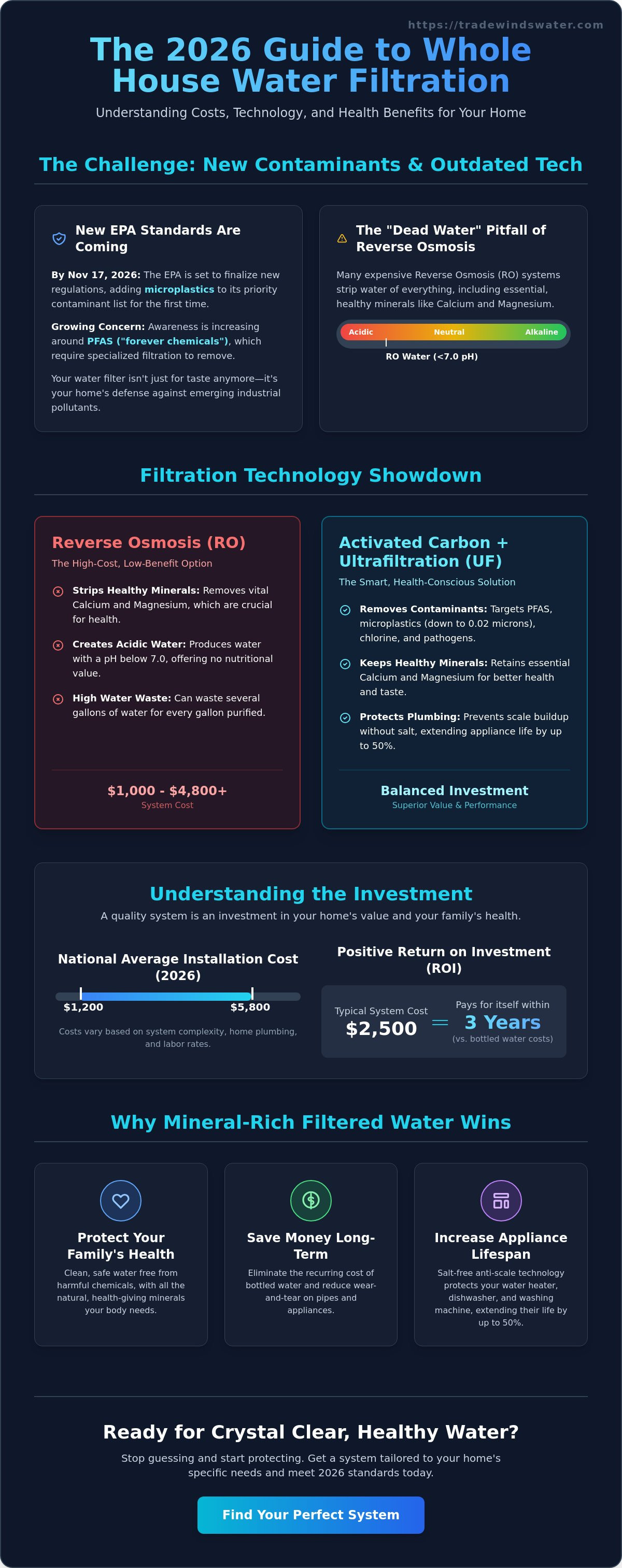
It's natural to feel concerned about toxic PFAS or the microplastics the EPA is adding to its priority list by November 17, 2026. You deserve peace of mind and crystal clear water without the high maintenance costs of outdated technology. This guide breaks down the national average installation range of $1,200 to $5,800 and explains how a $2,500 investment typically pays for itself within three years compared to the expense of bottled water. You'll discover why the combination of activated carbon block cartridge filters and Ultrafiltration offers the best protection for your family's health and your home's plumbing while maintaining the water's vital nutritional value.
Key Takeaways
- Learn how new 2026 EPA standards for PFAS and microplastics impact your choice of home filtration technology.
- Break down the whole house water filter system cost 2026 to see how a professional installation adds long-term value to your property.
- Discover why the pairing of activated carbon block cartridge filters and Ultrafiltration provides superior safety without creating acidic "dead water."
- Explore how mineral-rich filtration protects your family’s health and extends the life of your appliances by up to 50%.
- Master the two essential steps to sizing a system correctly for your home's specific plumbing and peak water usage.
Understanding the 2026 Market for Whole House Water Filtration
Whole house filtration serves as a comprehensive barrier that treats every drop of water entering your home. Unlike small pitchers or faucet filters, which are point-of-use (POU) systems, a point-of-entry (POE) setup ensures that the water you use for bathing, laundry, and drinking is consistently clean. In 2026, the value proposition of these systems has shifted. Homeowners no longer view filtration as a luxury but as a necessary defense against aging infrastructure and emerging contaminants. When evaluating the whole house water filter system cost 2026, it's vital to consider the protection provided at every tap versus the limited reach of cheaper, localized filters.
Regulatory changes are also reshaping the market. The EPA's development of the Sixth Contaminant Candidate List (CCL 6), which includes microplastics as a priority for the first time, is expected to be finalized by November 17, 2026. This federal focus, combined with the February 17, 2026, deadline for Clean Water Act revisions, has pushed homeowners to seek advanced water filtration methods that can handle more than just basic chlorine. You aren't just buying a filter; you're investing in a system designed to meet the rigorous safety standards of a new era in water quality.
The Shift Toward Holistic Water Health
Many families are moving away from Reverse Osmosis (RO) because it produces what experts call "dead water." Originally designed for commercial desalination, RO strips away everything, including the essential minerals your body needs. This process results in acidic water with a pH level below 7.0, offering no nutritional health benefits. 2026 homeowners prioritize mineral retention, ensuring that calcium and magnesium remain in their supply. For a deeper look at these shifts, see The Ultimate Guide to Whole House Water Filtration Systems in 2026. A holistic approach focuses on removing toxins while keeping the water's natural, healthy structure intact.
Contaminants Driving Costs in 2026
The primary drivers of the whole house water filter system cost 2026 are specialized media and advanced membranes. Removing PFAS, often called "forever chemicals," requires high-grade activated carbon block cartridge filters. These components have seen price adjustments as demand for high-capacity PFAS removal grows. Additionally, the need to capture microplastics has made Ultrafiltration a standard requirement for modern homes. These systems use fine membranes to block microscopic particles that standard filters miss. To see which specific contaminants are affecting your area, you should check your local water report. Understanding your specific water profile helps you avoid overpaying for features you don't need while ensuring your family stays protected from the chemicals that are actually present.
Breaking Down Whole House Water Filter System Costs by Technology
The whole house water filter system cost 2026 depends heavily on the filtration technology you choose to protect your family. Homeowners today are moving away from one-size-fits-all solutions in favor of systems that target specific contaminants like PFAS without ruining the water's natural chemistry. While some technologies appear cheaper upfront, their long-term operational costs and impact on your health tell a different story. Choosing the right setup means balancing initial hardware prices with the ongoing value of mineral-rich, alkaline water at every faucet.
Ultrafiltration (UF) has emerged as a leader in cost-efficiency for 2026. Unlike traditional sediment filters that only catch large particles, UF membranes provide a physical barrier down to 0.02 microns. This level of precision captures pathogens and microscopic debris that standard systems miss. When you pair this with activated carbon block cartridge filters, you create a robust defense system. This combination is often more affordable than high-end salt-based softeners, which require monthly salt purchases and heavy maintenance. Many families now prefer salt-free anti-scale technology to protect their plumbing without the "slippery" feel or environmental burden of salt discharge.
The High Price of "Dead Water": The RO Pitfall
Reverse Osmosis (RO) systems often range between $1,000 and $4,800, but they carry hidden biological and financial costs. This technology was originally created for commercial desalination, not for daily residential use. RO is notoriously inefficient; it can waste three to five gallons of water for every single gallon of filtered water produced. This waste drives up utility bills and strains local resources. More importantly, RO creates "dead water." By stripping away every mineral, it leaves the water acidic with a pH level below 7.0. This acidity can actually leach metals from your home's copper pipes, potentially introducing new toxins into your supply. Because it lacks the calcium and magnesium your body needs, RO water offers no real health benefits to your household.
The 2026 Gold Standard: Carbon Block & Ultrafiltration
For those seeking the best price-to-performance ratio, the pairing of activated carbon block cartridge filters and Ultrafiltration is the modern benchmark. This setup doesn't just remove odors and chlorine; it's specifically designed to tackle modern threats like PFAS while keeping the water's nutritional value intact. Unlike RO, this method maintains a healthy alkalinity, which is better for your body and your home's infrastructure. You get the peace of mind that comes with 0.02-micron filtration without the "dead water" drawbacks. If you want to ensure your home has the highest quality supply, you can explore professional filtration options that prioritize both safety and mineral balance.
Installation and Maintenance: The Real Cost of Ownership
Understanding the whole house water filter system cost 2026 requires looking past the initial purchase. While hardware is the foundation, professional installation typically ranges from $1,200 to $5,800 depending on the complexity of your home's plumbing. Factors like pipe material, specifically whether you have older copper or modern PEX, and the physical location of the main water line can shift labor costs. If your system requires a power source for smart monitoring, an electrician might be needed, adding to the total setup fee. Using a licensed, authorized installer isn't just about safety; it's often a requirement to keep your warranty valid.
Annual maintenance is where the savings of holistic systems shine. Traditional salt-based softeners require you to lug heavy bags of salt every month, with comprehensive maintenance costs ranging from $150 to $500 per year. In contrast, systems using activated carbon block cartridge filters and Ultrafiltration membranes are much simpler. You typically only need to swap cartridges once or twice a year. This keeps your maintenance budget predictable while ensuring your water remains mineral-rich and free from PFAS. By avoiding the water waste associated with desalination technologies like RO, you also save on monthly utility bills.
Professional Setup vs. DIY
It's tempting to try a weekend DIY project, but professional installation is vital for high-flow whole-home systems. A minor plumbing error can lead to significant pressure drops, leaving your upstairs shower with a weak trickle. Experts ensure the system is sized correctly for your home's peak flow rate and that all connections are secure. For those living in rural areas, the setup may involve additional stages to handle sediment or sulfur. Professional guidance ensures your filtration strategy addresses the specific contaminants found in your water supply without compromising your home's infrastructure.
Protecting Your Investment with Smart Technology
Modern 2026 systems often integrate leak detection systems to provide total home security. While these add to the initial whole house water filter system cost 2026, they offer immense value. An automatic water shut off valve can detect a pinhole leak and close the main line instantly. This technology doesn't just prevent water damage; many insurance providers offer premium discounts for homes with these safety features. Smart monitoring also tracks your flow rates and filter life in real time, so you never have to guess when it's time for a maintenance check. This proactive approach turns a simple filter into a complete home health and security hub.
Health Benefits and ROI: Why Mineral-Rich Water Wins
Investing in your home's water quality provides a return that goes far beyond the initial whole house water filter system cost 2026. One of the most significant financial gains comes from protecting your infrastructure. Hard water and chemical contaminants take a heavy toll on appliances. By installing a holistic filtration system, you can extend the lifespan of your water heater, dishwasher, and washing machine by 30% to 50%. This prevents premature equipment failure and keeps your home running efficiently. For a family of four, the savings on bottled water alone, which typically ranges from $800 to $1,500 annually, means a standard system often pays for itself in just three years.
The "Health ROI" is equally compelling. Unlike systems that strip away everything, holistic filtration maintains essential minerals like calcium and magnesium. These elements are vital for cardiovascular health and bone strength. When you choose a system that preserves these nutrients, you aren't just drinking water; you're supporting your family's daily wellness. Additionally, a certified PFAS removal system significantly boosts home resale value. In the 2026 real estate market, buyers prioritize homes with documented protection against "forever chemicals" and microplastics, making your filtration system a powerful selling point.
The Acidity Argument: RO vs. Holistic Filtration
Many people mistake "pure" water for healthy water. Reverse Osmosis systems use desalination technology to remove every particle, which results in a "flat" taste and a lack of character. More importantly, this process creates acidic water with a pH level below 7.0. Your body thrives on a balanced, slightly alkaline diet. Mineral-rich water from a combination of activated carbon block cartridge filters and Ultrafiltration tastes refreshing because it retains the natural elements that give water its structure. It's the difference between drinking processed, "dead water" and enjoying a crisp, healthy supply at every tap.
Eradicating PFAS and Forever Chemicals
Protecting your family from modern contaminants requires specific technical solutions. Activated carbon block cartridge filters are the industry standard for capturing PFAS and other synthetic chemicals that traditional filters miss. This technology provides the peace of mind that comes from knowing your children are bathing in and drinking water free from pathogens and industrial runoff. You can browse the Tradewinds collection to find systems specifically engineered for certified contaminant removal. Ensuring your water is safe shouldn't mean sacrificing its nutritional value. If you're ready to upgrade your home's health, you can get started with a professional water solution today.
How to Choose the Right System for Your Budget and Home
Selecting the right filtration setup shouldn't feel like a guessing game. To secure the most accurate whole house water filter system cost 2026, you must start with a diagnosis of your specific water chemistry. A one-size-fits-all approach often leads to overpaying for unnecessary stages or, worse, missing critical contaminants like PFAS. By following a structured selection process, you can ensure your investment provides the mineral-rich, safe water your family deserves.
- Step 1: Conduct a comprehensive water test. You can't fix what you haven't identified. Start by checking your local water report or performing an on-site test to see if you're dealing with high chlorine, heavy metals, or specific industrial chemicals.
- Step 2: Calculate your peak flow rate. Sizing is critical. Measure your needs in Gallons Per Minute (GPM). A standard home with three bathrooms typically requires a flow rate of 12 to 15 GPM to ensure no pressure drops when multiple showers are running.
- Step 3: Prioritize 0.02-micron Ultrafiltration. In 2026, standard sediment filters aren't enough to catch microplastics. Insist on Ultrafiltration technology that provides a physical barrier against pathogens and microscopic debris.
- Step 4: Insist on a salt-free approach. Protect your health and the environment by choosing anti-scale technology instead of salt-based softeners. This keeps beneficial minerals in your water and prevents the discharge of brine into local ecosystems.
Evaluating System Longevity
When comparing the whole house water filter system cost 2026, look closely at the warranty terms. A high-quality system should offer robust coverage on tanks and valves, which are the heart of the unit. Be wary of generic "one-size-fits-all" filters. Systems that use proprietary activated carbon block cartridge filters ensure consistent performance because the components are engineered to work together. Additionally, Made-in-USA hardware often provides better long-term reliability and easier access to replacement parts, saving you from the frustration of a system that becomes obsolete in just a few years.
Final Checklist Before You Buy
Before you sign a contract or click "purchase," run through this final safety and value check. First, confirm the system does not use Reverse Osmosis for whole-home use. You want to avoid the "dead water" and acidity issues that come with desalination tech. Second, verify the inclusion of high-grade activated carbon block filters to handle chemical tastes and odors. Finally, ask about smart leak detection integration. Having a system that can automatically shut off your water during a pipe failure adds a layer of home security that pays for itself in peace of mind and potential insurance savings.
Securing Your Home's Health and Safety for the Future
Choosing a filtration system is about more than just numbers on a quote. It's about ensuring every shower and every glass of water supports your family's long-term wellness. By moving away from acidic, "dead water" technologies like reverse osmosis and embracing a holistic approach, you keep essential minerals like calcium and magnesium in your home's supply. The whole house water filter system cost 2026 represents a smart investment that pays for itself through increased appliance longevity and the elimination of expensive bottled water.
You now have the tools to choose a system that combines certified PFAS removal technology with 0.02-micron Ultrafiltration. These advanced solutions don't just clean your water; they protect your entire household by integrating with smart leak detection to prevent catastrophic damage. It's time to stop worrying about what's in your tap and start enjoying the peace of mind that comes with guaranteed purity and healthy alkalinity.
Take the next step toward a healthier, more secure home. View our 2026 Whole House Filtration Systems to find the perfect fit for your family. You're making a choice that prioritizes health, protects your plumbing, and brings the refreshing taste of mineral-rich water to every tap.
Frequently Asked Questions
How much does a whole house water filter system cost in 2026?
The national average whole house water filter system cost 2026 typically ranges from $1,200 to $5,800. This estimate includes the filtration unit and professional labor, though a typical homeowner spends approximately $2,500 for a standard installation. Your final price depends on the specific contaminants in your supply and the complexity of your home's plumbing layout. Annual maintenance for these systems generally adds $50 to $200 for routine cartridge replacements.
Is a whole house water filter better than Reverse Osmosis?
A whole house system is significantly better for residential health because it provides mineral-rich water without the "dead water" issues of Reverse Osmosis. RO technology was originally created for commercial desalination and strips away healthy minerals like calcium and magnesium. This process creates acidic water with a pH level below 7.0. A holistic system using Ultrafiltration keeps your water alkaline and healthy while protecting every tap in your home.
How often do I need to replace the filters in a whole house system?
You generally need to replace activated carbon block cartridge filters every 6 to 12 months. This frequency depends on your household's total water consumption and the level of sediment in your local supply. Ultrafiltration membranes are much more durable and often last between 3 and 5 years before they need to be swapped. Staying on top of this schedule ensures your water pressure remains high and your filtration stays effective.
Will a whole house filter remove PFAS and forever chemicals?
Systems equipped with high-grade activated carbon block cartridge filters are the industry standard for removing PFAS and other "forever chemicals." When you combine this technology with Ultrafiltration, you get a barrier that captures contaminants as small as 0.02 microns. This technical pairing is the most effective way to ensure your family is protected from modern industrial runoff and synthetic chemicals at every faucet in your home.
Does a whole house water filter reduce water pressure?
A correctly sized filtration system won't cause a noticeable drop in your home's water pressure. It's vital to calculate your peak flow rate in Gallons Per Minute (GPM) based on your bathroom count before installation. Most modern systems are engineered to handle high-demand households, allowing you to run multiple appliances simultaneously. If you experience a pressure drop, it's often a sign that the filters are full and need a routine change.
What is the difference between a water softener and a whole house filter?
A whole house filter targets chemical toxins and pathogens, while a water softener specifically manages mineral hardness to prevent scale. In 2026, many families choose salt-free anti-scale systems instead of traditional salt softeners. This approach protects your pipes and water heater without the high maintenance of salt bags or the slippery feel of softened water. Combining these technologies provides the ultimate balance of safety and plumbing protection.
Do I need a plumber to install a whole house water filtration system?
Professional installation by a licensed plumber is highly recommended to ensure your system functions safely and your warranty stays valid. Experts can correctly integrate the unit into your main water line and install smart leak detection systems for added security. While some homeowners consider DIY, a professional ensures there are no cross-connections or pressure issues. This expert setup provides long-term peace of mind and prevents potential water damage.
Can a whole house filter system increase my home value?
A certified whole house filtration system is a valuable asset that can increase your home's resale appeal in the 2026 market. Buyers today are more aware of water quality issues like PFAS and microplastics than ever before. Providing a home that already features "plug-and-play" protection and mineral-rich water is a significant competitive advantage. It demonstrates that the property has been well-maintained and prioritizes the health of its occupants.