

What if the government's definition of "safe" water actually ignores the long-term health of your family? It's a question more people are asking as they wonder, "is my city tap water safe to drink" in a year where new reports on PFAS and microplastics seem to surface every week. You probably feel a sense of confusion when you look at your annual water report; it says everything is within legal limits, yet you still worry about invisible contaminants. It is completely natural to feel that gap between a legal checkmark and the actual well-being of your household.
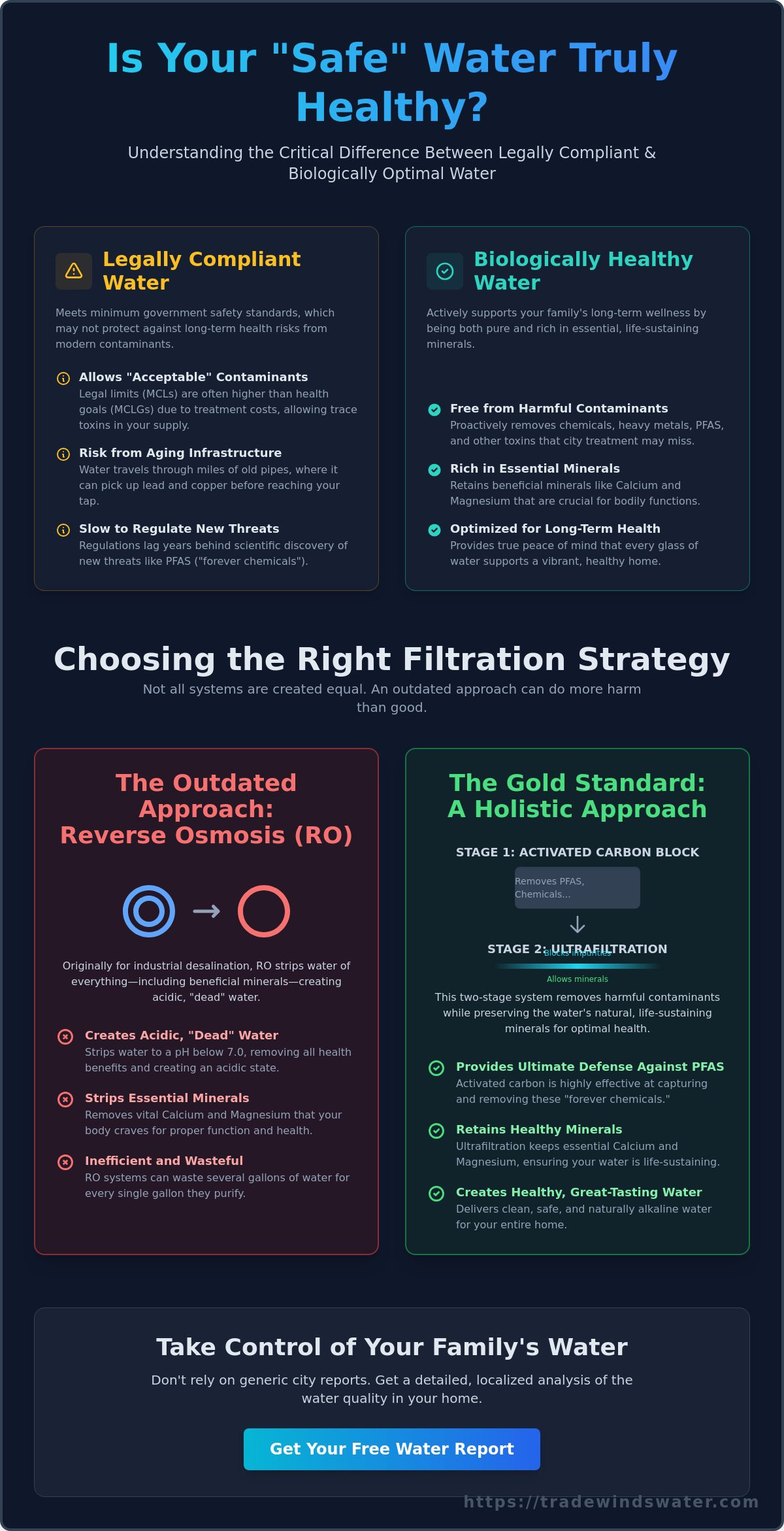
This guide will help you bridge that gap by explaining the difference between legally compliant water and biologically healthy water. You'll learn why stripping everything away with commercial desalination tech like Reverse Osmosis creates "dead," acidic water that lacks the calcium and magnesium your body craves. Instead, we'll show you how to build a filtration strategy using activated carbon block cartridge filters and Ultrafiltration. This approach removes toxins like PFAS while keeping your water mineral-rich and life-sustaining, giving you the quiet confidence that every glass from your tap supports a healthy, vibrant home.
Key Takeaways
- Many homeowners ask, "is my city tap water safe to drink" only to realize that meeting legal standards doesn't always mean the water is biologically healthy for long-term consumption.
- Learn why Reverse Osmosis systems, originally built for commercial desalination, produce acidic "dead water" that lacks the vital minerals your body needs.
- Discover how the combination of activated carbon block cartridge filters and Ultrafiltration provides the ultimate defense against PFAS while keeping beneficial minerals intact.
- Identify the gaps in your local Consumer Confidence Report (CCR) and find out how to access a more detailed look at your water quality using specialized tools.
- See why protecting your entire home with a holistic filtration system is more effective for your family's health than relying on a single kitchen-only filter.
Understanding the Gap Between Legal and Healthy Tap Water
When you ask, "is my city tap water safe to drink," the answer you receive from your local utility is based on a set of minimum requirements. These Drinking water quality standards were established primarily to prevent mass outbreaks of waterborne diseases. While municipal systems do an excellent job at managing bacteria and viruses, these standards often represent a baseline for safety rather than a ceiling for optimal biological health. For many families, the goal isn't just to avoid getting sick today, but to ensure long-term wellness through the water they consume and bathe in every day.
Environmental science moves at a much faster pace than federal legislation. It's common for researchers to identify health risks associated with specific chemicals years before those substances are even considered for regulation. This lag means your local utility might be perfectly compliant with the law while still delivering water that contains emerging contaminants like PFAS. Testing reports also use the term "non-detectable" frequently. This phrase sounds reassuring, but it doesn't mean the contaminant is entirely absent. It simply means the amount present is below the sensitivity of the laboratory's current equipment. As testing technology improves, we often find that substances we thought were gone were actually present at low, chronic levels.
The Safe Drinking Water Act (SDWA) Explained
The SDWA was passed in 1974 to regulate the nation's public drinking water supply. It gives the EPA the power to set Maximum Contaminant Levels (MCLs), which are the highest levels allowed in drinking water. However, there's also a category called Maximum Contaminant Level Goals (MCLGs). This is the level where no known health risk exists. In many cases, the legal MCL is significantly higher than the health goal because of the high costs associated with municipal treatment. Most plants focus on pathogens, leaving modern chemical mixtures for the homeowner to address.
Why Legal Compliance May Not Be Enough for Your Family
Municipalities operate on tight budgets and must provide water that's affordable for the general population. This economic reality means "acceptable" levels are often calculated based on what's feasible to treat at scale rather than what's best for human biology. If you're concerned about the cumulative effects of trace toxins, you can't rely solely on citywide averages. You can use the Tradewinds Water Report tool to get a clearer, more localized picture of the water entering your home.
Even if the water leaves the treatment plant in perfect condition, it still travels through miles of aging pipes. This journey is where lead and copper often enter the picture. Much of the infrastructure in American cities is decades old, and internal corrosion can leach metals directly into your supply. By the time that water reaches your kitchen or shower, its quality has fundamentally changed. True peace of mind requires a proactive strategy that addresses these variables before the water touches your glass or your skin.
How to Read Your City Consumer Confidence Report (CCR)
Every year, your local water utility is required to provide a snapshot of the substances found in your supply. This document is known as the Consumer Confidence Report (CCR). While it’s the most direct way to answer the question, "is my city tap water safe to drink," these reports can be notoriously difficult to navigate. You can quickly find your specific results using the Tradewinds Water Report tool, which helps cut through the technical noise and provides a clearer picture of your local quality.
The EPA offers a detailed guide on how to read your annual water quality report, which explains the mandatory disclosures your utility must provide. When you open your report, look for the "Source Water" section first. This tells you whether your water comes from groundwater (aquifers) or surface water (rivers and lakes). Surface water is more prone to industrial runoff, while groundwater often contains higher levels of natural minerals. Identifying the source helps you understand which contaminants are most likely to be present before the treatment process begins.
Decoding Technical Terms in Your Water Report
Reports use measurements that can feel abstract. Parts per million (ppm) is roughly equivalent to one drop in a large bathtub. Parts per billion (ppb) is like one drop in an Olympic-sized swimming pool. In 2026, regulations have become even more precise, measuring some substances in parts per trillion (ppt). To put that in perspective, one ppt is like a single drop in twenty Olympic pools. You should also look for "Action Levels." If lead or copper concentrations exceed these levels, the utility must take steps to control corrosion in the aging infrastructure that delivers water to your home.
Emerging Contaminants: What Your Report Might Be Missing
Even a perfect report has its limits. Many standard CCRs don't yet list "forever chemicals" (PFAS) or microplastics because federal monitoring requirements are still catching up to the science. As of June 2026, the EPA has finalized limits for six PFAS compounds, but public water systems aren't required to provide this information in every report until 2027. This means your current report might not show the pharmaceutical runoff or microplastics that municipal plants aren't designed to catch.
Checking for past violations is also essential. A report might show the water is currently safe, but a history of missed safety benchmarks suggests a system under stress. Because the report only reflects the water quality at the treatment plant or specific sampling points, it doesn't account for the lead or copper your own pipes might add. If you want to ensure your home is protected from these invisible threats, exploring Ultrafiltration is a logical next step for maintaining a healthy living space.
The Problem with Reverse Osmosis: Why Pure Water Isn’t Always Healthy
Many homeowners looking for peace of mind ask, "is my city tap water safe to drink" and immediately turn to Reverse Osmosis (RO) as the ultimate solution. It's a common mistake. While RO is marketed as the gold standard for purity, it's vital to understand its origins. This technology was originally developed for commercial desalination, a process meant to strip salt from seawater for industrial use. It wasn't designed with human biology or long-term health in mind. If you've spent time worrying about your family's wellness, you deserve a solution that doesn't compromise your health in the process.
When you use RO in a residential setting, you create what experts call "dead water." By stripping away every single dissolved solid, the system removes the essential minerals that give water its life-sustaining properties. This process doesn't just make the water empty; it makes it aggressive. Without minerals to balance it, the water becomes acidic, typically dropping to a pH level well below 7.0. This acidity means the water provides no health benefits to the consumer and can actually be detrimental over time.
Why Your Body Needs Minerals Like Calcium and Magnesium
Your body isn't designed to process mineral-free water. Calcium and magnesium are vital for heart health, bone density, and proper nerve function. When you drink acidic water, you're consuming a liquid that is essentially "hungry." Because it lacks its own mineral structure, it can leach those very same minerals from your body to find a balance. Mineral-rich water is a fundamental part of maintaining your internal pH levels and ensuring your cells stay properly hydrated. Stripping these away creates a liquid that is technically pure but biologically vacant.
The Desalination Myth: RO for PFAS Removal
There is a persistent myth that RO is the only effective defense against PFAS and other modern chemicals. However, RO membranes are fragile. They can become fouled by common sediment or fail entirely without any outward sign, leaving you unprotected. Better alternatives, like activated carbon block cartridge filters combined with Ultrafiltration, target chemicals without destroying the water's natural structure.
The Gold Standard: Activated Carbon and Ultrafiltration
While the legal standards might leave you wondering, "is my city tap water safe to drink," the solution doesn't have to involve stripping your water of its life. True safety comes from a strategy that targets modern toxins without turning your tap into a source of acidic, "dead" water. By combining activated carbon block cartridge filters with Ultrafiltration, you create a powerful synergy. This pairing provides a comprehensive shield for your home that outperforms single-stage filters while respecting the natural chemistry of your water.
How Activated Carbon Block Cartridge Filters Work
Activated carbon block cartridge filters operate through a process called adsorption. On a microscopic level, the carbon surface is covered in millions of tiny pores that act like a magnet for organic chemicals. While some filters use loose granules, "block" filters are superior for home use because they force every drop of water through a solid, compressed structure. This ensures maximum contact time, allowing the filter to effectively neutralize the taste and smell of chlorine. More importantly, these blocks are a frontline defense against VOCs and PFAS, trapping these "forever chemicals" before they can enter your household plumbing.
Ultrafiltration: The Final Barrier for Micro-Threats
Once the chemicals are addressed, Ultrafiltration acts as a physical sieve. This technology uses hollow fiber membranes with a pore size of just 0.01 microns. To put that in perspective, it is small enough to stop bacteria, cysts, and even the microplastics that municipal plants often miss. Unlike RO, which requires high pressure and wastes significant amounts of water, Ultrafiltration operates efficiently on your standard household water pressure. It provides a absolute barrier against micro-threats while allowing essential minerals like calcium and magnesium to pass through freely.
This specific combination is the most sustainable and health-conscious way to protect your family. You get the benefit of water that is biologically healthy and delicious, rather than water that has been over-processed and stripped of its nutritional value. If you're ready to upgrade your home's defense, you can explore our full range of whole-home filtration solutions to find the right fit for your living space.
Implementing a Proactive Whole-Home Water Strategy
Many homeowners start their journey by putting a small filter on the kitchen tap. While this is a helpful first step, it still leaves you asking, "is my city tap water safe to drink" and use for the rest of your daily needs. A single point of filtration ignores the fact that your home is an interconnected system. Every time you run the dishwasher, do a load of laundry, or step into the shower, you're interacting with the municipal supply. A comprehensive Whole House Water Filtration strategy ensures that every drop entering your property is treated for both safety and biological health.
Think about the peace of mind that comes from knowing your water quality is consistent throughout the house. When you rely on a combination of activated carbon block cartridge filters and Ultrafiltration at the main line, you aren't just cleaning your drinking water. You're protecting your family from the modern chemical mixtures that legal standards often overlook. This approach maintains the essential minerals like calcium and magnesium that keep your water healthy, unlike the "dead water" produced by desalination technologies like RO. It's about creating a harmonized living space where the water supports your wellness rather than complicating it.
This commitment to a health-conscious and well-prepared lifestyle often carries over into our time spent in nature. Whether you are ensuring your home has the best filtration or gearing up for a weekend in the wilderness, quality matters. For outdoor enthusiasts who value premium equipment, Wood To Water Outdoors offers a range of specialized gear to ensure your time away from home is as safe and restorative as your time in it.
Holistic Health: Filtration Beyond the Drinking Glass
Your skin is your body's largest organ. During a hot, steamy shower, your pores open up, and your lungs inhale the vaporized chemicals present in the water. If your city uses chlorine or chloramines, you're absorbing those substances directly into your system. By filtering at the source, you eliminate these exposures. This also protects your plumbing and high-end appliances. Removing corrosive chemicals and managing scale with tools like Flow-Tech MAX prevents the premature failure of water heaters and dishwashers, saving you from unnecessary repair stress. It's a quiet, magisterial way to ensure your home remains a sanctuary.
Smart Protection: Leak Detection and Shut-Off Valves
A truly proactive strategy pairs high-quality filtration with modern security. Integrating Leak Detection Systems like StreamLabs allows you to monitor your water usage in real-time. These smart sensors identify unusual patterns, such as a pinhole leak behind a wall or a running toilet, before they cause damage. For the ultimate level of security, Automatic Water Shut-Off Valves such as FloLogic can stop the flow of water instantly if a catastrophic failure is detected. This combination of quality and security creates a robust home water environment that looks out for your health and your property.
Take Control of Your Home’s Water Health
You now have the tools to look beyond the surface when asking, "is my city tap water safe to drink." While municipal reports provide a legal baseline, true biological health requires a proactive approach that removes modern toxins like PFAS and microplastics while keeping vital minerals intact. Moving away from acidic, over-processed water and toward a holistic whole-home strategy is one of the most impactful decisions you can make for your family's well-being. It's about more than just plumbing; it's about the foundation of a healthy life.
By choosing a system that combines activated carbon block cartridge filters and Ultrafiltration, you ensure your water stays pH-balanced and life-sustaining. You don't have to settle for the "dead water" produced by commercial desalination technologies. Instead, you can enjoy the quiet confidence that comes from professional-grade protection. Our authorized network of licensed installers is ready to help you implement a solution designed for the specific challenges of 2026.
Browse Healthy Whole-Home Filtration Solutions today and take the first step toward a more vibrant, health-conscious household. You deserve water that supports your body and your peace of mind.
Frequently Asked Questions
Is city tap water safer than bottled water?
Tap water is often more strictly regulated than bottled water, but it's not a simple comparison. While the EPA sets limits for over 90 contaminants in municipal supplies, bottled water is regulated as a food product by the FDA. Bottled water also frequently contains high levels of microplastics from the plastic packaging itself. For those asking "is my city tap water safe to drink," the best solution is treating your own supply to ensure it's both clean and mineral-rich.
Can I test my city water for PFAS at home?
Basic home test kits can detect some contaminants, but they are rarely sensitive enough for PFAS. These "forever chemicals" are measured in parts per trillion, requiring specialized laboratory equipment for accurate detection. Instead of relying on one-time tests, many homeowners install a proactive system. Using activated carbon block cartridge filters and Ultrafiltration provides a constant barrier against these emerging threats regardless of fluctuating test results in the city supply.
Does boiling tap water make it safe to drink?
Boiling water only kills biological pathogens like bacteria and viruses; it does not remove chemicals. In fact, boiling can actually concentrate non-volatile contaminants like lead, nitrates, and PFAS because some of the pure water evaporates away as steam. If you're concerned about the chemical safety of your supply, you need a physical and chemical barrier rather than heat. A combination of carbon filtration and Ultrafiltration is much more effective for daily safety.
What is the most effective way to remove lead from city water?
The most effective way to remove lead is through high-quality filtration at the point where water enters your home. Because lead often leaches from aging service lines or your own household plumbing, city-wide reports don't always reflect what's at your tap. Activated carbon block cartridge filters are specifically designed to trap heavy metals. This ensures that even if your infrastructure is older, the water reaching your family is safe and healthy.
Why does my tap water smell like chlorine or pool water?
That pool-like smell is caused by chlorine or chloramines added by the city to kill bacteria during transit. While these disinfectants are necessary for public health, they aren't ideal for consumption or your skin. High-quality carbon block filters are excellent at adsorbing these chemicals, removing the unpleasant taste and odor. This allows you to enjoy the benefits of municipal disinfection without having to drink or bathe in the chemicals themselves.
How often should I replace my whole-house water filters?
Most whole-house water filters should be replaced every 6 to 12 months, though this depends on your household's water usage. If you notice a drop in water pressure or a change in taste, it's usually a sign that the cartridges are reaching their capacity. Regularly replacing your activated carbon block cartridge filters and Ultrafiltration membranes ensures your system continues to provide optimal protection against contaminants while maintaining a healthy, mineral-rich flow for your family.
Is hard water dangerous to drink?
Hard water is not dangerous to drink; it's actually a sign of mineral-rich water. The "hardness" comes from calcium and magnesium, which are essential for your heart and bone health. While these minerals can cause scale buildup in your pipes, they provide significant nutritional benefits. Using a salt-free softener or anti-scale system allows you to protect your plumbing without stripping away these vital, health-promoting minerals from your drinking supply like acidic Reverse Osmosis systems do.
Can city water quality change throughout the year?
Yes, city water quality can fluctuate significantly based on the season and local weather events. Heavy rainfall or snowmelt can increase runoff into surface water sources, leading to higher levels of sediment or agricultural chemicals. Additionally, water main breaks or routine maintenance can temporarily introduce lead or rust from aging pipes into your home. A whole-house filtration strategy provides a consistent, reliable shield against these unpredictable changes throughout the entire year.