

The very technology designed to provide the cleanest water in your home might actually be stripping away the essential nutrients your body needs to thrive. While a reverse osmosis system is often marketed as the gold standard for purity, it was originally engineered for industrial desalination and large-scale commercial use. By the time that water reaches your glass, it's frequently "dead water" with an acidic pH level below 7.0. We understand you want total peace of mind when you turn on the tap, especially since the EPA’s April 2024 ruling now sets strict limits on six types of PFAS in drinking water. You want to protect your family from contaminants, but you shouldn't have to sacrifice the calcium and magnesium that make water truly healthy.
This article will show you why traditional filtration often falls short and how you can achieve superior results without the waste. You'll discover how a combination of activated carbon block cartridge filters and Ultrafiltration provides a holistic solution for the entire home. We'll explore the science of mineral-rich water and help you choose a system that supports your long-term health while keeping your plumbing simple and efficient.
Key Takeaways
- Understand why a traditional reverse osmosis system—originally designed for industrial desalination—creates acidic "dead water" by stripping away the essential minerals your body needs.
- Discover the health implications of drinking water with a pH level below 7.0 and why maintaining natural minerals like calcium and magnesium is vital for your family’s well-being.
- Learn why the "Gold Standard" combination of activated carbon block cartridge filters and Ultrafiltration is the superior choice for targeting modern contaminants like PFAS.
- Compare traditional filtration methods against modern alternatives to see how you can achieve high-purity water without the environmental waste or loss of nutritional value.
- Get expert guidance on implementing a holistic, mineral-rich water solution that provides your home with refreshing quality and long-term peace of mind.
Understanding the Reverse Osmosis System: From Desalination to the Kitchen Sink
A reverse osmosis system is a high-pressure mechanical separation technique. It works by forcing water through a microscopic, semi-permeable membrane to catch ions and molecules. While this sounds like a modern miracle for your kitchen, it's essentially a brute-force method of cleaning water that was never originally designed for the average family home. It's built on a philosophy of total removal, which sounds good on paper but often ignores the biological needs of the human body.
The Industrial Roots of RO Technology
The history of this technology starts in the mid-1950s. Scientists engineered the process to solve high-salinity problems, specifically for commercial desalination. This process, often cited in the journey From Desalination to the Kitchen Sink, allows ocean-going vessels and coastal industrial plants to turn seawater into something usable for machinery. In an industrial setting, "purity" means the absence of everything. Factories need water that won't leave scale on a boiler or interfere with chemical reactions. However, your body isn't a piece of industrial equipment. Residential health needs are different. For drinking water, "total removal" shouldn't be the goal because it strips away the essential minerals like calcium and magnesium that make water healthy and give it a crisp, refreshing taste.
How Reverse Osmosis Operates in a Home Setting
When you bring this technology into a house, it usually takes the form of an under-sink setup. Because the membrane works so slowly, the system requires a dedicated storage tank to hold water until you turn on the tap. This setup creates a few headaches for the modern homeowner. First, there's the issue of waste. These systems are notoriously inefficient; they often discharge 3 to 5 gallons of wastewater for every single gallon of treated water produced. This waste happens during a multi-stage process that typically includes:
- Pre-filtration: Carbon or sediment filters that protect the delicate membrane from large particles.
- The RO Membrane: The core stage where high pressure forces water through the semi-permeable barrier.
- Post-filtration: A final polish intended to improve the flavor of the "flat" water.
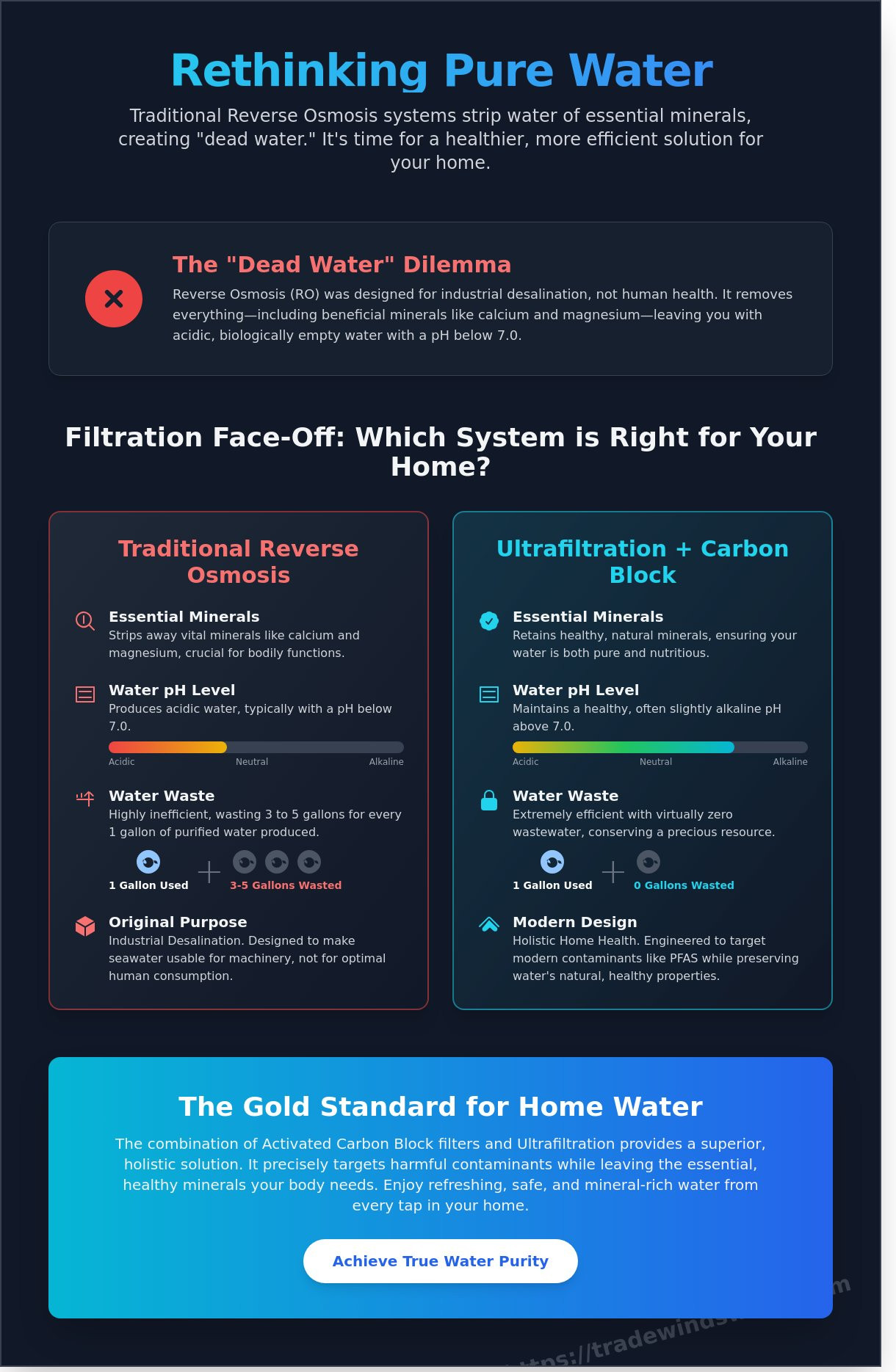
The result is what many experts call "dead water." Because it lacks minerals, the water often has a pH level below 7.0, making it acidic. This acidity means the water provides no real health benefits and can't support your body's natural balance. If you're looking for a holistic way to protect your family, you don't need to strip your water of its life. A more effective approach for a healthy home is a combination of activated carbon block cartridge filters and Ultrafiltration. This pairing targets contaminants like PFAS and lead while keeping those vital minerals right where they belong: in your glass.
The Hidden Downside of RO: Is "Dead Water" Impacting Your Health?
While a reverse osmosis system is often marketed as the ultimate solution for purity, it creates a product many experts call "dead water." This technology wasn't originally intended for your kitchen sink. It was developed for industrial desalination and marine use, where turning seawater into something drinkable was the only goal. In a home setting, this process is often too aggressive. By forcing water through a semi-permeable membrane at high pressure, the system removes 99.9% of everything. This includes the heavy metals you want to avoid, but it also eliminates the vital electrolytes your body needs to function. The result is water that's chemically pure but biologically empty. This lack of mineral content can lead to the water leaching minerals from your own body to find a balance, potentially Impacting Your Health in ways most homeowners aren't told about.
Why pH Levels Matter for Hydration
The pH scale measures how acidic or alkaline a liquid is, with 7.0 being perfectly neutral. Most natural spring water sits slightly above 7.0, providing a healthy, alkaline balance. Because a reverse osmosis system removes the alkaline minerals that act as natural buffers, the resulting water typically tests between 5.0 and 6.5. This makes the water acidic. Drinking acidic fluids for years doesn't support a healthy internal environment. Your body has to work harder to maintain its own neutral pH when you constantly ingest acidic "dead water." If you're curious about what you're starting with before any filtration, you can check the Tradewinds Water Report to see your local baseline.
The Importance of Essential Minerals
Calcium and magnesium aren't just additives; they're essential for heart rhythm, muscle function, and bone density. Research from the World Health Organization suggests that your body may absorb these minerals more efficiently from water than from food. RO systems fail to distinguish between a harmful contaminant and a helpful mineral. They simply strip it all away. RO systems strip 99.9% of minerals, leaving the water biologically empty. This is why many people find that RO water tastes flat or "hollow." It lacks the crisp, refreshing character that comes from natural mineralization.
Instead of this aggressive approach, we recommend a more holistic method for your home. Using a combination of activated carbon block cartridge filters and Ultrafiltration allows you to target dangerous contaminants like PFAS and lead while keeping the beneficial minerals intact. This ensures your family enjoys water that's safe, hydrating, and full of life. It's about finding the right balance for a healthy home.
Comparing Reverse Osmosis vs. Ultrafiltration for Whole-Home Health
Many homeowners assume a reverse osmosis system is the gold standard because it's used in industrial desalination. However, what works for a massive cargo ship doesn't always serve a busy family home. RO systems are notoriously inefficient for whole-home applications. They often create significant pressure drops that make your morning shower feel like a drizzle, and they waste up to 75% of the water they process. This technology strips away every single mineral, leaving you with "dead water" that lacks the refreshing quality nature intended. When water is stripped of its character, it often tests at an acidic pH level below 7.0, which offers no health benefits to the consumer.
Choosing the right filtration means looking at the long-term health of your household. You want water that's safe, but you also want the essential nutrients that keep your body functioning. Relying on an outdated, industrial-style process often creates more problems than it solves, especially when modern alternatives offer better performance without the waste.
Ultrafiltration: The Mineral-Rich Alternative
Ultrafiltration (UF) offers a smarter, more health-conscious path to clean water. Instead of stripping everything out, UF membranes use a 0.02-micron barrier to block bacteria, parasites, and sediment while letting essential minerals like calcium and magnesium pass through. It's the difference between drinking processed, empty water and enjoying mineral-rich hydration that supports your family's wellness. These systems are incredibly efficient; they require no bulky storage tank and produce zero wastewater. You can see how these systems integrate into a modern household by exploring our Ultrafiltration Collection. Because there's no waste, you're protecting your local environment while ensuring every tap in your house delivers high-quality, life-sustaining water.
The PFAS Challenge: RO vs. Carbon Block
There's a common myth that a reverse osmosis system is the only way to handle "forever chemicals" like PFAS. The reality is that high-quality activated carbon block cartridge filters are exceptionally effective at capturing these contaminants. These filters work through adsorption, a process where the massive surface area of the carbon traps chemical pollutants. When you combine activated carbon block cartridge filters with Ultrafiltration, you create a comprehensive health shield for your home. This pairing removes harmful chemicals and heavy metals while keeping the water's nutritional value intact. It's a holistic approach that prioritizes safety without sacrificing the minerals your body needs. For a deeper look at why this combination is the future of home filtration, read The Ultimate Guide to Under Sink Water Filters. We believe your water should be as healthy as it is clean, and that starts with avoiding the "dead water" trap of older technologies.
How to Achieve Superior Filtration Without Stripping Essential Minerals
The gold standard for home water safety isn't found in stripping water of its life. Instead, it's found in the powerful combination of activated carbon block cartridge filters and Ultrafiltration. This pairing creates a sophisticated barrier that targets heavy metals, PFAS, and chemicals while leaving vital minerals like calcium and magnesium untouched. Unlike a reverse osmosis system, which was originally designed for industrial desalination, this holistic approach keeps your water's pH level neutral or slightly alkaline. Water from an RO unit often tests at a pH below 7.0, making it acidic and essentially "dead water" that offers no nutritional value to your family.
The Role of Activated Carbon Block Cartridge Filters
Activated carbon block cartridge filters are the workhorses of a healthy home system. They work through adsorption, a process where chemicals like chlorine, VOCs, and pesticides stick to the vast surface area of the carbon. We prefer "block" filters over granular carbon because they're more densely packed. This density prevents "channeling," where water finds a path of least resistance without being filtered. Because these blocks retain the natural mineral balance, the water keeps its crisp, refreshing taste. You'll notice the difference in your morning coffee and your children's drinking water immediately. It's clean, safe, and biologically active.
Whole House vs. Point-of-Use Solutions
Investing in a Whole House Water Filtration System is a proactive step for your home's longevity. While point-of-use filters only protect one tap, a whole-house approach ensures every drop entering your property is treated. This protects your plumbing and expensive appliances from scale buildup without using harsh chemicals. It's a holistic strategy that prioritizes the health of your skin in the shower and the integrity of your dishwasher. By choosing Ultrafiltration with a 0.01-micron rating, you remove microscopic contaminants across the entire home while maintaining the healthy mineral content that a reverse osmosis system would otherwise discard.
Professional installation is vital to maintain the integrity of these systems. A certified technician ensures that flow rates are optimized and that the seals remain airtight, preventing any bypass of unfiltered water. This expert setup provides the peace of mind that your system will perform at peak efficiency for years. When your water is handled with professional care, it becomes the foundation of a healthy, happy household. You don't have to choose between purity and health.
The Tradewinds Approach: Holistic Water Technology for the Modern Home
Tradewinds Water believes your family deserves better than dead water. A standard reverse osmosis system might remove contaminants, but it also strips away the life-giving minerals your body needs. This process leaves you with acidic water, often featuring a pH below 7.0. Water without calcium and magnesium isn't just flat; it's nutritionally empty. We've shifted the focus toward holistic technology that mimics nature's own filtration process. Instead of relying on technology designed for industrial desalination, we utilize a combination of activated carbon block cartridge filters and Ultrafiltration. This pairing removes harmful substances like PFAS while keeping the water's healthy mineral structure intact. It's a more effective method for whole-home use than outdated RO membranes.
You won't have to worry about complex setups or DIY headaches. Tradewinds partners with a national network of licensed, professional installers to ensure every system operates at peak performance. This expert oversight guarantees that your home's infrastructure is respected and your water quality is verified from day one. We provide a seamless transition from your current tap water to a mineral-rich alternative that supports your family's long-term wellness. Our nationwide coverage means you get consistent, professional service regardless of where you live. This approach ensures your system stays efficient and your family stays hydrated with water that actually nourishes the body.
Health-First Filtration Standards
Our systems are built for the modern American family. We prioritize biological health by ensuring your water remains alkaline and mineral-rich. We don't believe in stripping water down to a sterile, acidic state. Our technology targets modern contaminants without sacrificing the essential elements that support bone health and hydration. You can explore our full hardware range to see how we balance purity with nutrition.
Beyond Filtration: Protecting Your Home
A truly comprehensive water plan goes beyond what's in the glass. It includes safeguarding your property from unforeseen damage. Integrating Leak Detection and automatic shut-off valves provides an extra layer of security. We want to give you peace of mind through both purity and protection. When you choose Tradewinds, you're investing in a system that looks out for your health and your home's integrity. It's time to choose a healthier water future with Tradewinds.
Protect Your Home With Living, Mineral-Rich Water
Your family deserves water that supports their health, not just water that's been stripped of its essence. While a reverse osmosis system was originally designed for industrial desalination, it often leaves homeowners with "dead water" that has an acidic pH level below 7.0. This process removes 100% of the natural Calcium and Magnesium your body needs for daily vitality. You can achieve superior results by switching to a combination of activated carbon block cartridge filters and Ultrafiltration. This pairing targets contaminants like PFAS while keeping your water's nutritional value intact.
Tradewinds Water provides professional installation through licensed experts across all 50 states to ensure your system performs perfectly from day one. Our holistic technology includes smart leak detection to protect your property while providing the peace of mind you expect from a trusted expert. It's time to stop drinking processed water and start enjoying the refreshing taste of nature. We're here to help you make the transition to a healthier household foundation.
Upgrade to Mineral-Rich Ultrafiltration Today
Frequently Asked Questions
Is reverse osmosis water acidic?
Yes, water produced by a reverse osmosis system is typically acidic with a pH level below 7.0. This occurs because the process strips away the natural alkaline minerals that balance the water's chemistry. Without these minerals, the water becomes aggressive and can even pull nutrients from your body. Your family deserves water that supports health rather than creating an acidic environment in the home.
Does a reverse osmosis system remove healthy minerals?
A reverse osmosis system removes 99% of all substances from your water, including essential healthy minerals like calcium and magnesium. While it targets contaminants, it also strips away the nutritional value your family needs for bone health and proper hydration. We believe your home's water should be clean and mineral-rich. Choosing a system that retains these electrolytes ensures every glass provides genuine nourishment for your loved ones.
What is the difference between Ultrafiltration and Reverse Osmosis?
The primary difference lies in what stays in your water after the filtration process. While a reverse osmosis system uses a membrane to strip every particle, Ultrafiltration targets harmful bacteria and sediment while leaving beneficial minerals intact. Ultrafiltration membranes have a pore size of 0.02 microns, which is small enough to block pathogens but large enough for calcium to pass through. This results in refreshing water that hasn't been over-processed.
Can I get a whole-house reverse osmosis system?
You can install these systems for the whole home, but it's rarely the best choice for a household. Because the water is acidic and aggressive, it can corrode your home's plumbing and fixtures over time. These systems also waste 3 to 20 gallons of water for every gallon produced. A more sustainable approach for your family involves using high-quality filtration that protects your pipes and provides mineral-rich water at every tap.
Does reverse osmosis water provide any health benefits?
Reverse osmosis water provides no specific health benefits because it lacks the essential minerals found in natural spring water. Drinking demineralized water can lead to a pH imbalance in the body over time. The World Health Organization reported in 2005 that drinking water low in calcium and magnesium carries increased risks for cardiovascular disease. Your family's health thrives on water that's clean and full of life-sustaining minerals.
What is the best alternative to reverse osmosis for removing PFAS?
The most effective alternative for removing PFAS is a combination of activated carbon block cartridge filters and Ultrafiltration. Carbon blocks are highly effective at adsorbing "forever chemicals" like PFOA and PFOS. When paired with Ultrafiltration, this setup provides a comprehensive barrier against modern contaminants. This approach ensures your home's water is safe from chemicals without stripping away the minerals that make water taste fresh and stay healthy.
Why is RO water often called "dead water"?
RO water is called "dead water" because the desalination process strips away the vital mineral content that gives water its life-sustaining properties. This results in a liquid that's chemically pure but nutritionally empty. Since it has a pH below 7.0, it's essentially an empty solvent. We focus on providing water that's alive with the calcium and magnesium your family needs for a healthy, vibrant lifestyle in your home.
Do I need a storage tank for an Ultrafiltration system?
You don't need a bulky storage tank for an Ultrafiltration system. Unlike a reverse osmosis system that produces water slowly and requires a tank, Ultrafiltration works at a higher flow rate in real-time. This saves valuable space under your sink and ensures you always have a fresh supply of water. It's a simpler, more efficient way to give your family the peace of mind they deserve without the clutter of extra equipment.