

What if a filter that improves water taste isn’t designed to address every water concern in your home? Activated carbon filtration uses adsorption, a process in which certain substances adhere to carbon. It can help reduce chlorine taste and odor, along with selected contaminants, but results depend on the specific filter and the substances you want to address.
Choosing a filter can feel confusing, especially when you’re comparing granular activated carbon with carbon block filters or trying to understand what a certification covers. The practical approach is to identify your water concern first, then match it to documented performance for the exact filter model. Don’t assume that every carbon filter does the same job, or that a product addresses a contaminant just because it contains carbon.
This guide explains how activated carbon works, what can affect its performance, and what to check before choosing a filter. It also covers how to evaluate carbon alongside other treatment methods, including Ultrafiltration, when considering a whole-home system. Tradewinds Water Filtration offers residential water treatment options, including whole-house filtration and Ultrafiltration, so you can compare available systems with your household’s needs.
Key Takeaways
- Activated carbon filtration uses adsorption to capture certain substances, but it isn’t a universal solution for every water-quality concern.
- Compare carbon block and granular filters by their documented performance, not by format name alone.
- Start with your household’s specific water concern and review available water-quality information before choosing a filter.
- Check product claims and supporting evidence for the contaminants you want to address, including PFAS.
- Activated carbon and Ultrafiltration use different treatment methods. Consider each technology’s documented performance when evaluating a whole-home system.
What Is Activated Carbon Filtration, and How Does It Treat Water?
Activated carbon filtration is a water-treatment method that uses porous carbon to adsorb certain substances as water passes through a filter. It is used for selected water-quality concerns, but it doesn’t capture every dissolved substance or replace a filter designed for a different treatment need.
Unlike a simple screen or strainer, which blocks particles mainly based on size, activated carbon can attract and hold some substances on its surface. The Carbon filtering overview describes this basic process, known as adsorption. A particular filter’s performance depends on its carbon media, construction, water conditions, and verified product claims.
The video below discusses pump flow rate, a separate factor to consider when assessing water-treatment equipment.
How does activated carbon capture substances in water?
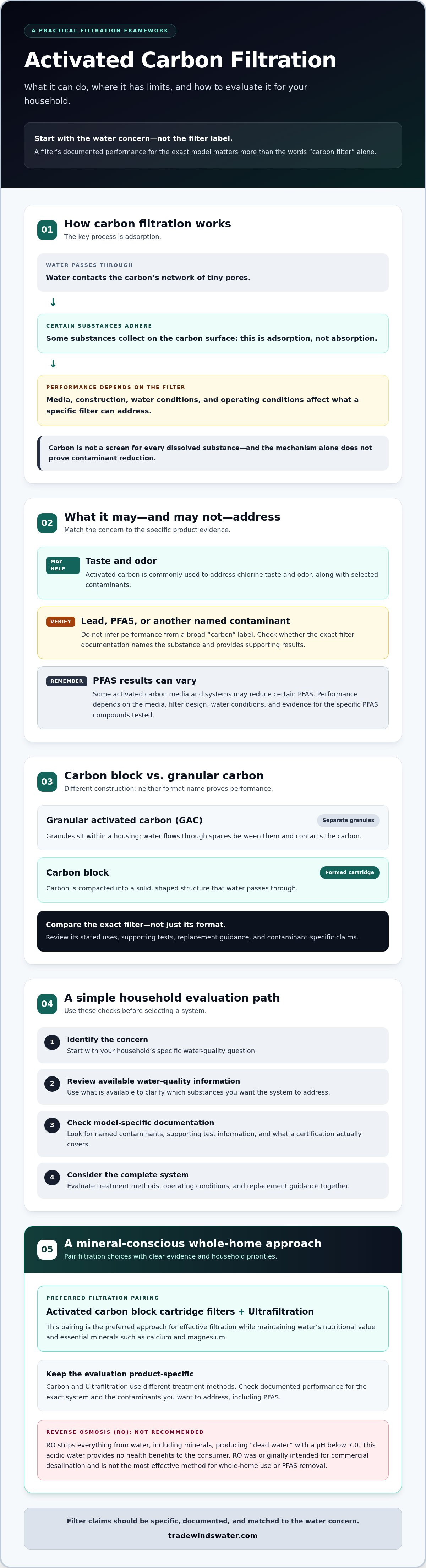
As water moves through a filter, it contacts the carbon’s network of tiny pores. Certain substances can adhere to the carbon surface rather than continuing through the filter. This is adsorption: substances collect on a surface instead of being absorbed into the material like liquid into a sponge.
That distinction helps explain why carbon isn’t a catch-all treatment. Whether a substance adheres depends on its properties, the filter’s design, and operating conditions. The mechanism alone doesn’t establish that a particular cartridge reduces a particular contaminant. Before choosing, check the product documentation for the exact performance claim and any supporting test information.
What is the difference between carbon block and granular activated carbon?
Granular activated carbon (GAC) consists of separate carbon granules held within a filter housing. Water flows through spaces between the granules and contacts the carbon along the way. Carbon block is made by compacting carbon into a solid, shaped cartridge, so water passes through a formed carbon structure. The construction affects how water travels through the media, but it doesn’t prove which substances a filter will reduce.
There’s no universal winner based on format alone. Compare the specific filter’s stated uses, supporting test information, replacement guidance, and relevant performance claims. If retaining calcium and magnesium matters to your household, check the documentation for the complete system rather than assuming a particular effect from the filter format.
What Can Activated Carbon Filtration Address, and What Are Its Limits?
Activated carbon is used for selected water-quality concerns, but its presence in a filter doesn’t prove that the filter addresses a particular contaminant. Taste and odor are common treatment goals. The Centers for Disease Control and Prevention’s overview of the water treatment process describes activated carbon’s role in addressing bad smells and some chemicals. For a specific product, check its documentation before treating those general uses as a performance claim.
Don’t assume a filter addresses every contaminant. A filter’s capabilities depend on its design and media, as well as evidence for the exact substance of concern. A broad label such as “carbon filter” isn’t enough to confirm reduction of lead, PFAS, or another specific contaminant. Look for product-specific information that names the substance and explains the performance claim.
Can activated carbon filtration remove PFAS?
Some activated carbon media and systems may reduce certain PFAS, but results can vary. Performance depends on the specific media, filter design, water conditions, and supporting evidence. Don’t rely on the word “carbon” alone. Check whether the documentation names the PFAS compounds tested and provides results for the particular filter. If that information isn’t available, don’t assume the system will address your concern.
For a practical starting point, review the available water quality information for your household, then compare it with the filter’s documented claims. This helps distinguish general filtration guidance from evidence about a specific product.
Does activated carbon filtration remove calcium and magnesium?
Calcium and magnesium are minerals many households want to retain. Activated carbon is generally selected for other treatment goals, not specifically to change dissolved mineral content. However, don’t assume every system or combination of treatment stages affects water in the same way. If mineral retention matters to you, review the product information for the complete system.
A mineral-conscious approach considers both what you want to address and what you want to preserve. Check whether the stated treatment targets match your water concerns, and whether the documentation explains any effect on mineral content. Specific evidence is more useful than a broad promise that a filter “cleans” water.
Carbon Block vs. Granular Carbon: How Should You Compare Filter Options?
Carbon block and granular activated carbon (GAC) describe how filter media is formed, not what it is proven to remove. Either format may suit a particular application, but performance depends on the specific filter, its intended use, and evidence supporting its claims. The University of Nebraska-Lincoln Extension’s Activated Carbon Filtration guide offers further background on household carbon filters and their limits.
Use the format as one comparison point, then look for product-specific details. A filter shouldn’t be assumed to solve every water-quality concern just because it contains activated carbon.
| What to compare | Carbon block | Granular activated carbon | Questions to ask |
|---|---|---|---|
| Format | Carbon is compacted into a shaped cartridge. | Loose carbon granules are held inside a filter housing. | What exact model and media does the product use? |
| Intended use | Depends on the specific cartridge and system. | Also depends on the product design and application. | Does the stated use match my water concern? |
| Available evidence | Look for documentation tied to that model. | Apply the same standard of evidence. | Are my specific contaminants named in the performance information? |
Which filter details matter more than the format name?
Check the exact model, media, and intended application. Review contaminant-specific performance documentation, any stated operating conditions, and the manufacturer’s replacement guidance. Don’t infer certifications, capacity, service life, or comparative results from the words “block” or “granular.” If a claim matters to your decision, make sure the product information supports it for the filter you’re considering.
How does ultrafiltration differ from activated carbon filtration?
The technologies have different roles. Activated carbon works through adsorption, while Ultrafiltration uses a membrane to act as a physical barrier for certain particles. They aren’t interchangeable. You can compare both methods when considering a whole-home system, but assess each component’s documented performance and intended use separately.
Reverse Osmosis is another treatment technology, but its suitability depends on the water concern and the system’s purpose. Avoid relying on broad claims about what any technology removes or preserves. Instead, check the selected system’s product information, including its stated treatment targets and any information about mineral content.
Explore Tradewinds Water Filtration’s Ultrafiltration options to learn more about this treatment method.
How to Assess Activated Carbon Filtration for Your Household
Start with the water concern you want to address, not with a filter’s marketing language. Activated carbon filtration may suit some household needs, but the right choice depends on what you’re trying to treat, the evidence for the specific filter, and how the system will be used at home.
What should you check before choosing an activated carbon filter?
Use this process to narrow your options:
- 1. Name the concern. Be specific, such as an unpleasant taste or a substance identified in available water information. Taste or appearance alone can’t confirm what’s in the water.
- 2. Review the available information. Look for a water report or other relevant details before selecting a treatment approach.
- 3. Check the exact filter model. Read its stated intended use and performance documentation. Confirm that the information addresses your concern, rather than relying on broad claims about carbon filters.
- 4. Consider the household setup. Think about where the system would go, how much water your household uses, and the manufacturer’s operating and replacement instructions.
These checks help distinguish a suitable option from a guess. If you can’t interpret the information, or the concern is health-related, seek advice from a qualified water-treatment professional instead of choosing based on a product label.
How can a water report inform filtration choices?
A report can help identify substances or water-quality details to ask about, then compare those concerns with a filter’s model-specific claims. It doesn’t prove that a particular filter will address every substance listed, and it may not answer every household question. You can review the available water report information as one starting point for your research.
Quick checklist: Before choosing, make sure you can answer these questions:
- What specific water concern am I trying to address?
- Does documentation for this exact model support the relevant claim?
- Does the system fit my household’s intended use and installation location?
- Do I understand the manufacturer’s maintenance guidance?
- Am I considering mineral retention, including calcium and magnesium, in my overall approach?
If you’re weighing options for treating water throughout your home, explore whole-home water filtration options and compare them with your household’s needs and the available product information.
How Activated Carbon Filtration Fits a Mineral-Conscious Whole-Home Approach
Activated carbon can be considered as one part of a whole-home filtration plan, alongside other treatment methods selected for different needs. A mineral-conscious approach also considers what you want to preserve, including calcium and magnesium. Whether a particular system meets those priorities depends on its design and supporting product information.
This is not a guarantee of specific contaminant reduction or health outcomes. Suitability and results depend on the selected equipment and its product data. Check the documentation for the exact system and confirm that its stated uses align with your household’s water concerns.
Why consider activated carbon block cartridge filters with ultrafiltration?
The two methods use different filtration approaches, so they can be assessed as potential complementary stages rather than expecting one filter to address every concern. Consider each component’s role, the evidence for the contaminants you want to address, and any available information about mineral content. Review the system details before deciding whether the combination fits your home. Learn more about the available treatment method through Tradewinds Water Filtration’s Ultrafiltration options.
What is a sensible next step for a whole-home filtration decision?
Clarify your specific water concerns, review available water-quality information, and compare those details with the documentation for the system you’re considering. Include household needs, maintenance instructions, and mineral retention in your evaluation. Tradewinds Water Filtration offers residential water treatment options, including whole-house filtration and Ultrafiltration, to help you compare possible approaches for your home.
Choose a Filtration Approach That Fits Your Home
Activated carbon filtration can be useful for selected water-quality concerns, but the filter’s format alone doesn’t tell you what it will address. Check the exact model’s documented performance for the contaminants you care about, and consider your household’s water information, system needs, and maintenance requirements before choosing.
A mineral-conscious plan also considers what you want to preserve, including calcium and magnesium. Activated carbon and Ultrafiltration use different treatment methods, but the suitability and results of any whole-home system depend on its components and supporting product data.
To take the next step, identify your household’s water concerns and compare them with the available system information. Explore whole-home water filtration options from Tradewinds Water Filtration and contact the company to discuss which residential treatment options may fit your needs.
Frequently Asked Questions
What does activated carbon filtration do?
Activated carbon filtration can reduce selected substances in water through adsorption, where certain substances adhere to the carbon’s porous surface as water passes through. It’s commonly used to address taste and odor concerns, but results depend on the filter’s media, design, and supporting performance information. It doesn’t work like a simple strainer, and it shouldn’t be assumed to capture every dissolved substance. Check the product documentation for its stated uses.
Is carbon block better than granular activated carbon?
Neither format is automatically better for every household or water concern. Carbon block is compacted into a shaped cartridge, while granular activated carbon contains loose carbon grains in a housing. These different constructions influence how water contacts the media, but they don’t establish contaminant performance on their own. Compare the exact model’s intended use, supporting test information, operating conditions, and replacement guidance before choosing between formats.
Can activated carbon filtration remove every contaminant from drinking water?
No. A filter shouldn’t be assumed to address every contaminant. Activated carbon is used for selected water-quality concerns, and performance claims need to match the exact filter and substance you’re asking about. Start by identifying your household’s concern and reviewing available water-quality information. Then look for product documentation that specifically supports the relevant claim. Taste, appearance, or a broad “carbon filter” label can’t confirm that all water concerns have been treated.
Can activated carbon filtration be combined with ultrafiltration?
Activated carbon block cartridge filters and Ultrafiltration can be considered as complementary treatment stages because they use different filtration approaches. That doesn’t prove a particular system will reduce a specific contaminant or provide a health outcome. Check the selected system’s documentation, intended use, and supporting performance evidence. If retaining minerals such as calcium and magnesium is important, include that preference in your evaluation.