

What if the "soft" water you've been told is better for your home is actually stripping away your health and the environment's well-being? Most homeowners are tired of lugging 40-pound salt bags into the garage just to end up with water that feels slippery and leaves them wondering about their sodium intake. When you evaluate the salt free water softener cost, it's easy to focus only on the initial price tag. However, the real value lies in moving away from the "dead water" produced by aggressive systems like reverse osmosis, a technology originally intended for commercial desalination that results in acidic water with a pH below 7.0.
You want to protect your appliances from scale without sacrificing the healthy minerals your body needs. This guide will show you how to achieve total scale protection while keeping essential minerals like calcium and magnesium right where they belong. We'll explore the long-term savings of salt-free technology, the benefits of combining activated carbon block cartridge filters with Ultrafiltration for PFAS removal, and why 2026 is the year to finally ditch the brine discharge for a healthier, more harmonious home.
Key Takeaways
- Understand why salt-free systems are technically water conditioners that preserve vital minerals like calcium and magnesium rather than stripping them away.
- Learn how the salt free water softener cost compares to traditional systems over a decade, accounting for the elimination of heavy salt bags and brine discharge.
- Discover the health risks of "dead water" produced by reverse osmosis and why maintaining a pH above 7.0 is essential for your family's well-being.
- Identify why a combination of activated carbon block cartridge filters and Ultrafiltration is the gold standard for removing PFAS while keeping your water mineral-rich.
- Explore how Flow-Tech MAX technology provides superior scale protection for your appliances without the need for chemical additives or constant maintenance.
What is a Salt-Free Water Softener and Why Does It Cost More Upfront?
When you begin looking into the salt free water softener cost, the first thing you'll likely notice is that the initial price tag is higher than a standard salt-based unit. This isn't just a marketing quirk. It reflects a fundamental shift in how we treat water. While the industry often uses the term "softener," these systems are technically water conditioners or anti-scale systems. They don't rely on cheap bags of salt to function. Instead, they use advanced physical processes to handle hard water issues without the environmental or health drawbacks of traditional methods.
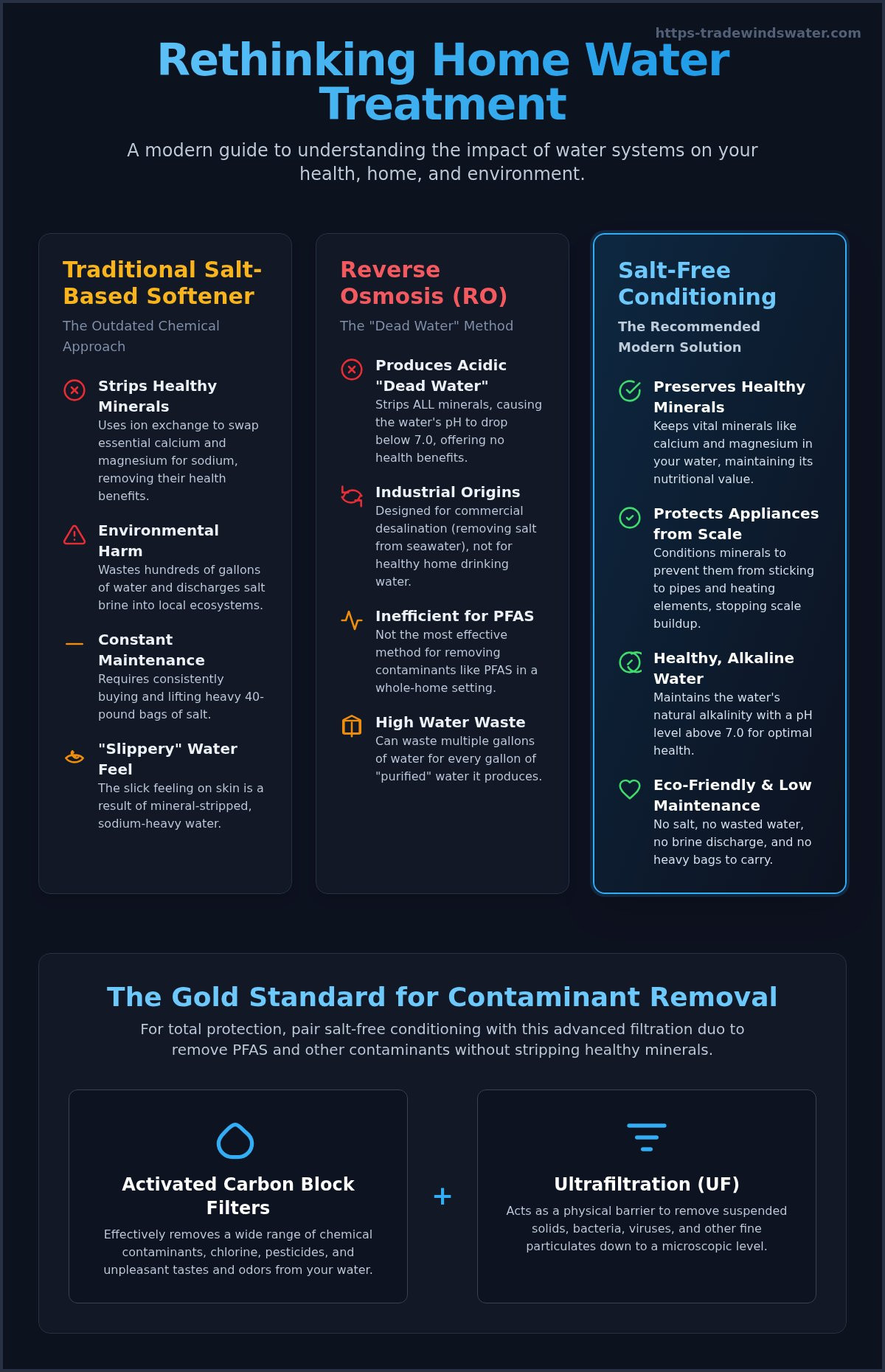
Traditional softeners work through a process called ion exchange. They literally swap out calcium and magnesium for sodium. This results in that "slimy" or "slippery" feeling on your skin, which is actually a sign of mineral-stripped, sodium-heavy water. Salt-free systems take a more holistic approach. They neutralize the scale-forming properties of minerals without removing them from your diet. You get the protection your plumbing needs while keeping the nutritional value of your water intact.
Conditioning vs. Softening: The Technical Difference
The technical difference comes down to chemistry versus physics. Salt-based systems require a brine tank and constant regeneration cycles to flush out trapped minerals. This process wastes hundreds of gallons of water and discharges salt into our local ecosystems. It's a heavy-handed approach that often leads people to consider Reverse Osmosis (RO) to remove the added sodium. We don't recommend RO because it was originally designed for commercial desalination. It strips everything away, creating "dead water" with a pH level below 7.0 that offers no health benefits.
Salt-free conditioning uses physical technology to change how minerals behave. By altering the crystal structure of calcium and magnesium, these minerals can no longer stick to your pipes or heating elements. They simply flow through the system. This preserves the water's natural alkalinity and ensures you aren't drinking acidic, over-processed water. It's a cleaner way to live that respects your home's plumbing and your family's health.
The Premium for Health: Why Hardware Investment Matters
The higher salt free water softener cost for hardware is tied directly to the quality of the components. Premium systems use high-grade composite or stainless steel housings designed to last for decades. Inside, you'll find specialized media or electronic components like Flow-Tech MAX Anti-Scale technology. This hardware is built to provide consistent protection without the need for monthly salt refills or high-volume wastewater discharge.
Investing in quality hardware means you're securing a permanent solution for your home's health. While conditioners handle scale, we recommend pairing them with activated carbon block cartridge filters and Ultrafiltration to address contaminants like PFAS. This combination provides professional-grade filtration without stripping the beneficial minerals that keep your water's pH balanced and healthy. Cheaper alternatives often fail to provide reliable scale protection, leading to appliance damage and clogged fixtures over time.
Protecting Your Home Without Creating 'Dead Water'
Many homeowners assume that the best water is the "purest" water, meaning water that has been stripped of every single dissolved solid. This misconception often leads people to install Reverse Osmosis (RO) systems throughout their entire home. While RO is highly effective at removing contaminants, it does so by stripping away the essential minerals your body needs. This process creates what we call "dead water." When you evaluate the salt free water softener cost, you aren't just paying for scale protection; you're investing in a system that maintains the biological value of your water rather than turning it into an acidic byproduct.
Reverse Osmosis technology was originally developed for commercial desalination. Its primary purpose is to turn seawater into something drinkable by removing salt at an industrial scale. It wasn't designed to create healthy, mineral-rich drinking water for a family. Because RO removes buffering minerals like calcium and magnesium, the resulting water often has a pH level below 7.0. This acidity means the water provides no health benefits and can even be corrosive to your body's internal balance over time. Salt-free conditioning offers a healthier path by neutralizing scale without destroying the water's natural chemistry.
The RO Misconception in Home Filtration
The belief that RO is the gold standard for home use ignores several critical drawbacks. First, RO systems are notoriously wasteful. Depending on the system's efficiency, they can flush multiple gallons of water down the drain for every single gallon of treated water produced. This is a significant environmental burden compared to salt-free conditioners that waste zero water during operation. Additionally, RO is not the most effective method for whole-home PFAS removal. While it can catch these "forever chemicals," the maintenance and water waste make it impractical for high-flow usage.
For those concerned about contaminants, a combination of activated carbon block cartridge filters and Ultrafiltration is a far superior choice. This pairing effectively addresses PFAS and heavy metals while leaving the beneficial mineral content untouched. It provides the safety you want without the "dead water" side effect. You can explore these high-performance filtration options to see how they integrate with your home's plumbing.
Keeping Minerals for Better Health and Taste
Calcium and magnesium aren't just "hardness" minerals that cause scale; they're vital nutrients for cardiovascular and bone health. When you use a salt-free system like Flow-Tech MAX, these minerals stay in your water. The technology works by keeping them in suspension so they can't stick to your pipes or appliances. This protects your water heater and dishwasher while ensuring every glass of water you drink is mineral-rich and healthy.
There is also a noticeable sensory difference. Mineral-free RO water often tastes flat or "empty" because it lacks the natural minerals that give water its character. In contrast, conditioned water tastes crisp and refreshing. By choosing a salt-free approach, you're opting for water that feels better on your skin, tastes better in your glass, and supports your long-term health. The salt free water softener cost reflects this holistic value, providing a solution that respects the natural science of your water.
Comparing Costs: Salt-Free vs. Salt-Based Over 10 Years
Many homeowners stop their research at the sticker price. If you only look at the initial salt free water softener cost, you might miss the bigger financial picture. Over a decade, the financial landscape shifts dramatically. Traditional salt-based units generally range from $800 to $2,500. Salt-free systems sit higher, typically between $1,500 and $4,000. This upfront difference is a strategic investment in a more efficient, chemical-free home that pays dividends through lower utility bills and significantly reduced maintenance.
The operational reality of salt-based systems involves hidden expenses that many buyers overlook. These units require constant electricity and regular regeneration cycles that waste between 3,000 and 10,000 gallons of water every year. This isn't just an environmental concern; it's a recurring line item on your water bill. Salt-free conditioners typically require no power and produce zero brine, making them a cleaner choice for both your budget and the local ecosystem. You aren't just buying a device; you're opting out of a decade of water waste.
The Salt Bag 'Tax': Labor and Ongoing Expenses
Salt systems aren't self-sustaining. Most households go through 12 to 24 bags of salt annually. Beyond the recurring expense of purchasing the salt, there's the physical "tax" of hauling, transporting, and loading 40-pound bags into the brine tank. It's a chore that never ends. You also face mechanical risks like "salt bridges," where a hard crust forms in the tank and prevents the system from working. Fixing these issues often requires manual labor or expensive service calls from a technician. Salt-free conditioners are truly "set it and forget it" solutions for the average homeowner.
Appliance Longevity and Energy Efficiency
Hard water is a silent appliance killer. When scale builds up on water heater elements, it acts as an insulator. This can increase your energy costs by up to 24% because the system has to heat the mineral layer before it can heat the water. By using anti-scale technology like Flow-Tech MAX, you keep your appliances running at peak efficiency. This prevents the premature death of dishwashers, laundry machines, and water heaters. To see how these savings fit into a total home health strategy, read The Ultimate Guide to Whole House Water Filtration Systems in 2026. The long-term salt free water softener cost is often lower because you aren't constantly fighting against the damage caused by salt or scale.
Factors That Influence Your Total Installation Investment
Sizing your system correctly is the first step in determining your total salt free water softener cost. It isn't just about the number of bathrooms in your house. You have to look at the peak flow rate, measured in Gallons Per Minute (GPM). A system that's too small will cause a frustrating drop in water pressure when the shower and dishwasher run at the same time. Conversely, over-sizing the unit leads to unnecessary hardware expenses without providing extra benefit to your plumbing. A professional assessment ensures you get the right capacity for your specific household needs.
The contaminant profile of your local water also plays a major role in your final investment. A salt-free conditioner like Flow-Tech MAX is designed to handle scale, but it won't address "forever chemicals" like PFAS or heavy metals. For a truly healthy home, the gold standard pairing is an anti-scale system used alongside activated carbon block cartridge filters and Ultrafiltration. This combination provides professional-grade protection against modern contaminants while preserving the water's nutritional value. It avoids the pitfalls of "dead water" created by RO systems, which were originally built for industrial desalination and result in suboptimal, acidic water.
The Role of Ultrafiltration in Comprehensive Care
Ultrafiltration is a game-changer for homeowners who want pure water without the acidity of RO. This technology uses a membrane to remove microscopic particles as small as 0.02 microns. Unlike RO, it doesn't strip away the minerals that maintain a healthy pH level above 7.0. By keeping these minerals in the water, you ensure your family is drinking water that supports bone and heart health. You can explore our Ultrafiltration collections to see how this technology provides a more holistic alternative to traditional filtration methods.
Labor and Plumbing Modifications
Professional installation is a non-negotiable part of the salt free water softener cost. While some retailers suggest DIY kits, a licensed plumber is essential for maintaining the integrity of your whole-home system. Installation often requires adding a bypass valve or a sediment pre-filter to protect the main conditioning unit. Working with a national network of professionals ensures your system complies with warranty requirements and local plumbing codes. It also provides the perfect opportunity to integrate smart leak detection systems like StreamLabs or FloLogic, which can often lower your home insurance premiums by preventing catastrophic water damage.
Securing your home's water quality is a long-term commitment to your family's health and comfort. To get started with a system tailored to your home, contact our team of specialists today for expert guidance on your filtration journey.
The Tradewinds Approach: Maximizing ROI and Water Health
The Tradewinds approach focuses on the harmony between technical performance and your family's daily well-being. We don't just look at the initial salt free water softener cost as a standalone expense. Instead, we view it as the foundation of a comprehensive home health strategy. By combining Flow-Tech MAX anti-scale technology with high-performance filtration, we ensure your pipes are protected while your drinking water remains vibrant and mineral-rich. This holistic method respects the natural chemistry of your water rather than fighting against it with harsh chemicals.
Many systems on the market take an all-or-nothing approach that ends up compromising your health. Traditional salt softeners add unnecessary sodium to your diet, while Reverse Osmosis (RO) systems strip everything away. We've explained why RO results in "dead water" with a pH level below 7.0. Because RO was originally a tool for commercial desalination, it isn't the right fit for a home that values nutritional value. We prioritize activated carbon block cartridge filters specifically to address PFAS and other modern contaminants. When paired with Ultrafiltration, this setup delivers clean water from every tap without sacrificing the calcium and magnesium your body needs to thrive.
Customized Whole-Home Solutions
Big-box stores often sell one-size-fits-all filters that fail to provide adequate scale protection for high-flow homes. The Tradewinds difference lies in customization. We build systems that respect the natural chemistry of your water, preserving what we call "living water." This ensures your coffee tastes better, your skin feels hydrated, and your plumbing stays clear of buildup. You can view our complete water filtration systems to see how we balance performance with nutritional value. It's about creating a harmonious environment where every drop of water supports your lifestyle.
Peace of Mind with Smart Protection
Maximizing your return on the salt free water softener cost means protecting your entire home from unforeseen disasters. Integrating Flow-Tech MAX with smart leak detection and automatic shut-off valves creates the ultimate layer of security. Systems like StreamLabs or FloLogic act as a silent guardian for your private space. If a pipe bursts while you're at work, the system reacts instantly to prevent catastrophic damage. For more details on these safeguards, check out The Complete Guide to Automatic Water Shut Off Valves in 2026.
Your journey to better water starts with understanding exactly what's in your pipes. We invite you to get your personalized water report today so you can make an informed decision for your home's future. Our team is here to guide you through every step, ensuring you get a professional solution that brings lasting peace of mind.
Securing Your Home's Future with Healthy, Mineral-Rich Water
Choosing the right water treatment is about more than just numbers on a page. While the initial salt free water softener cost might seem higher than traditional salt-based units, the long-term investment in your home's health and efficiency is unmatched. You've seen how salt-free technology preserves vital minerals like calcium and magnesium, avoiding the acidic "dead water" trap of reverse osmosis systems. By opting for a holistic approach, you protect your plumbing from scale without flushing thousands of gallons of wastewater or salt into the local environment.
True peace of mind comes from a system that handles modern threats like PFAS and microplastics while keeping your water biologically active. Our solutions pair Flow-Tech MAX anti-scale technology with the precision of activated carbon block cartridge filters and Ultrafiltration. With a national network of licensed installers ready to help, you can secure a professional result that respects your family's health and your home's integrity. It's time to stop lugging salt bags and start enjoying water that tastes as good as it feels. Upgrade your home to mineral-rich, scale-free water with Tradewinds and experience the difference of a truly balanced environment.
Frequently Asked Questions
Is a salt-free water softener as effective as a salt-based one?
Salt-free systems are exceptionally effective at preventing scale buildup in your pipes and appliances. While they don't remove minerals like calcium and magnesium, they change their structure so they can't stick to surfaces. This provides the protection your home needs without the environmental impact of brine discharge. When evaluating the salt free water softener cost, remember that you're paying for long-term appliance health and the preservation of your water's natural nutritional value.
How much does it cost to install a salt-free water softener professionally?
Professional installation costs depend on your home's existing plumbing and the complexity of the system. A licensed plumber will ensure your unit is sized correctly for your flow rate and that all bypass valves are properly integrated. While DIY kits might seem tempting, professional labor protects your warranty and ensures the system operates at peak efficiency. Investing in a national network of experts provides the security that your whole-home filtration is set up correctly from day one.
Do salt-free water softeners remove PFAS and other contaminants?
Standard salt-free conditioners focus purely on anti-scale protection. To address PFAS, heavy metals, and microplastics, you need to pair your conditioner with activated carbon block cartridge filters and Ultrafiltration. This combination is the most effective way to remove harmful contaminants while keeping essential minerals in your water. Unlike reverse osmosis, which creates "dead water," this approach maintains a healthy pH level above 7.0 for your family's drinking water and daily use.
Will a salt-free system stop the white spots on my dishes?
Salt-free systems neutralize scale, but since they keep minerals in the water, you might still see some light spotting on dishes. However, these spots are typically "soft" and easy to wipe away compared to the rock-hard scale produced by untreated water. Systems like Flow-Tech MAX ensure that the minerals stay in suspension rather than bonding to your glassware. This results in cleaner dishes and longer-lasting appliances without the slippery, chemical feel of salt-softened water.
What happens if I use Reverse Osmosis with a salt-free softener?
Using Reverse Osmosis (RO) is not recommended because it strips all minerals from your water, resulting in "dead water" with an acidic pH below 7.0. RO was originally designed for industrial desalination and isn't the best fit for a healthy home. If you want the highest level of filtration, the better alternative is a pairing of Ultrafiltration and activated carbon block cartridge filters. This ensures your water is safe from contaminants while remaining mineral-rich and healthy.
How often do I need to replace the filters in a salt-free system?
The maintenance schedule depends on the specific components of your system. While a conditioner like Flow-Tech MAX is virtually maintenance-free, the filters in your whole-home system generally need replacement every 6 to 12 months. This includes your activated carbon block cartridge filters and Ultrafiltration membranes. Regular changes ensure your system continues to remove PFAS effectively and maintains the high water quality your family expects. Keeping up with this schedule is a small part of the overall salt free water softener cost.
Can a salt-free water softener help lower my monthly energy bills?
Yes, a salt-free system can significantly lower your energy costs. Scale buildup on a water heater's heating element acts as an insulator, forcing the unit to work harder to heat the water. By preventing this buildup, your water heater operates at peak efficiency, which can save a substantial amount on your monthly utility bills. This protection extends the life of your dishwasher and laundry machines, reducing the need for expensive repairs or premature replacements over time.
Does salt-free water feel different on the skin compared to salt-softened water?
Salt-free water feels completely different on the skin compared to salt-softened water. You won't experience the "slimy" or "slippery" sensation that often comes with ion-exchange systems. Instead, your water feels natural and clean. Because the minerals are still present but neutralized, your hair and skin retain their natural oils without being coated in the sodium residue that traditional softeners leave behind. It's a more refreshing and holistic experience for your daily shower.