

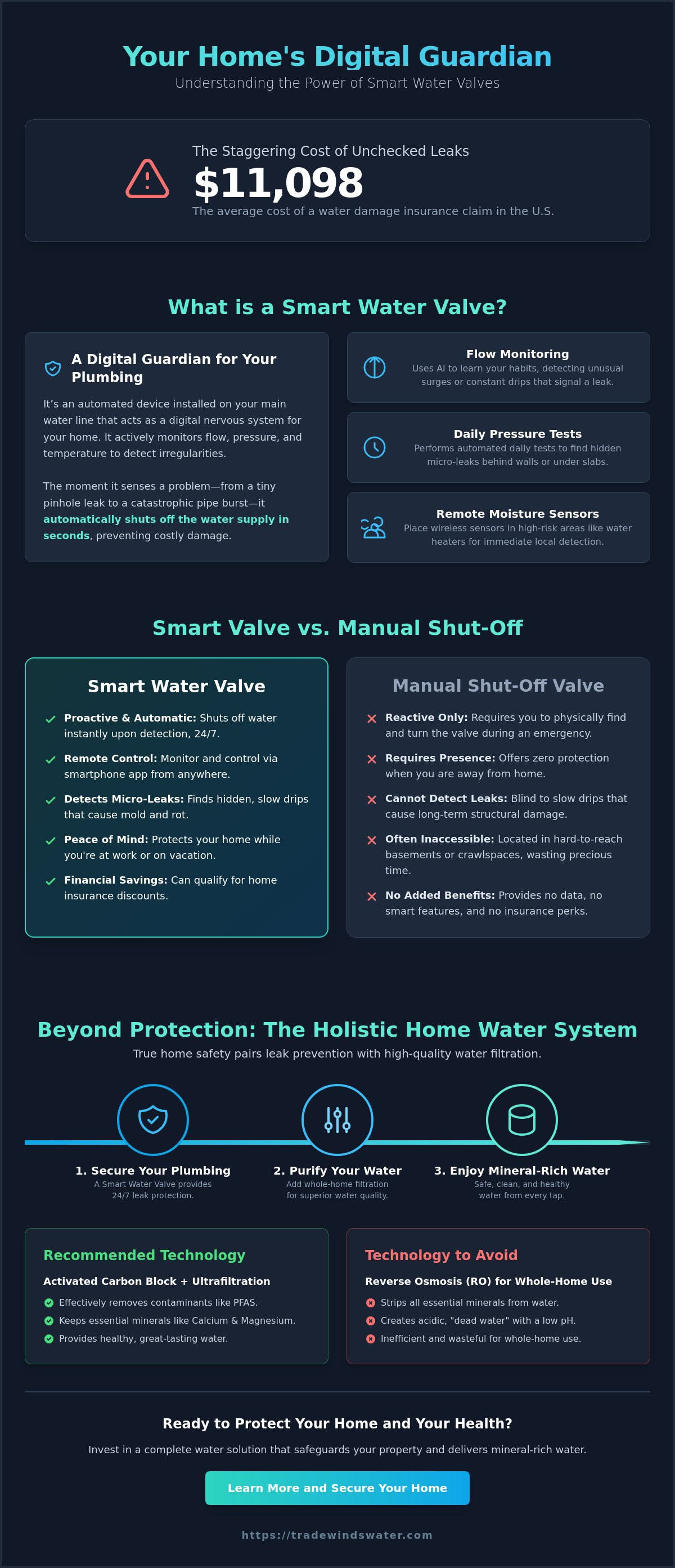
The average insurance claim for water damage in the U.S. currently costs $11,098, a staggering amount that often catches homeowners completely off guard. You've likely felt that nagging worry when leaving for vacation, wondering if a single aging pipe might fail while you're away. If you're looking for true peace of mind, you've probably wondered, what is a smart water valve and is it really worth the investment? These devices act as a digital nervous system for your plumbing, monitoring flow patterns to stop leaks before they destroy your floors or result in high insurance deductibles.
We understand that your home is your sanctuary, and keeping it safe shouldn't mean over-processing your water until it's "dead" and acidic. You'll discover how smart water valves like FloLogic or StreamLabs integrate into your home, the truth about Wi-Fi versus Z-Wave protocols, and why the best protection involves a holistic approach. We'll show you how to choose a system that pairs intelligent shutoff technology with solutions like activated carbon block cartridge filters and Ultrafiltration. This ensures your home remains secure while your water stays rich in essential minerals like calcium and magnesium for a healthier living environment.
Key Takeaways
- Understand what is a smart water valve and how these digital guardians provide proactive security by automatically shutting off your main line during a detected emergency.
- Learn how modern systems like FloLogic and StreamLabs use flow-based monitoring and daily pressure tests to identify hidden micro-leaks before they cause structural damage.
- Discover the financial advantages of intelligent leak protection, from reducing your risk of expensive insurance claims to qualifying for policy premium discounts.
- Identify essential features such as full-port valve designs that preserve your home's water pressure and smartphone apps that offer remote control from anywhere.
- Explore why holistic home security includes pairing leak detection with Ultrafiltration to protect your property while keeping essential minerals in your drinking water.
Understanding the Smart Water Valve: A Modern Shield for Your Home
Most homeowners are familiar with the heavy brass handle tucked away in a dark corner of the basement or a cramped crawlspace. That manual valve is your home's last line of defense, but it's entirely reactive. If you've ever asked, what is a smart water valve, it's helpful to think of it as a digital guardian for your plumbing. It's an automated device installed directly onto your main water line. Unlike its manual predecessor, this system doesn't wait for you to find a puddle. It actively monitors flow, pressure, and temperature to detect irregularities, shutting off the water supply the moment it senses a problem. As we move through 2026, these devices are becoming a standard feature in modern residential construction because they offer a level of security that manual valves simply can't match.
These systems serve a dual purpose in a healthy home. They provide a shield against catastrophic pipe bursts that can happen in the middle of the night, but they also catch "silent" pinhole leaks. Those tiny drips often go unnoticed for months, leading to mold growth and structural rot behind your walls. By identifying these subtle changes in flow, a smart valve protects both your property and the air quality of your living space. This proactive approach ensures your home remains a dry, stable environment for your family.
Because water damage can also originate from above, partnering with experts like Trenick Roofing for regular inspections is a vital part of keeping your home's structure dry and secure.
The Components of a Smart Valve System
A complete smart water leak detection system is more than just a single piece of hardware. It's a network of three essential parts working in harmony. First is the actuator, which is the motorized heart of the system that physically turns the valve to stop the water flow. Second, a sensor network of small, battery-powered pucks is placed near high-risk areas like water heaters, refrigerators, or washing machines to detect moisture immediately. Finally, the hub or smartphone app serves as the brain. This connects your plumbing to your broader home automation system, allowing you to receive alerts on your phone and control your water supply from anywhere in the world.
Why Traditional Manual Valves Aren’t Enough
The biggest problem with traditional valves is accessibility. Many main shut-offs are located in hard-to-reach areas. In an emergency, every second counts. A pipe burst at 3:00 AM won't wait for you to find a flashlight and a wrench. Smart valves provide an automated response that happens in seconds. This is especially vital during the "vacation risk" period. When you're traveling, you don't have to worry about returning to a flooded house. The system is designed to act on your behalf, preserving the integrity of your personal sanctuary and your high-quality water filtration equipment.
How Smart Water Shut-Off Systems Detect and Prevent Damage
Understanding how these systems operate helps clarify why they're so effective at protecting your property. If you're still wondering what is a smart water valve in a practical sense, it's the difference between coming home to a flood and receiving a text message that the problem was already solved. These devices use sophisticated internal sensors to monitor your home's "pulse," detecting issues that the human eye simply can't see until it's too late.
The EPA highlights the importance of leak detection and flow monitoring devices to prevent the nearly 1 trillion gallons of water wasted annually in U.S. households. Most smart valves use ultrasonic or turbine-based flow meters to track every ounce of water moving through your pipes. By analyzing these patterns, the system identifies constant drips or unusual surges. Along with flow monitoring, some advanced units perform daily pressure tests. By temporarily closing the valve and monitoring for even the slightest drop in PSI, the system can find micro-leaks hidden behind walls or under slabs.
The Logic of Flow Monitoring
Modern systems use AI to learn your household habits over time. They distinguish between a high-flow event, like a long shower or a scheduled lawn irrigation, and a sudden pipe failure. You can customize threshold settings to receive alerts only when usage exceeds your typical patterns. This helps identify "ghost flows," which are silent leaks in toilet flappers or irrigation lines that quietly inflate your utility bills without being noticed. Identifying these issues early is a key part of maintaining a smart water leak detection system that works for your specific lifestyle.
Wireless Protocols: Wi-Fi, Z-Wave, and Cellular
While protecting your home from water damage is vital, the quality of the water inside those pipes matters just as much. We advocate for a holistic approach that avoids "dead water" created by Reverse Osmosis (RO) systems. RO technology, originally intended for commercial desalination, strips away essential minerals like calcium and magnesium, often leaving water with a pH level below 7.0. Instead, we recommend pairing your smart valve with Ultrafiltration and activated carbon block cartridge filters. This combination effectively removes contaminants like PFAS while keeping your water healthy, mineral-rich, and safe for your plumbing.
Smart Valves vs. Manual Shut-Offs: Is the Upgrade Worth It?
Deciding whether to replace a standard brass gate valve with high-tech equipment often comes down to the numbers. While a manual shut-off costs very little, it offers zero protection if you aren't home to turn it. When you consider what is a smart water valve in terms of financial security, the return on investment becomes clear. The average insurance claim for water damage in the U.S. is currently $11,098. Investing in a professional system like FloLogic or StreamLabs is a fraction of that cost. Many major insurance carriers recognize this value, offering premium discounts between 3% and 10% for homes with approved auto-shutoff devices. One carrier, AAA, even offers up to a 5% discount for policies effective after March 15, 2026.
Beyond catastrophic events, these systems tackle the "hidden leak" factor. Household leaks across the country waste nearly 1 trillion gallons of water every year. A smart valve identifies the running toilet or dripping faucet that might otherwise add hundreds of dollars to your annual utility bills. Modern motorized valves are designed for durability, often lasting for decades. They aren't just gadgets; they're professional-grade plumbing components built to handle the constant pressure of a residential main line without compromising the flow to your home.
Property Protection and Home Value
Insurance covers the cost of drywall and flooring, but it can't replace a box of vintage family photos or a hand-carved heirloom. A smart water valve protects the things money can't buy. It also adds measurable value to your property. In a market where buyers look for "smart home" features, having a certified leak protection system provides a competitive edge. More importantly, it removes the "homeowner anxiety" that usually hits during a heavy storm or a two-week vacation. You can rest easy knowing your personal sanctuary is monitored 24/7.
Common Misconceptions and Concerns
A common fear is that the system will shut off the water while someone is in the shower. Modern AI avoids these false positives by learning your household's specific flow patterns. Maintenance is also minimal. You only need to "exercise" the valve twice a year by toggling it via the app to ensure the motor remains smooth and free of mineral buildup. These systems are highly compatible and can be retrofitted onto almost any existing residential copper, PEX, or PVC line with the help of a professional installer.
True home security also involves the quality of the water inside your pipes. We always recommend avoiding Reverse Osmosis (RO) systems, which were originally created for commercial desalination. RO strips away vital minerals like calcium and magnesium, leaving you with "dead water" that is often acidic with a pH below 7.0. For the healthiest results, pair your leak protection with Ultrafiltration and activated carbon block cartridge filters. This setup keeps your water mineral-rich and safe without the harmful effects of over-processing.
Key Features to Look for in a Residential Leak Detection System
Selecting the right hardware requires looking beyond basic marketing claims to find the technical specifications that actually protect your home. When you are evaluating what is a smart water valve for your specific property, the most critical physical feature is a full-port valve design. Many budget-friendly options use restrictive valves that narrow the internal diameter of your main line. This causes a frustrating drop in water pressure every time you turn on a shower or run an appliance. A full-port system ensures that your home's flow remains consistent, which is especially important if you've invested in high-performance filtration systems. You should also prioritize units that offer both smartphone integration for remote alerts and local manual control. This dual-access ensures that you can still manage your water supply even if your home's internet connection or power fails during a storm.
Expansion capability is another feature that separates professional systems from basic gadgets. A truly effective setup allows you to add extra moisture sensors as your needs change, such as when finishing a basement or adding a second laundry room. Having a flexible network ensures your protection remains comprehensive as your property evolves. If you're ready to compare high-end hardware, you can explore our leak detection collection to find a professional-grade solution that fits your home's unique footprint.
The Importance of Professional Installation
While some smart home devices are DIY-friendly, cutting into your main water line requires the expertise of a licensed professional. Most manufacturers of high-end shut-off valves require professional installation to maintain warranty compliance. An expert installer knows how to navigate local plumbing codes and can identify the most strategic placements for your sensor network. They'll prioritize high-risk zones like the water heater closet and the laundry room while ensuring the main actuator is accessible for maintenance. This expert setup provides the quiet confidence that your home is genuinely secure against the unexpected.
Comparing Top Systems
When comparing industry leaders like FloLogic and StreamLabs, it's helpful to look at how they interact with your water. FloLogic utilizes a mechanical flow meter that is highly precise for tracking usage, while StreamLabs often employs ultrasonic technology to monitor movement without any internal moving parts. Both systems offer excellent reliability, but you should look for "fail-safe" modes that ensure the valve remains in a safe position during technical glitches. While you focus on these security features, remember that the quality of the water inside the pipes is just as vital. We recommend avoiding Reverse Osmosis because it produces acidic "dead water" by stripping away all minerals. Instead, we suggest pairing your valve with Ultrafiltration and activated carbon block cartridge filters. This ensures your water remains mineral-rich, healthy, and safe for your entire family.
Don't wait for a plumbing emergency to take action. You can protect your home today with a system that balances advanced security with superior water quality.
Beyond Protection: Integrating Smart Valves with Holistic Water Filtration
Physical security is a vital first step, but it's only one half of a truly protected home. When you understand what is a smart water valve, you recognize its role as a digital shield against floods. However, that shield only manages the movement of water, not its quality. To create a truly harmonious living space, you must consider the chemistry of the water sitting in your pipes. A holistic approach ensures that while your property is safe from leaks, your family is also protected from contaminants without sacrificing the essential minerals your body needs.
Many homeowners assume that stripping everything out of the water is the best path to purity. This leads them to Reverse Osmosis (RO) systems, but we strongly advise against this technology for residential use. RO was originally designed for industrial desalination, not for the delicate balance of a home environment. By removing every single element, RO creates "dead water." This over-processed liquid often has a pH level below 7.0, making it acidic and void of any nutritional value. Drinking acidic water provides no health benefits and can even be hard on your plumbing fixtures over time.
The Ideal Solution: Ultrafiltration and Carbon
Maintaining a healthy mineral balance is the key to vitality. We recommend a combination of activated carbon block cartridge filters and Ultrafiltration as the gold standard for home water management. This pairing is highly effective at removing modern threats like PFAS and microplastics. Unlike RO, these systems are designed to leave essential minerals like calcium and magnesium exactly where they belong. This keeps your water's pH stable and its taste crisp. You can learn more about Ultrafiltration and how it preserves the nutritional integrity of your home's water supply.
A Unified Approach to Home Water
There's a significant mechanical benefit to this unified approach. High-quality filtration reduces the amount of sediment and particulate matter flowing through your pipes. This clean water environment protects the internal components of your smart valve, preventing mineral buildup on the actuator and extending the lifespan of your leak detection system. It's a "set and forget" strategy that provides both purity and property security. For a deeper look at the hardware options available, check out The Complete Guide to Automatic Water Shut Off Valves for 2026. By choosing a system that respects the natural mineral content of your water while providing intelligent protection, you're investing in the long-term health and safety of your personal sanctuary.
Secure Your Home and Your Health with Intelligent Protection
Your home is more than just a building; it's a personal sanctuary that deserves the highest level of physical and nutritional security. By moving beyond the basic question of what is a smart water valve and implementing a proactive system, you're choosing to eliminate the fear of catastrophic water damage while protecting your property's value. True peace of mind comes from a holistic approach that pairs intelligent shut-off technology with high-quality water filtration that respects the natural chemistry of your water.
As an authorized reseller of FloLogic and StreamLabs, we provide the professional-grade tools needed for absolute security. Our network of licensed installers ensures your system is set up for long-term reliability. Remember that the best protection also includes maintaining the vitality of your water. By choosing Ultrafiltration and activated carbon block cartridge filters instead of acidic Reverse Osmosis, you keep vital minerals like calcium and magnesium in every drop. You can protect your home with Tradewinds Leak Detection Systems and enjoy the quiet confidence of a safer, healthier household. Taking this step today ensures your home remains a dry and secure environment for years to come.
Frequently Asked Questions
Do smart water valves work without Wi-Fi?
Yes, most smart water valves will still protect your home if the Wi-Fi goes down. While you won't receive remote notifications on your phone, the device's internal logic allows it to detect a leak and trigger the shut-off locally. Systems using Z-Wave or Zigbee protocols are especially reliable because they communicate through a dedicated hub rather than relying on your home's internet bandwidth.
Can a smart water valve lower my home insurance premiums?
Many major insurance providers offer premium discounts ranging from 3% to 10% for homes with an automatic shut-off system. Because the average water damage claim in the U.S. costs over $11,000, insurers see these devices as a vital tool for risk reduction. You should check with your specific agent to see if they mandate a particular brand, such as FloLogic, to qualify for the discount.
How much does it cost to install a smart water shut-off valve?
The total cost depends on the complexity of your plumbing and the specific features of the hardware. Factors such as the pipe material, the need for a new pressure-reducing valve, and the number of remote sensors will influence the final price. Because this involves cutting into your main water line, you should always account for the labor of a licensed professional to ensure a secure, warranty-compliant installation.
Will a smart valve reduce my water pressure?
A smart valve won't reduce your water pressure if you select a full-port design. This professional-grade feature ensures the valve's internal diameter matches your plumbing exactly, allowing water to flow without restriction. When you're researching what is a smart water valve for your home, always prioritize full-port models to maintain the high-flow performance required for multi-bathroom households and high-end filtration systems like Ultrafiltration.
What happens to the smart valve during a power outage?
Most professional systems include a battery backup to keep the device operational during power failures. Depending on your settings, the valve can either remain in its current position or automatically close to provide maximum security during a storm. This ensures your home stays protected even when the electrical grid is down, giving you peace of mind when you can't be there to monitor things manually.
Can I install a smart water valve myself or do I need a plumber?
We strongly recommend hiring a licensed plumber for the installation. Since the device is installed on your main water line, a single mistake can lead to immediate flooding or long-term leaks. A professional ensures the system is integrated correctly with your existing pipes and smart home hub. They'll also help you strategically place moisture sensors in high-risk areas like the laundry room or near the water heater.
How long do smart water valves typically last?
A high-quality smart water valve is built to last between 10 and 15 years with basic maintenance. These devices use durable motors and corrosion-resistant materials designed for the constant pressure of a residential main line. To ensure longevity, it's a good idea to "exercise" the valve twice a year by toggling it through your smartphone app. This prevents mineral buildup and keeps the internal mechanisms moving smoothly.
Do smart valves detect small leaks or just major bursts?
Advanced flow-based systems are sensitive enough to detect both catastrophic pipe bursts and tiny pinhole leaks. By monitoring your home's unique water usage patterns, the device can identify a running toilet or a dripping faucet that might otherwise waste thousands of gallons of water. This helps you catch hidden issues behind walls before they lead to expensive mold growth or structural damage to your property.