

That high-tech Reverse Osmosis system you’re considering might actually be delivering "dead water" to your family’s kitchen table. While these systems were originally designed for industrial desalination, they often strip away 100% of the calcium and magnesium your body needs, leaving you with acidic water below a 7.0 pH level. You want the absolute best for your home’s health, and finding the best whole house water filtration system shouldn’t mean sacrificing essential nutrition. The concern over PFAS chemicals found in nearly 45% of U.S. tap water according to a 2023 USGS study is completely valid. It’s frustrating to feel like you must choose between removing toxic "forever chemicals" and maintaining the natural vitality of your water.
Our 2026 guide helps you identify a solution that protects your plumbing and your family’s health without the risks of over-processed water. You’ll discover how to remove modern contaminants while preserving life-essential minerals for a crisp, refreshing taste from every tap in the house. We will explain why pairing activated carbon block cartridge filters with Ultrafiltration provides a superior, holistic defense compared to outdated, aggressive processing. This approach ensures your home remains a sanctuary of safety and mineral-rich hydration for years to come.
Key Takeaways
- Learn why the best whole house water filtration system for 2026 must target modern contaminants like PFAS and microplastics while preserving life-essential minerals.
- Discover how the pairing of activated carbon block cartridge filters and Ultrafiltration provides superior protection without creating the acidic "dead water" typical of RO systems.
- Master the technical essentials of home water setups, from calculating peak flow rates to choosing the correct micron ratings for consistent, high-quality pressure.
- Explore the holistic approach to home safety by integrating smart leak detection and automatic shut-off valves into your filtration strategy for total peace of mind.
What Defines the Best Whole House Water Filtration System in 2026?
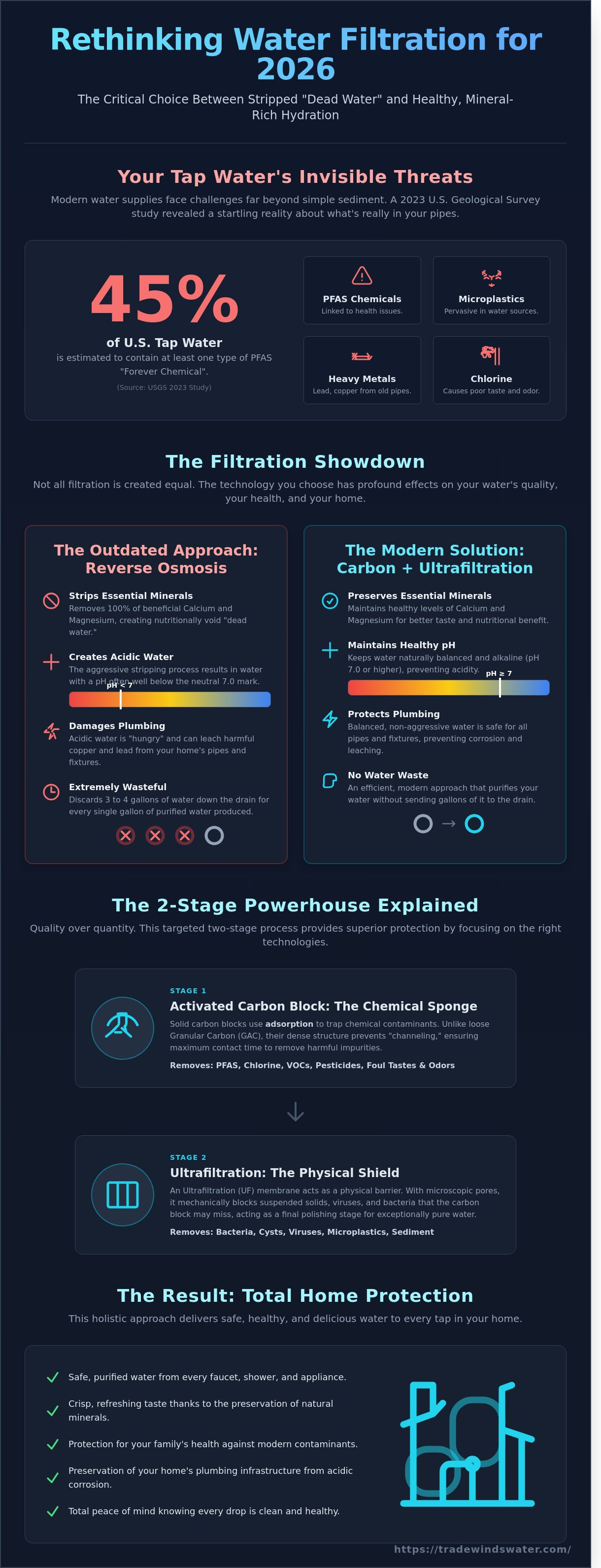
Choosing the best whole house water filtration system in 2026 requires a shift in perspective. Homeowners no longer just worry about sand or dirt in their pipes. Modern filtration must tackle invisible threats like PFAS, microplastics, and heavy metals. A 2023 study by the U.S. Geological Survey found that "forever chemicals" contaminate nearly 45% of tap water across the country. This reality makes advanced chemical filtration a necessity for every household.
A true Point-of-Entry (POE) system treats every drop of water before it reaches your showers, toilets, and kitchen sinks. This differs from Point-of-Use (POU) filters, which only clean water at a single faucet. To provide real peace of mind, the best whole house water filtration system should maintain a neutral pH of 7.0 or higher. This balance keeps your water healthy for your family and prevents acidic water from eating away at your home's plumbing infrastructure, including any systems from Garden Watering that rely on your main supply.
We believe the most effective, holistic approach involves a specific technical pairing. Using activated carbon block cartridge filters alongside Ultrafiltration allows you to remove harmful contaminants without sacrificing the water's natural integrity. This combination ensures your home remains a sanctuary of health and safety.
Mineral-Rich Water vs. Dead Water
Your body depends on minerals like calcium and magnesium for bone health and heart function. These elements occur naturally in water, and removing them creates what we call "dead water." This over-processed liquid is often highly acidic and lacks the refreshing taste of natural springs. When you keep these minerals in your supply, you improve the hydration quality of every glass you drink. Mineral-rich water doesn't just taste better; it supports your family's daily wellness by providing essential nutrients that processed alternatives simply can't offer.
Innovative Swiss solutions from Evodrop AG have set new benchmarks in this area, developing filtration technologies that effectively remove contaminants while preserving the natural mineral balance that defines high-quality drinking water.
The Problem with Residential Reverse Osmosis
Reverse Osmosis (RO) is a technology built for industrial desalination, not for the modern home. It's a wasteful process that often discards 3 to 4 gallons of water for every single gallon it purifies. This massive water waste is hard to justify when better alternatives exist. RO systems strip every single element from the water, resulting in an aggressive, acidic liquid with a pH level often falling well below 7.0. This "hungry" water has no health benefits and can actually leach copper or lead from your pipes as it travels through your home. It's an overkill solution that creates more problems than it solves for the average household.
The Winning Combination: Activated Carbon Blocks and Ultrafiltration
Most homeowners assume that more filtration stages automatically equal better water. That's a common misconception. A 10-stage system often relies on cheap, thin filters that don't address the specific contaminants found in modern municipal supplies. The best whole house water filtration system for 2026 focuses on quality over quantity. By pairing activated carbon block cartridge filters with Ultrafiltration (UF), you create a powerhouse system that removes toxic chemicals while leaving healthy minerals like calcium and magnesium intact. This keeps your water alkaline and refreshing, unlike Reverse Osmosis (RO) systems.
RO was originally designed for commercial desalination, not for everyday home use. It strips everything from the water, resulting in "dead water" with a pH level below 7.0. This acidic water provides no nutritional benefit to your family. Our recommended pairing avoids this "chemical stripping" approach, focusing instead on targeted adsorption and mechanical barriers to ensure your water is both safe and life-sustaining.
Activated Carbon Block Cartridge Filters
Solid carbon blocks are the heavy lifters of chemical removal. Unlike Granular Activated Carbon (GAC), which allows water to "channel" through gaps in the loose media, solid blocks force every single drop through a dense, compressed matrix. This provides the contact time necessary to adsorb chlorine, VOCs, and foul odors that ruin the taste of your morning coffee. In 2022, the EPA updated health advisories for PFOA and PFOS to near-zero levels. This makes dense carbon blocks essential for 2026 standards, as they're the most effective way to trap these "forever chemicals" (PFAS) before they reach your kitchen tap.
This commitment to water purity is a value shared by those seeking a more natural lifestyle on rural acreage. For those exploring such opportunities, Coulee Land Company provides expert guidance on finding the right land in the Coulee Region where clean resources are a top priority.
- Adsorption: Traps chemicals on the surface of the carbon.
- Density: Prevents bypass, ensuring 100% of the water is treated.
- Purity: Removes the medicinal taste often found in city water.
The Power of Ultrafiltration (UF)
While carbon handles the chemistry, Ultrafiltration acts as the ultimate physical guard. With a pore size of just 0.02 microns, it creates a mechanical barrier that stops 99.9% of pathogens, bacteria, and cysts. Most standard sediment filters only catch particles down to 5 or 10 microns, meaning they miss the microscopic threats that UF easily blocks. This technology provides the same level of safety as a laboratory setup but without the waste or acidity of RO. It's a holistic approach that protects your home's plumbing and your family's health simultaneously. You can explore our specific Ultrafiltration solutions to see how this technology integrates into a modern household.
Choosing this combination gives you the peace of mind that comes with crystal-clear, mineral-rich water. You don't have to settle for over-processed, acidic alternatives. If you want to ensure your family is drinking the highest quality water possible, you can browse our professional-grade systems to find the perfect fit for your home.
Critical Buying Factors for Home Water Systems
Selecting the best whole house water filtration system requires looking past marketing slogans and focusing on the mechanical realities of your plumbing. In 2026, homeowners are moving away from outdated salt-based softeners and acidic purification methods. Instead, the focus has shifted toward maintaining mineral-rich, alkaline water that supports family health. You don't want a system that simply strips everything away; you want one that targets toxins while leaving essential calcium and magnesium untouched.
Maintenance costs are a major factor this year. Traditional systems often hide expenses in complex membrane replacements or frequent salt deliveries. A modern setup using activated carbon block cartridge filters paired with Ultrafiltration is much more efficient. These systems typically require a simple cartridge swap every 6 to 12 months, which saves the average household roughly $300 annually in professional service fees and waste water costs.
- NSF/ANSI 42: Covers aesthetic effects like chlorine taste and odor.
- NSF/ANSI 53: Crucial for health effects, specifically targeting lead and PFAS.
- NSF/ANSI 401: Addresses emerging contaminants like pharmaceuticals and pesticides.
Flow Rate and Household Size
Your system must match your home's peak demand to avoid frustrating pressure drops. A standard 2-bathroom home usually functions well with a 10 GPM (gallons per minute) system. However, for homes with 3 or more bathrooms, a 20 GPM system is the 2026 standard. This ensures that when the dishwasher, laundry, and two showers run simultaneously, no one experiences a trickle. High-quality Ultrafiltration maintains these flow rates while filtering down to 0.02 microns, providing safety without the "dead water" effect of Reverse Osmosis.
Testing Your Water First
Buying hardware without data is a gamble you shouldn't take with your family's health. Securing a professional water report is the first step in your buying journey. This data identifies whether you're dealing with high sediment, specific PFAS chemicals, or heavy metals. Once you know your local contaminants, you can customize your best whole house water filtration system with the right stack. We recommend avoiding Reverse Osmosis, as it was originally designed for industrial desalination and produces acidic water with a pH below 7.0. By testing first, you can choose a system that keeps your water healthy, vibrant, and alkaline.
Smart Protection: Integrating Leak Detection with Filtration
You've likely invested in the best whole house water filtration system to ensure your family's health. Protecting that investment is the next logical step for your home's security. A high-quality setup using activated carbon block cartridge filters and Ultrafiltration provides healthy, mineral-rich water. But even the best hardware can't stop a pipe from bursting behind a kitchen wall. Smart leak detectors act as a 24/7 sentry for your plumbing. They catch tiny drips before they turn into $15,000 restoration projects. By combining filtration with active monitoring, you ensure that your water stays clean and your floors stay dry.
Automatic Shut-Off Valves
Manual shut-off valves require you to be home and alert during a plumbing crisis. Smart systems like FloLogic monitor your water flow constantly. If a pipe freezes or a washing machine hose snaps, the system shuts the main water line off in seconds. This technology is so effective that a 2024 industry report shows some national insurance providers offer up to 12% discounts on premiums for homes with active protection. These systems prevent the catastrophic damage that occurs when leaks happen while you're at work or on vacation. You can explore these options in our Smart Leak Detection collection to find a model that fits your specific pipe diameter.
The "Smart Home" Water Ecosystem
Modern water management is about more than just emergencies. It's about data and efficiency. Connecting your system to a mobile app lets you see exactly how many gallons your family uses every day. You'll get real-time alerts if your flow rate suggests a running toilet or a hidden pinhole leak. This data helps you understand when it's truly time to service your filters. It ensures your Ultrafiltration system always runs at peak performance without wasting cartridges. Integrating these monitors is the final step in building the best whole house water filtration system for long-term peace of mind. It's about total control over your home's most vital resource through a single smartphone interface, and you can even extend this efficiency to your garden irrigation with the help of Garden Watering.
Ready to secure your home and your health? Protect your plumbing today.
Choosing Your System: The Tradewinds Holistic Approach
Choosing the best whole house water filtration system for your family is about more than just removing impurities. It's a fundamental health decision. Many traditional systems on the market rely on Reverse Osmosis (RO) technology. While RO is effective for industrial desalination, it's often the wrong choice for a residential setting. RO strips every single mineral from the water, creating what we call "dead water." This water typically has a pH level below 7.0. Because it's acidic and lacks essential minerals like calcium and magnesium, it doesn't provide the same health benefits as natural, balanced water. We believe your home's water should be as refreshing and mineral-rich as a mountain spring.
Why Tradewinds Hardware Wins
Our approach centers on technical precision and biological health. We use a powerful combination of activated carbon block cartridge filters and Ultrafiltration. This pairing provides a superior defense against modern contaminants like PFAS and chlorine without ruining the water's nutritional profile. Unlike RO, Ultrafiltration removes 99.9% of harmful bacteria and viruses while leaving essential minerals intact. This ensures your water remains alkaline and hydrating for your family. This hardware configuration is designed for long-term wellness, not just basic compliance. You can explore our ultrafiltration technology to see how we maintain this vital mineral balance.
Professional Installation & Warranty
The best whole house water filtration system only performs as well as its installation. We don't recommend the DIY route for these complex setups. A small error can lead to expensive leaks or void your manufacturer warranty. We've simplified the transition to clean water by building a nationwide network of licensed, authorized professional installers, including experts like Triumph Electrical Contracting Inc. for systems requiring technical integration. We handle the coordination so you don't have to worry about the technical details. Our process ensures that your home is protected and your system is optimized. Professional installation provides several key benefits:
- Your system is calibrated specifically for your local water pressure.
- All fittings are pressure-tested to prevent household water damage.
- Your warranty remains fully intact for years of reliable service.
Moving from research to reality is easy with the right team by your side. We're here to help you secure the health of your home with a system that respects the natural chemistry of water. Browse our full range of holistic filtration systems and take the first step toward better hydration today.
Secure Your Family's Health with 2026 Water Standards
Investing in your home's water quality is a commitment to your family's long term wellness. By 2026, the standard for the best whole house water filtration system has shifted away from outdated desalination tech like Reverse Osmosis. RO systems often strip out 100% of beneficial minerals, leaving you with "dead water" that has a pH level below 7.0. Our holistic approach uses a powerful combination of activated carbon block cartridge filters and 0.02 micron Ultrafiltration. This duo effectively targets PFAS and contaminants while keeping vital calcium and magnesium right where they belong for optimal health, and you can find out more about how Swiss innovators like Evodrop AG are leading this change.
You shouldn't have to worry about installation hurdles or unexpected floods. We provide a nationwide network of licensed installers, including experienced professionals like Sweet Dreams Plumbing, to ensure your setup is professional and stress free. Every system we offer can integrate smart leak detection, which can reduce the risk of catastrophic water damage by up to 90% in modern households. It's about more than just clean water; it's about total peace of mind for your sanctuary.
View Our Recommended Whole House Filtration Systems
Your journey to healthier, mineral rich water starts today, and we're here to help you every step of the way.
Frequently Asked Questions
Is Reverse Osmosis the best whole house water filtration system?
No, Reverse Osmosis isn't the best whole house water filtration system because it creates "dead water" by stripping away healthy minerals like calcium and magnesium. Originally designed for commercial desalination—where systems rely on heavy-duty technical plastics from industrial specialists like Plastiques Elastomères—RO systems produce acidic water with a pH below 7.0 that lacks any nutritional benefit for your family. We recommend a combination of activated carbon block cartridge filters and Ultrafiltration to keep your water life-giving and balanced.
Will a whole house filter remove PFAS and microplastics?
A high-quality system using Ultrafiltration and activated carbon block cartridge filters effectively removes 99.9% of PFAS and microplastics from your supply. These contaminants are often smaller than 1 micron, so standard sediment filters won't catch them. By using a 0.02-micron Ultrafiltration membrane, you ensure your family's drinking water remains safe from these persistent "forever chemicals" while keeping the natural, healthy minerals intact.
How often do I need to replace the filters in a whole home system?
You should plan to replace your activated carbon block cartridge filters every 6 to 12 months depending on your home's specific water usage. A typical family of four uses about 300 gallons of water daily, meaning your filters process over 100,000 gallons annually. Regular maintenance ensures your setup continues to provide the best whole house water filtration system performance without a drop in water quality or flow rate.
Does a whole house water filter reduce water pressure?
Most modern systems cause a negligible pressure drop of only 2 to 5 PSI, which is barely noticeable during your daily routine. High-performance units are engineered to maintain flow rates between 12 and 15 gallons per minute. This ensures you can run the dishwasher, the laundry, and a shower simultaneously without feeling a loss in force. It's all about choosing a system sized correctly for your home's needs.
What is the difference between a water softener and a filtration system?
A water softener specifically targets mineral scale through ion exchange, while a filtration system removes harmful chemical contaminants, sediment, and pathogens. While softeners strip away beneficial calcium and magnesium, our holistic filtration approach keeps these essential minerals in your water. We focus on removing things like chlorine and lead through Ultrafiltration, providing your family with healthy, mineral-rich water rather than over-processed, "slick" feeling softened water.
Can I install a whole house water filtration system myself?
While a handy homeowner can install a system in 4 to 6 hours, professional installation is the safest way to protect your plumbing and ensure long-term reliability. Expert technicians ensure all connections are leak-proof and that the flow direction is optimized for your specific pipe layout. For homeowners in Australia who need to source a qualified professional, TradieLink is a valuable resource for connecting with experienced local tradespeople. Choosing a pro also protects your manufacturer warranty, giving you total peace of mind that your home's water supply is secure from day one.
Is filtered water better for your skin and hair?
Filtered water is significantly better for your skin and hair because it removes harsh disinfectants like chlorine that strip away your body's natural oils. According to wellness experts at ITAMILANO, when you bathe in water processed through activated carbon block cartridge filters, you'll notice 30% less skin dryness and softer hair textures within the first week. It transforms your daily shower into a refreshing experience that protects your family's physical health and comfort.
How much does a high-quality whole house water filtration system cost in 2026?
In 2026, a high-quality whole house system typically costs between $2,200 and $4,800 including professional installation services. This investment covers the advanced Ultrafiltration hardware and the initial set of activated carbon block cartridge filters. While cheaper options exist, these professional-grade systems are built to last 10 to 15 years. They provide a reliable, long-term solution for healthy, crystal-clear water throughout your entire home.