

With an estimated 45% of U.S. tap water containing PFAS, making the choice to install a filtration system is one of the best things you can do for your family's health. You want water that's safe but still contains the essential minerals like calcium and magnesium that keep it life-giving and balanced. It's frustrating when that goal is sidelined by a sudden drop in water pressure or a mysterious leak. Common whole house water filter installation problems often stem from small oversights during the setup process, which can lead to unexpected water damage or systems that don't meet local plumbing codes.
We understand that your home is your sanctuary, and you deserve the peace of mind that comes with a job done right. This guide will show you how to identify and prevent the most frequent errors, from choosing the wrong location to ignoring critical air gap requirements. You'll learn why a combination of activated carbon block cartridge filters and Ultrafiltration is the gold standard for maintaining a healthy pH above 7.0 without the risks of "dead water" produced by desalination technologies like reverse osmosis. Let's ensure your installation provides the high-flow, mineral-rich water your household depends on.
Key Takeaways
- Learn how to secure a high-flow filtration setup that eliminates PFAS while keeping essential minerals like calcium and magnesium in your water.
- Identify and prevent common whole house water filter installation problems such as reversed flow ports and improper sealing to avoid costly water damage.
- Understand why reverse osmosis creates "dead water" and why Ultrafiltration is the better choice for maintaining a healthy, alkaline pH level.
- Discover the importance of sizing your system based on flow rate (GPM) rather than just pipe diameter to ensure consistent pressure throughout your home.
- Explore how adding smart leak detection and automatic shutoff valves provides the final layer of security for your home's infrastructure.
Why Proper Whole House Water Filter Installation is Critical
A water filter that's simply hooked up isn't the same as one that's professionally integrated into your home's ecosystem. Many homeowners assume that if water is flowing through the pipes, the job is a success. However, common whole house water filter installation problems often hide just beneath the surface. A poorly placed unit can restrict flow to your water heater, shortening its lifespan, or create chronic stress on plumbing joints that eventually lead to catastrophic flooding. Our philosophy focuses on a holistic approach; we believe water should be safe from PFAS but remain alive with the minerals your body needs to thrive.
The Goal: Clean, Mineral-Rich Water at Every Tap
True health comes from water that maintains its natural balance. Technologies like reverse osmosis were originally designed for commercial desalination. They strip away every particle, leaving you with "dead water" that has an acidic pH below 7.0. This type of water provides no health benefits and can even be aggressive toward your plumbing. By choosing a whole house water filtration system that utilizes activated carbon block cartridge filters and Ultrafiltration, you protect your family while keeping essential calcium and magnesium. This setup must be sized for your home's peak demand. If your system isn't matched to the flow requirements of your modern appliances, you'll experience frustrating pressure drops whenever someone starts a shower or runs the dishwasher.
The Hidden Costs of DIY Installation Mistakes
While the DIY spirit is admirable, home plumbing is often unforgiving. There are many different types of water filters on the market, and each requires specific knowledge regarding pressure regulation and drainage. Simply following a manual might help you connect the pipes, but it won't tell you if your home's unique layout creates a backflow risk. A professional installation ensures your system meets local standards and keeps your manufacturer warranty intact. Licensed installers understand that a minor drip today can become a foundation-damaging leak tomorrow. Avoiding common whole house water filter installation problems means looking beyond the instruction booklet to ensure the long-term safety of your personal living space and your home's infrastructure.
Common Pre-Installation Blunders: Planning for Success
Many homeowners think the hard part begins when they start cutting into their main water line. In reality, some of the most frustrating common whole house water filter installation problems happen because of poor planning. If you don't know exactly what's in your water, you're essentially guessing at the solution. Choosing a system without a clear roadmap can lead to inadequate filtration or a system that fails to protect your family from specific local contaminants.
The Necessity of a Detailed Water Report
Relying on a generic city water report is a gamble. While municipalities meet federal standards at the treatment plant, they can't account for what happens in the miles of aging pipes between the plant and your kitchen faucet. We recommend getting a comprehensive water report to identify specific threats like heavy metals, microplastics, and PFAS, which is estimated to be in 45% of U.S. tap water. Choosing the right filter for your needs depends on this data. Without it, you might install a system that strips away healthy minerals while leaving behind the very toxins you're trying to avoid. A holistic approach ensures your water stays mineral-rich rather than becoming the "dead water" typical of reverse osmosis systems.
Sizing Your System for Real-World Use
One of the biggest technical mistakes is sizing a system based solely on the number of bathrooms in a home. Pipe size is just a measurement; flow is what actually matters for your daily comfort. You need to calculate your peak demand in Gallons Per Minute (GPM). Think about a Tuesday morning: the dishwasher is running, the laundry is mid-cycle, and someone is in the shower. An undersized system will cause a significant pressure drop, turning your high-pressure shower into a disappointing trickle. We focus on pairing activated carbon block cartridge filters with Ultrafiltration to maintain high flow rates without sacrificing water quality. If you're unsure which capacity fits your lifestyle, exploring our whole house filtration options can help you find a balance between performance and protection.
Finally, consider the physical environment of your installation. Placing a system in direct sunlight can encourage algae growth inside the housings, while uninsulated garages or crawlspaces put you at risk for burst pipes during a freeze. Always check local plumbing codes before you begin. Many areas require specific permits or backflow prevention devices to ensure your new system doesn't accidentally contaminate the public supply. Taking these steps early prevents your health investment from becoming a legal or structural headache.
Once you've mapped out the location and sized your unit, the physical assembly begins. This is where mechanical precision matters most. Even the best Ultrafiltration technology can't perform if the plumbing foundation is shaky. Many common whole house water filter installation problems arise from simple mechanical oversights that snowball into major headaches.One frequent error is reversing the water flow. The "In" and "Out" ports on filter heads aren't suggestions. Reversing them puts pressure on the internal core of your activated carbon block cartridge filters, which can cause the filter to collapse or dump trapped sediment back into your home lines. You should also watch out for O-ring damage. A single pinched or dry seal is the primary culprit behind persistent, slow drips. Using a tiny amount of food-grade silicone grease keeps these seals seated and watertight. Finally, never skip the bypass valve. If you don't install one, you'll have to shut off water to the entire house every time you need to swap a filter cartridge. It's a small investment that prevents massive frustration during routine maintenance.
Managing Water Pressure and Flow Direction
Reversed flow often shows up as milky water that doesn't clear or an immediate, severe drop in pressure. If you suspect a mistake, you must depressurize the system before making any adjustments. Shut off the main supply and open a faucet downstream to bleed off the energy. We recommend installing pressure gauges on both the inlet and outlet sides of the system. This allows you to monitor system health in real-time, showing you exactly when a filter is reaching capacity before it affects your shower experience.
Sealing and Plumbing Integrity
Properly sealing your connections requires a "less is more" approach with plastic components. While you need 3 to 5 wraps of plumber's tape applied clockwise, over-tightening is one of the most common whole house water filter installation problems. Plastic housings can develop microscopic stress fractures if they're cranked too hard, leading to a sudden failure weeks later. Hand-tight plus a quarter turn with a wrench is usually the sweet spot. Ensure all fittings meet NSF/ANSI 372 standards for lead-free components. This protects the health-conscious, mineral-rich environment you're building. If you're using heavy multi-stage systems, always use mounting brackets to secure the unit to a wall stud. Hanging that weight on PEX or copper lines creates long-term stress that leads to joint failure.
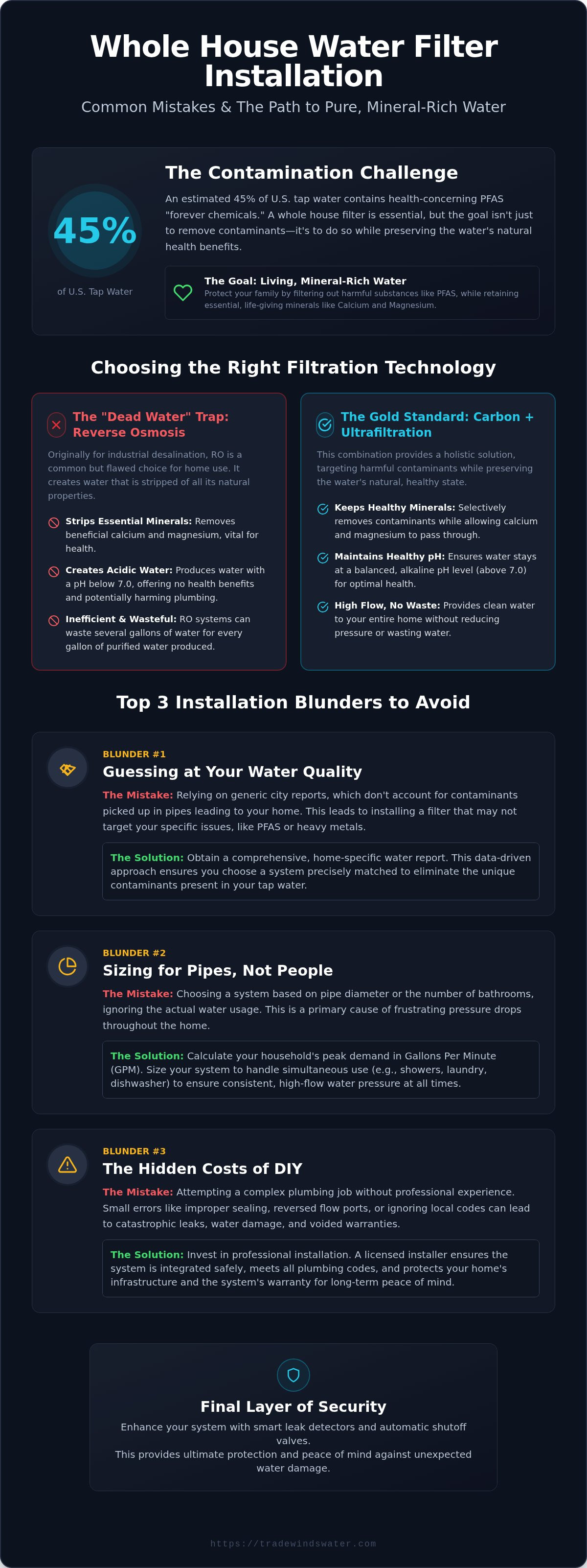
The "Dead Water" Trap: Why RO is a Common Installation Mistake
One of the most frequent common whole house water filter installation problems isn't a mechanical leak; it's a fundamental choice of technology. Many homeowners are led to believe that Reverse Osmosis (RO) is the pinnacle of home water treatment. This technology was originally developed for commercial desalination to remove salt from seawater. While effective in industrial settings, it's often the wrong choice for a personal living space. RO strips every single particle from your supply, including the vital minerals your body needs. The result is "dead water" that lacks the natural character and nutritional value of healthy spring water.
Understanding pH and Mineral Content
Water is meant to be a source of life, which means it should contain essential minerals like calcium and magnesium. When an RO system removes these, the water's pH level often drops below 7.0. This acidic "dead water" provides no health benefits to the consumer. In fact, it can be quite aggressive. Because the water is stripped of its mineral content, it becomes "hungry" and may pull minerals from your home's copper pipes or fixtures, leading to premature corrosion and pinhole leaks. Utilizing Ultrafiltration allows you to maintain a healthy alkaline balance. It targets contaminants while leaving the beneficial minerals untouched, ensuring your water supports your wellness goals rather than undermining them.
The Synergy of Carbon Blocks and Ultrafiltration
The most effective method for whole-home use is a pairing of activated carbon block cartridge filters and Ultrafiltration. This combination offers a holistic defense without the waste or acidity of RO. Activated carbon block cartridge filters are exceptional at adsorbing chemical tastes, odors, and modern threats like PFAS. When you follow this with Ultrafiltration, you create a physical barrier that stops bacteria, parasites, and microplastics. This system works in harmony with your home's plumbing to provide high-flow, mineral-rich water at every tap. It's a professional solution that respects both your health and your infrastructure. If you're ready to move away from over-processed water, you can explore our holistic filtration systems to see the difference quality makes.
Final Steps: Smart Protection and Professional Setup
Even when you've selected the ideal technology and followed every plumbing rule, your home still needs a final layer of defense. A professional setup goes beyond just connecting pipes; it involves creating a secure environment where your family can enjoy mineral-rich water without worry. Many common whole house water filter installation problems are actually maintenance or monitoring issues that show up months after the initial work is done. This is why a "safety net" is essential for long-term home health and structural integrity.
Integrating Smart Leak Detection
Modern homes benefit greatly from leak detection technology that works alongside your filtration system. Even a perfectly installed unit can face unexpected pressure spikes from the city main or accidental damage. Systems like FloLogic and StreamLabs provide 24/7 peace of mind by monitoring flow patterns and identifying micro-leaks before they cause damage. You can read our guide to automatic water shut off valves to understand how these devices act as a digital sentry for your plumbing. These valves can automatically stop the water supply if they detect an abnormality, preventing the catastrophic flooding that DIY errors sometimes trigger.
Tradewinds Water Filtration utilizes a professional network of authorized and licensed installers to ensure these systems are integrated correctly. These experts understand the nuances of local plumbing codes and can spot potential failures, such as inadequate support or reversed ports, before they lead to common whole house water filter installation problems. They ensure your system doesn't just work, but thrives within your specific home layout.
Maintenance: Keeping Your Holistic System Running
A holistic system requires a simple but consistent maintenance schedule to stay effective. Unlike reverse osmosis systems that produce "dead water" and require complex membrane cleanings, a setup using activated carbon block cartridge filters and Ultrafiltration is straightforward to manage. You should set a recurring schedule to swap out your replacement cartridge filters to ensure chemical contaminants like PFAS are always being captured. Most Ultrafiltration membranes will also need attention or flushing depending on your water's sediment levels. Annual professional check-ups can help identify wear on O-rings or seals before they develop into drips.
Before you consider the job finished, you must perform a thorough system flush. This process removes air pockets and any fine dust from the new carbon filters. Open several high-flow faucets, like a bathtub, and let the water run for at least 10 minutes. This prevents sputtering at the tap and ensures your water is clear, mineral-rich, and ready for your family to enjoy. Taking these final steps bridges the gap between a simple mechanical installation and a truly healthy home environment.
Take Control of Your Home’s Water Health
Installing a filtration system is a significant step toward a healthier lifestyle, but success lies in the details. By understanding common whole house water filter installation problems, you can avoid the frustration of unexpected leaks and poor water pressure. True water quality isn't just about removing toxins like PFAS; it's about preserving the life-giving minerals like calcium and magnesium that balance your water's pH. Choosing a holistic setup of activated carbon block cartridge filters and Ultrafiltration over acidic, "dead water" desalination technologies ensures your family enjoys water that's both safe and nutritionally beneficial.
We're here to help you bridge the gap between complex plumbing and daily comfort. Our authorized network of licensed professional installers ensures your system meets national standards for safety and performance. From advanced filtration to integrated smart leak detection and automatic shut-off options, we provide the security your home deserves. You can Explore Holistic Whole House Filtration Systems today to find the perfect match for your household's needs. Investing in your water is an investment in your peace of mind, and we're honored to be part of that journey.
Frequently Asked Questions
Is it hard to install a whole house water filter myself?
It depends on your plumbing experience, but it's generally considered an intermediate to advanced task. You'll need to cut into your main water line and ensure all connections are watertight. Many common whole house water filter installation problems start here when DIYers skip pressure testing or ignore local codes. If you aren't comfortable with soldering or PEX crimping, a professional setup provides much better security for your home's infrastructure.
Why does my water look milky after installing a new filter?
Milky water is typically caused by tiny air bubbles trapped within the new filter media or the plumbing lines. It's a normal occurrence after a fresh installation or a cartridge change. You can resolve this by flushing the system through a high-flow faucet for about 10 minutes. If the cloudiness persists after a thorough flush, check your connections to ensure air isn't being pulled into the system through a loose fitting.
Can a whole house water filter cause low water pressure?
A system can cause pressure drops if it isn't sized correctly for your home's peak Gallons Per Minute (GPM) demand. If you have multiple showers and appliances running at once, an undersized unit will struggle to keep up. Choosing high-flow Ultrafiltration instead of restrictive reverse osmosis membranes helps maintain consistent pressure. Always verify that your system's flow rate matches or exceeds the requirements of your modern household appliances to avoid a trickle.
What happens if I install my water filter backwards?
Reversing the flow can lead to mechanical failure of the filter cartridges and significantly restricted water pressure. When water enters the "Out" port, it applies pressure to the wrong side of the activated carbon block cartridge filters. This can cause the internal core to collapse or release sediment into your home's pipes. It's a serious error that usually requires a complete re-plumbing of the unit's inlet and outlet connections to restore proper function.
Do I need a plumber to install a whole house water filtration system?
While some homeowners choose the DIY route, hiring a licensed plumber is the safest way to avoid common whole house water filter installation problems. Professionals ensure your system meets the Uniform Plumbing Code, including critical air gap requirements for drain lines. They also have the tools to properly support heavy filter housings, preventing stress on your copper or PEX lines. A professional setup often protects your manufacturer warranty and provides long-term peace of mind.
Why is my water filter housing leaking from the top?
A leak at the top of the housing is almost always related to the O-ring seal. The ring might be dry, pinched, or improperly seated within its groove. You should depressurize the system, remove the housing, and inspect the O-ring for any visible damage. Applying a small amount of food-grade silicone grease often solves the issue. Remember to hand-tighten the housing; using a wrench to over-tighten can actually cause the plastic to crack.
How much does it cost to have a whole house water filter professionally installed?
Professional installation costs are determined by the complexity of your existing plumbing and the type of system you've selected. Factors like the distance from the main shut-off valve and the need for additional bypass valves will influence the final price. While it's an upfront investment, professional work helps you avoid the catastrophic costs of water damage from DIY errors. It also ensures your system is optimized for high-flow, mineral-rich water from day one.
Does a whole house filter remove PFAS if installed correctly?
Correctly installed systems using activated carbon block cartridge filters and Ultrafiltration are highly effective at removing PFAS. The key is ensuring proper contact time between the water and the carbon media. Unlike reverse osmosis, which creates "dead water" and wastes significant amounts of water, this holistic pairing removes "forever chemicals" while keeping healthy minerals like calcium and magnesium. A professional installer will verify that the flow rate is optimized for maximum contaminant reduction.